
A pixel has always done one job. On a screen it emits light to build a picture. In a camera it absorbs light to record one. A team in Switzerland has now made one that does both.
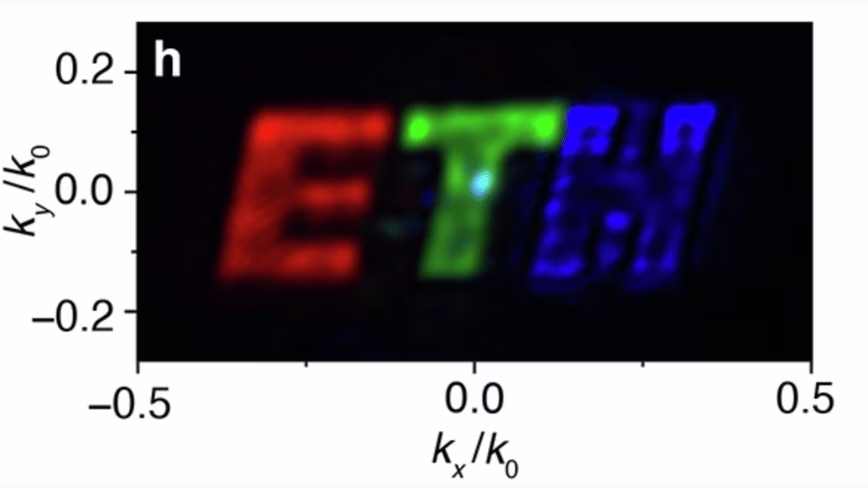
Researchers at ETH Zurich have built the first bidirectional pixel, in work published in Nature. The same tiny patch of chip can create an image and analyse the light falling on it. Not just brightness, but the phase and polarisation of the wave too.
The promise is a camera-display: one surface that shows you a picture and watches you at the same time. Picture a phone screen that is also its own front camera, with no notch and no cut-out. Or a video call where the lens sits behind the eyes you are looking at.
How a pixel learns two jobs
The trick is interference. The team, led by Professor David Norris, sculpts the chip’s surface to within a few nanometres. Incoming light becomes a wave that travels along the surface, then scatters back out as light. Where the waves meet, they add up or cancel, and an image forms. Fourier analysis, the maths the pixel is named after, works out the surface shape needed for a given picture.
Run the same physics backwards and the pixel reads light instead of writing it. “We can also apply the principle of interference and Fourier analysis in the opposite direction to analyse light,” said postdoctoral researcher Sander Vonk. The pixel can also shape exotic beams, including doughnut-shaped ones with a hole in the middle, and it works across colours.
The part the internet noticed
A screen that is also a camera is a useful idea and an unsettling one. When TechRadar covered the work, the comments went straight to surveillance. “Screens that are also cameras, what could go wrong?” ran one. Others reached for Orwell’s telescreens, the two-way sets that watched citizens back.
That reaction says more about 2026 than about the lab bench. The worry is fair in a world already wary of creeping surveillance. But the technology is nowhere near a shipping product, and there are good reasons not to panic yet.
The catch
For now the pixels need laser light to work. Each one is also fixed in what it can show, unlike a screen that displays anything. Scaling from a handful of pixels to a full matrix is the next job. Norris wants to extend the method to many Fourier pixels, the way real cameras and displays use millions.
So the honest headline is not a spy screen. It is a new, flexible building block for light. The paper lists holographic displays, optical communication, adaptive optics and quantum information processing as targets. These are the nearer wins, the quiet plumbing of how light is steered and read.
Why a humble pixel matters
The most striking claim is the quietest. The surface waves do maths as they travel. So Norris suggests a pixel could react to an image and answer in light, with no computer in between. That points at a future where some computing happens in light itself, not in silicon logic.
It fits that the work comes from a country that punches above its weight in deep tech. The patent is already up for an ETH innovation prize. Next year marks a century since the word pixel first appeared in print. A hundred years on, the smallest unit of the screen has learned a second trick.
Get the TNW newsletter
Get the most important tech news in your inbox each week.


