Etched
 Credit: LinkedIn / Etched
On Tuesday, Etched, the San Jose company said a great deal at once: a working chip, $800m raised across a run of undisclosed rounds, and more than $1bn in signed customer contracts. For a startup that is not yet three years past its seed funding, it is a lot of news to release on a single morning.
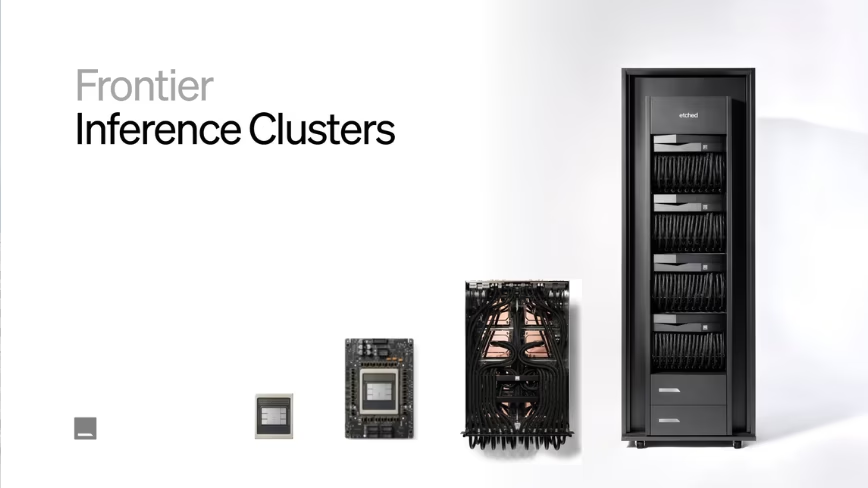
The company builds what it calls frontier inference clusters, hardware tuned for running AI models rather than training them. Its first silicon, an A0 design, worked on the first pass on TSMC’s N4P process, the sort of first-attempt success that chip engineers tend to treat with superstition. Etched says it is now validating its first rack-scale product with customers, with systems already running DeepSeek, Qwen, Mamba and Llama.
The most recent round, a $500m financing at a $5bn post-money valuation, closed in December. The backers are a particular crowd: Peter Thiel, the trading firms Jane Street, Hudson River Trading, Jump Trading and Two Sigma, and venture investors including Stripes, Ribbit Capital, Radical Ventures, Primary and Positive Sum.
There is also a strategic investment from VentureTech Alliance, a fund tied to TSMC, which the company frames as evidence of a deep foundry partnership.
The roster of individual believers reads like a who’s who of the field. Etched lists Andrej Karpathy, Geoffrey Hinton, Fei-Fei Li, the investor Stanley Druckenmiller, Mistral’s Arthur Mensch and Cognition’s Scott Wu among its named backers.
“We recognised early on that frontier AI would become one of the most economically significant technologies ever created, but that the infrastructure needed to serve those models in a sustainable and economically viable way simply did not exist,” said Gavin Uberti, Etched’s co-founder and chief executive.
What the company wants understood is that it intends to make the things, not just design them. Etched says it has stood up a factory in Taiwan and built a data centre, test house and prototyping lab at its San Jose headquarters, putting design, validation and production under one roof, with what it describes as a path to gigawatt-scale in 2027.
“Our approach from the beginning has been to build for gigawatt-scale,” said Rob Wachen, a co-founder. “Production is the product.” He added that the companies that end up mattering will be the ones able to manufacture, deploy and operate at scale, rather than those with the cleverest research alone.
The team now runs to more than 400 people, drawn, the company says, from Nvidia, Broadcom, Google’s TPU programme, SK Hynix and a scattering of high-frequency trading firms. Ken Fox of Stripes, which led the company’s Series B, said the founders had “resourced an incredible team around the ambition” and had moved faster than he had thought possible.
Etched is arriving into a crowded and well-funded contest to loosen Nvidia’s hold on AI hardware, a field where Groq, Fractile and the in-house programmes at OpenAI and Google are all pushing at inference from different angles.
What sets the announcement apart is less the pitch than the paperwork: a chip that reportedly works, and more than a billion dollars of customers who have already signed. Etched says it is ramping production now, with shipments due this summer.
Get the TNW newsletter
Get the most important tech news in your inbox each week.


