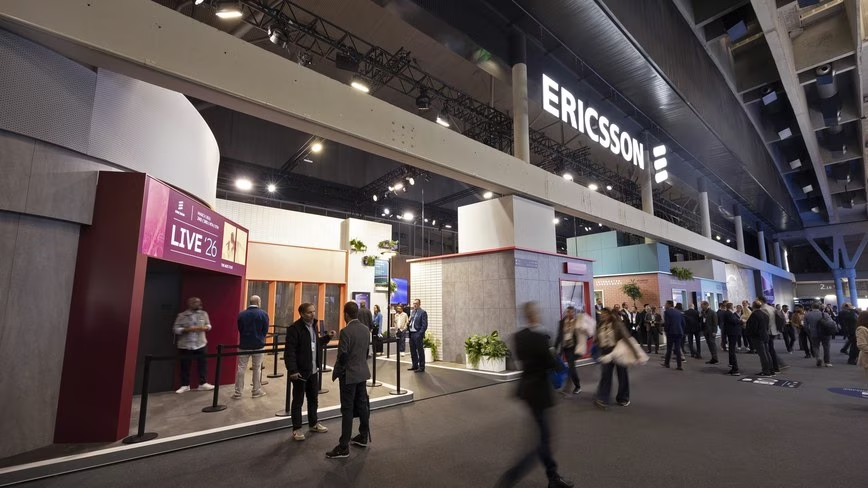
Ericsson’s stand at MWC Barcelona in March 2026.
 Credit: Ericsson
Ericsson’s adjusted earnings before interest, taxes and amortisation (EBITA) came in at SEK 10.1bn ($1bn) in the third quarter. Analysts had expected SEK 7.93bn on average, according to data compiled by Bloomberg.
The shares rose as much as 11% in Stockholm on Thursday, Bloomberg reported. It was their biggest intraday gain since 23 January, and took their rise this year to 18%.
Sales and profit
Reported sales were SEK 59.5bn, up from SEK 56.2bn a year earlier, the Swedish company said in its results statement. Organic sales, which strip out acquisitions, divestments and currency effects, rose 7%. Higher sales in Networks drove most of the growth, and sales grew in three of Ericsson’s four market areas.
Adjusted EBITA was down from SEK 15.8bn a year earlier, when the figure included a SEK 7.6bn capital gain. Without that gain, adjusted EBITA rose, Ericsson said. The adjusted EBITA margin was 17.0%, against 28.1%.
Net income fell to SEK 5.8bn from SEK 11.3bn. Free cash flow before M&A was SEK 4.9bn, and Ericsson spent SEK 4.8bn buying back its own shares.
‘The RAN market is flat’
Per Narvinger, who took over as chief executive this month, called them “strong third-quarter results”. His predecessor, Börje Ekholm, cut expenses and headcount, Bloomberg reported.
“Looking ahead, the RAN market is flat, geopolitical uncertainty remains elevated and component costs are a headwind to gross margin next year.” Per Narvinger, Ericsson CEO
Ericsson offset higher component costs with short-term measures in product development, chief financial officer Lars Sandström told Bloomberg. It will pass those costs on to customers when their current contracts end, he said. Narvinger told Bloomberg TV that part of the quarter’s demand came from customers buying ahead of price increases.
One Asia-Pacific market area
Ericsson also announced a simpler group structure. From 1 January 2027, Market Areas North East Asia and South East Asia, Oceania and India will form a single Market Area Asia-Pacific (APAC). Patrick Johansson, now head of Market Area Europe, Middle East and Africa (EMEA), will lead it. Ericsson will start recruiting a new head for EMEA.
The Enterprise Wireless Solutions business area will be broken up. Neutral Host solutions and Ericsson Private 5G move into Business Area Networks. Wireless WAN stays a standalone business, reporting to Yossi Cohen, head of Market Area Americas.
Three Executive Team members will transition from their current positions on 31 December. They are Åsa Tamsons, head of Enterprise Wireless Solutions, Chafic Nassif, head of North East Asia, and Andres Vicente, head of South East Asia, Oceania and India. The Executive Team will be “leaner and more balanced in terms of responsibilities”, Narvinger said.
He told Bloomberg TV the changes will help Ericsson focus on Asia and compete better with Elon Musk’s Starlink. Starlink is increasingly challenging telecom operators, he said.
Finnish rival Nokia has reorganised to prioritise networking equipment for AI data centres, Bloomberg noted. It is also building Nvidia chips into radio access networks. Ericsson remains a pure-play supplier of equipment for telecom operators.
Get the TNW newsletter
Get the most important tech news in your inbox each week.


