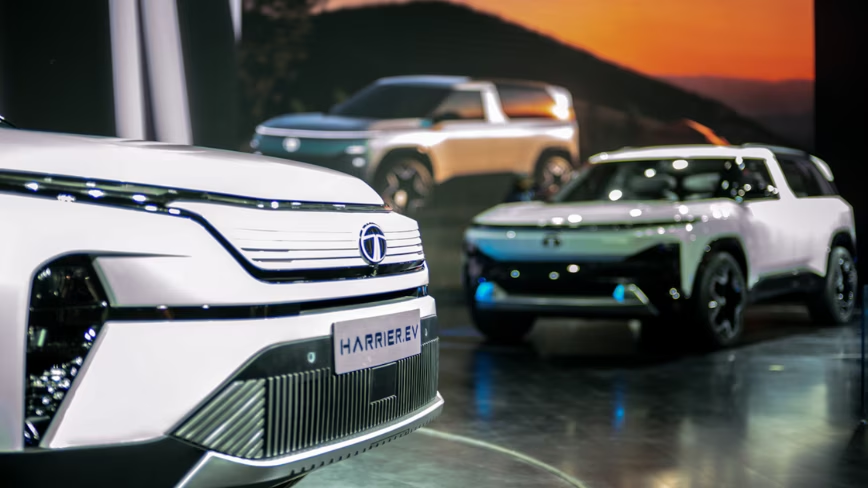
The two conglomerates are funding separate R&D centres focused on next-generation battery chemistries and advanced EV systems. The investment is a hedge: both groups currently buy critical battery components from Chinese suppliers and want options when Beijing tightens export rules again.
India’s two largest steel-and-everything-else conglomerates are putting close to $1bn behind a question that has become urgent for the country’s electric-vehicle industry: what happens when the Chinese suppliers stop picking up the phone?
Tata Group and JSW Group are separately funding research-and-development centres aimed at building in-house expertise in next-generation battery technologies and advanced EV systems, Bloomberg reported on Wednesday, citing people familiar with the plans. The combined commitment is just under $1bn.
Both companies are reasoning from the same exposure. India’s EV industry, including their own businesses, runs heavily on Chinese cells, materials and equipment.
China’s tightening of export controls on graphite, lithium-processing equipment and battery-making machinery has, over the past year, made that exposure a board-level problem rather than a procurement one.
What each group is funding
Tata’s R&D effort sits inside Agratas, the group’s battery arm, which is already building a 20 GWh gigafactory in Sanand, Gujarat to supply Tata Motors. The new spend goes upstream of that: chemistry, cell design, and process know-how the group has historically licensed or sourced.
Agratas has previously partnered Tata Technologies to fast-track battery solutions for mobility and renewable energy storage; the new funding extends that work into materials and proprietary cell formats.
JSW Group’s track is different but rhymes. JSW Motors, the JV vehicle through which the conglomerate sells MG cars in India alongside SAIC, opened JNEXT, the JSW NextGen Technology Center, in Pune in February through a partnership with Tata Elxsi.
Neither company has confirmed the figures publicly. The Bloomberg sources put the combined investment at “nearly $1 billion”, with the funds spread across multi-year R&D programmes rather than capex on production lines.
The trigger is policy on the other side of the Himalayas. Late last year, executives and engineers from Reliance Industries fanned out across Wuxi looking to lock in roughly $1.1bn of equipment for a planned battery plant; Beijing’s tightening of export controls on key battery-making technology arrived shortly after. Hundreds of equipment shipments to India have been delayed or rerouted since.
Tata Motors itself has had to lean further on Chinese suppliers in the meantime. The Curvv.ev launched with cells from Octillion Power Systems, and the company struck a sourcing arrangement with Envision AESC for higher-density packs.
Each of those deals tightened the supply chain rather than diversifying it. Building a domestic chemistry programme is the obvious medium-term hedge.
JSW’s exposure is structural in a different way. The MG joint venture, of which Sajjan Jindal’s group owns 35%, sources around 60% of its components from China.
JSW has publicly aimed at a million new-energy vehicles by 2030 and a 10 GWh battery plant in partnership with LG Energy Solution.
The new R&D push is what would make those numbers achievable without renegotiating the SAIC stack every time Beijing changes its rules. The dependency picture is the same dependency Europe is grappling with, and it is now driving capital allocation in Mumbai and New Delhi as much as Berlin and Paris.
The competitive backdrop
Tata is no longer India’s runaway EV leader. Mahindra overtook it in EV revenue in the most recent fiscal year, even though Tata still leads on sales volume. JSW MG has doubled its market share in the past twelve months.
The two competing R&D commitments arrive against that shifting hierarchy: each group needs proprietary technology to defend its margins, not just match its rivals on offer.
The pattern is recognisable. Europe’s homegrown battery cell push, spurred by Northvolt’s collapse and the energy-security argument, is the closest analogue. Indian groups have studied it carefully: the same logic of chemistry sovereignty, recycling capacity (UK recycler Altilium’s £18.5m round sits at one end of the same arc), and policy support for domestic cell production now drives the conversation at home.
The difference is that India’s industrial policy, including the PLI scheme for advanced chemistry cells, has been in place for several years; what was missing was private R&D capital. The Tata and JSW announcements move that piece into place.
What is at stake?
Even with $1bn flowing into research, neither group will displace Chinese chemistry leadership in this decade. The realistic ambition is narrower: enough internal capability to specify, validate and customise cells, to qualify alternative suppliers, and to negotiate with Chinese partners from a less precarious position.
That ambition shapes the spending profile. Most of the money will go to talent, lab equipment and pilot lines rather than to gigawatt-scale fabs. Both groups already have, or are building, those at scale; the gap they are closing is the one between buying technology and owning it.
Whether that is enough depends on how aggressively China continues to limit access. The export controls of the past year suggest the line is moving the wrong way, and that India is not the only economy facing it. EU battery industrial policy on much the same arithmetic, and the equity question is whether national champions can build technical depth fast enough to keep up.
Get the TNW newsletter
Get the most important tech news in your inbox each week.


