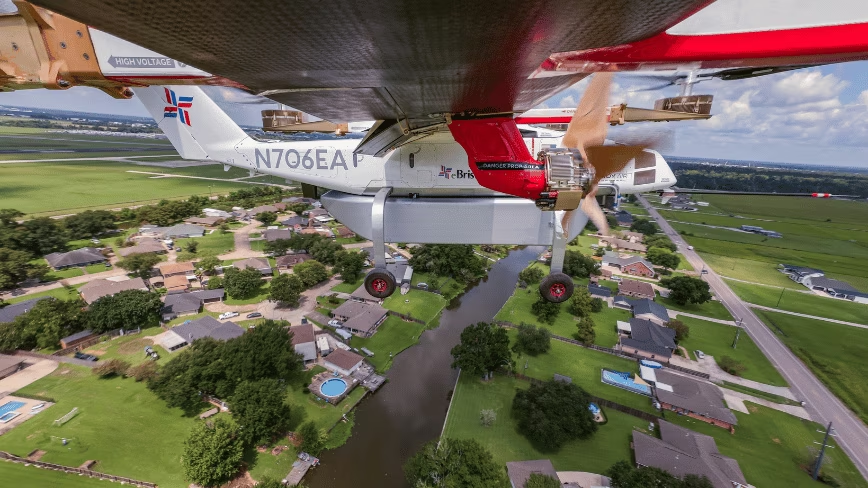
Elroy Air’s Chaparral during its uncrewed flights over Houma, Louisiana in late August. The aircraft carries more than 500lb of cargo and flies with no pilot on board.
 Credit: Elroy Air
An aircraft with nobody on board flew itself out of a working Louisiana airport last week. It carried spare parts, medical supplies and cans of water. Its route took it over people’s houses.
Elroy Air said on Wednesday it had completed the first uncrewed autonomous flights under a federal programme. That programme exists to fold self-flying aircraft into American airspace.
What flew, and where
Elroy Air calls the aircraft Chaparral. It is a hybrid-electric design that takes off vertically and carries more than 500lb of cargo. Its range runs to 450 miles. It needs no runway and no charging infrastructure.
The flights ran for a week in late August at Houma-Terrebonne Airport. The company describes it as one of the busiest rotorcraft airports in the country. Air traffic control handled the aircraft alongside everything else in the pattern.
The cargo was deliberately mundane. Packages, medical supplies, a toolbox of spare parts, food, and jerry cans of water.
That choice is the point. The company is not proving the aircraft can lift something exotic. It is proving the aircraft can do the dull, repetitive work that currently costs a helicopter and a pilot.
Two partners ran the week alongside Elroy Air. One is Bristow Group, a helicopter operator serving Gulf of Mexico energy platforms. The other is a state programme called LIFTOFF Louisiana.
The regulator put its name to it
What separates this from a company demonstration is who spoke. FAA Administrator Bryan Bedford said the flights showed how such aircraft could expand cargo delivery to communities nationwide. They would also improve logistics infrastructure, he said.
Regulators do not usually supply quotes for a startup’s press release. Josh Duplantis of the Louisiana Department of Transportation and Development went further. He said he watched it happen, and called it a disciplined, safe operation.
The programme is the eVTOL Integration Pilot Program, set up under an executive order titled Unleashing American Drone Dominance. It pairs manufacturers and operators with state and federal agencies, and the operational data feeds into future aviation policy.
Elroy Air joined in March 2026 through Louisiana’s application. It says Chaparral is the only purpose-built heavy-payload cargo drone in the programme.
A busy week for the FAA
The same agency has been clearing other autonomous systems for domestic skies. Testing at White Sands produced a safety agreement between the Department of War and the FAA. That agreement is what cleared a laser weapon for use inside US airspace, as we reported on Wednesday, before the Army had even bought it.
That is the pattern worth watching. One autonomous system delivers water. The other shoots drones down. American airspace opened to both within days.
This programme has produced results before. Its first flights in July carried transplant organs rather than passengers, and those aircraft had pilots aboard. These did not.
Cargo has consistently gone first. DoorDash won FAA clearance for its own drone operation in July, and Zipline is flying medical deliveries with the Cleveland Clinic.
Read the pipeline number carefully
Elroy Air says its commercial demand pipeline exceeds 1,400 aircraft, worth more than $5bn in potential revenue. It is a striking figure for a company that has not yet delivered a production aircraft.
Its own filing language undercuts that. The company states that the pipeline currently consists of non-binding letters of intent and memorandums of understanding, that there is no assurance any will convert to orders, and that investors should not treat the figure as an indicator of future revenue.
That warning exists because Elroy Air is going public through a merger with a special purpose acquisition company, Inflection Point Acquisition Corp VII. A registration statement has been submitted to the SEC in draft.
Reporting the number without the caveat would be doing the company’s work rather than ours.
Who is actually behind it
Chaparral will be built by Kratos Defense and Security Solutions, which holds exclusive US manufacturing rights and is expanding a Sacramento facility for it. The first production aircraft is planned for late 2026.
Lockheed Martin Ventures is an investor, alongside Shield Capital, Marlinspike Partners and others.
The defence side is not incidental. Elroy Air won a $46m multi-year Army contract in August, for an autonomous VTOL aircraft carrying modular payloads. In July it built three unattended delivery modes for Chaparral under a separate Army contract.
The company calls the design dual-use and names tactical resupply among its applications. Defence money has been reshaping this whole sector, as we found when the Pentagon’s drone push lifted valuations across the board.
So the aircraft that spent last week carrying water over Houma is the same airframe the Army is paying to develop for battlefield logistics.
What happens next
Bristow says its energy and government customers want low-risk, high-tempo ways to move cargo across the Gulf Coast. Louisiana, it notes, is its main US base of operations.
That is the commercial test. Offshore energy platforms are expensive to reach and dangerous to fly to, and helicopters with pilots in them currently do the job.
Nobody has yet said when uncrewed cargo flights move from a pilot programme to routine service. Nor has anyone set out the certification path. The eIPP is a data-gathering exercise, and Louisiana is now where the data comes from.
The residents of Houma did not apply to be part of it. That is true of every airspace trial, and it is why the FAA administrator lending his name to a week of flights matters more than the flights themselves.
Get the TNW newsletter
Get the most important tech news in your inbox each week.


