TL;DR
DonnaPro, a European executive assistant agency, trains its EAs on AI tools before placement and supports them with 2,500+ pages of operational frameworks. Founder Filip Pesek argues AI should amplify human judgment, not replace it. The company claims founders reclaim 60+ hours monthly and uses a six-stage selection process combining AI-assisted filtering with manual vetting.
Every productivity tool on the market right now is telling you the same thing: AI will replace what you do. Cut the middleman. Automate the humans. Do more with less.
Filip Pesek disagrees.
“The best AI tools still come with a human who knows how to think,” says the founder of DonnaPro, Europe’s premium executive assistant agency. “AI can draft faster, research deeper, process more. But it can’t understand context. It can’t read the room. It can’t know when a founder needs a briefing before they know they need it.”
That’s not a rejection of AI. It’s a philosophy about where AI belongs, and where it never should.
The Human-AI Equation That Most Companies Get Wrong
The future of work conversation has a blind spot. It assumes that more automation equals better outcomes. That replacing human steps with AI steps is inherently progress.
DonnaPro sees it differently.
“Our executive assistants are real, approachable people who are trained on AI tools before they even start,” Filip explains. “Every modern executive assistant agency should leverage technology. But we go further. Donna is married to AI tools. She uses them every day to deliver better results, faster.”
The distinction matters because the market is flooded with AI-powered tools and services that promise transformation and deliver frustration. Founders have watched automation promise to save time, only to spend more time managing outputs, correcting errors, and filling gaps that a human would have anticipated.
At DonnaPro, the approach is deliberate. AI tools amplify what human judgment makes possible, not replace it.
Why Human Vetting Still Matters in an AI Age
Here is what AI cannot do: read a room, assess personality fit, or determine whether someone is capable of thinking two steps ahead.
That gap is why DonnaPro maintains a rigorous six-stage selection process, even as AI tools become more sophisticated.
The process begins with AI-assisted filtering to handle volume efficiently. But every candidate who reaches the demo tasks and beyond is manually vetted by the DonnaPro team. Multiple rounds of interviews, demo task assessments, reference checks, and personality evaluation follow. Then comes two weeks of intensive training before any client work begins.
“We’re not just running people through a checklist,” Filip says. “We’re looking for people who can think, not just execute. AI handles the volume. Human judgment handles the quality.”
The result is an executive assistant who arrives ready to contribute. Not someone the founder must build from scratch.
What 60+ Hours a Month Actually Looks Like
The number founders hear most often from DonnaPro is 60+ hours reclaimed every month.
But Filip is careful about what that number represents.
“The hours matter less than what founders do with them,” he says. “If you get 60 hours back and spend them on more tasks, you’ve gained nothing. If you get 60 hours back and use them to close deals, build relationships, and think about where the business is going, that is when everything changes.”
The goal is not just time recovery. It is strategic reallocation. DonnaPro’s EAs handle the layer of work that would otherwise consume a founder’s entire week: scheduling, inbox management, research, project follow-ups, preparation. So the founder can operate at the level their business requires.
The 2,500-Page Foundation Behind Every Placement
Most executive assistant services match founders with available talent. DonnaPro builds systems.
Over 2,500 pages of frameworks, training materials, debriefs, operational memos, and know-how form the foundation of every placement. This documentation culture allows DonnaPro to maintain quality across placements, develop assistant skills over time, and ensure that every founder works with someone who understands context, not just tasks.
“The goal is a specific shift,” Filip explains. “From reactive task-executor to proactive thinking partner. When an assistant understands why something matters, what good looks like, and where they have freedom to make decisions, they stop waiting for instruction and start thinking ahead.”
That shift transforms an assistant from a cost to an investment.
The Future of Work DonnaPro Is Building
The executive assistant of the future isn’t a bot. It isn’t a freelancer on a marketplace. It’s a trained, supported professional who uses the best available tools to multiply what human judgment makes possible.
That model, AI-trained, human-led, is what sets DonnaPro apart in a market crowded with “AI-powered” alternatives.
“Founders aren’t hiring a bot,” Filip says. “They’re hiring a thought partner who happens to use the best tools available. The AI is the multiplier. The human is the foundation.”
That’s not a limitation. In a world where everyone is racing to automate, it’s a differentiator.


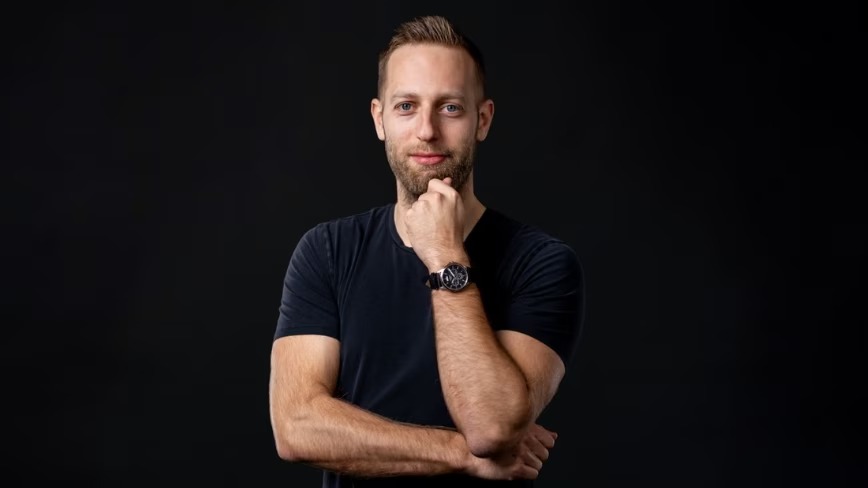
 Credit: Filip Pesek