TL;DR
People accumulate enormous digital archives but leave future viewers with no context. Eternal Memory founders Israel Elgamil and Itamar Evgey are building a digital time capsule platform where users curate meaningful moments with photos, videos, and stories. They cite Pew Research (84% on YouTube, 71% on Facebook), Library of Congress digital preservation guidance, and ResearchGate research on format obsolescence to frame the gap between accumulation and meaningful preservation.
The Pew Research Center’s 2025 survey found that 84% of U.S. adults use YouTube, 71% use Facebook, and 50% use Instagram, illustrating how deeply everyday expression has moved onto digital platforms.
The Library of Congress explains that digital materials can be harder to preserve than physical materials because access depends on changing technologies, formats, and devices. Its personal archiving guidance recommends selecting what matters, organizing it, and maintaining copies over time. Digital preservation could therefore involve decisions about meaning as well as storage.
The fragmentation is also visible in how people communicate. Pew’s 2025 research also found that Americans use a range of platforms with significant differences across age groups. A person’s photographs, conversations, videos and milestones can often exist across several services, accounts and devices, each designed around a particular form of communication.
The result is a paradox that may be becoming more relevant as digital life expands. People can accumulate enormous personal archives while leaving future viewers with little context about the moments inside them. The Library of Congress has emphasized that sustainable digital preservation requires attention to formats, metadata, access, and migration, underscoring the difference between retaining files and maintaining usable history.
It is within that gap that Israel Elgamil and Itamar Evgey, founders of Eternal Memory, see an emerging category they call digital legacy. To allow users to capture and retain memories, creating personalized digital time capsules while individuals are still alive, is why they created the app. They refer to the platform as a centralized, open, and accessible place where people can deliberately preserve the moments that help explain a life. “We are moving from capturing everything to curating what matters,” Elgamil says. “The question becomes what will future generations actually want to understand?”
Their vision begins with a simple behavioral shift. Instead of treating every photograph or video as equally significant, users can choose moments that carry meaning, whether that is a family celebration, a personal achievement, a favorite place, an important relationship, or an ordinary memory that later becomes precious. The platform currently operates as a free service, which Elgamil says is intentional. His priority is accessibility and engagement while Eternal Memory builds traction.
He compares the concept with the role picture albums once played. Albums gave families a physical place to gather selected images and stories. Elgamil argues that a digital legacy platform can offer a contemporary equivalent, with photographs, videos, milestones and connections organized in one location. He describes Eternal Memory as an “appetizer” that gives people a concentrated sense of who someone was and what mattered to them.
That distinction shapes their view of the emerging market. Evgey sees Eternal Memory as something that can sit alongside social platforms rather than replace them. Instagram and Facebook are built around ongoing social interaction, while Eternal Memory is designed around deliberate preservation. The difference, in his view, is purpose. A social post can capture a moment for today’s audience. A curated memory can provide context for someone who discovers it years later.
The platform’s public-facing design also reflects Evgey’s emphasis on openness. He says people should be able to encounter a memory without facing unnecessary barriers, while users who want to create and organize their own digital legacy can register and participate.
Elgamil imagines uses that extend beyond family albums. A person might collect memories from a childhood home, document a creative journey, preserve the story behind a meaningful photograph, or assemble milestones that help younger relatives understand an older generation. He sees these collections as living time capsules that can grow as people continue adding moments.
According to him, that future depends on a broader question of stewardship. Digital preservation research shows that files require ongoing attention because formats, storage media, and playback technologies change. Elgamil’s approach places curation and accessibility at the center of the user experience, with the larger ambition of making personal history easier to find and understand over time.
The founders see curation as a way to preserve ordinary details that may later become the most revealing. Small moments can carry context that photographs alone cannot.
The language around the project is deliberately optimistic. Elgamil wants memories to create moments of connection and happiness, including the kind of emotional response that comes from rediscovering something meaningful. “We can’t live forever, but our memories can,” he says. For him, the purpose is to create a place where a future family member can encounter a photograph or story and simply ask, “Did you know about this?”
That question captures the larger significance the founders assign to digital legacy. The next stage of digital life may involve fewer efforts to preserve everything and more deliberate choices about what deserves context, care, and continuity. “Your digital footprint is like your fingerprint,” they say. “It becomes part of who you are.”


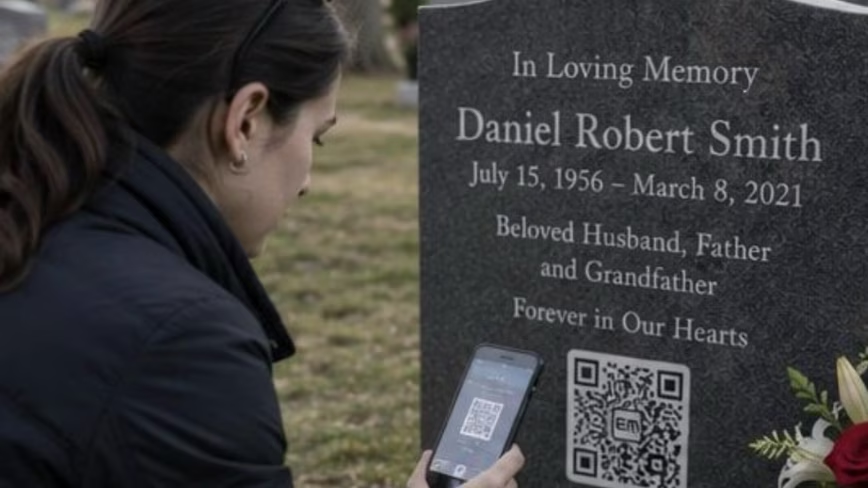
 Credit: Eternal Memory