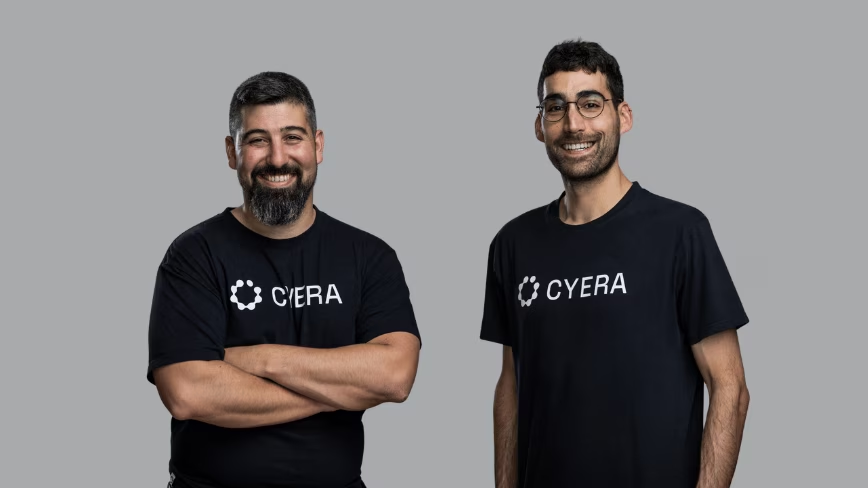
Cyera cofounders Yotam Segev, left, and Tamar Bar-Ilan.

They need to trust what AI agents can see and do before they can scale them.
Yotam Segev said that on Tuesday, about what the Global 2000 keeps telling his company. The Cyera cofounder and chief executive was announcing a $400m investment from Growth Equity at Goldman Sachs Alternatives.
The money extends Cyera’s Series G, which Evolution Equity Partners led in June. In its announcement, the company said the cash funds three things. An AI security roadmap, a push into the federal market, and growth across EMEA and APAC.
The valuation has not moved
Cyera describes itself as valued at over $12bn. That is the figure it set in June, when it raised $600m at exactly that mark.
So this is a flat extension rather than a fresh markup. The company gains $400m. The price per share sits where it did three months ago.
It is also the third large round Cyera has closed this year. Sophie Shulman reported for Calcalist that the company took $400m in January and $600m in June. That puts its 2026 total at $1.4bn.
Total funding now passes $2bn. Segev founded Cyera in 2021 with Tamar Bar-Ilan, its chief technology officer. As recently as 2024 it was worth $3bn.
The June round brought in Cyberstarts and Temasek. Accel, AT&T Ventures, Blackstone, Coatue, Georgian, Lightspeed, Sequoia and Spark Capital were already on the register.
What the product does
Cyera started by classifying enterprise data. It works out what an organisation holds, how sensitive each piece is, and who can reach it.
This year it extended that to the software acting on the data. Two products do the work.
Agent Guardian and Cyera Endpoint track what AI agents do. The company says they log more than prompts and responses. They record the tool calls, the database queries and the actions in between.
That runs from cloud deployments down to endpoint devices. Local coding agents such as Claude Code and Cursor increasingly handle sensitive work there, according to the company.
The company frames the whole thing as one job. It says it secures data at rest, in motion and in use, whether a person touches it or an agent does.
Customers named in the announcement include Paramount, Chipotle and Valvoline.
The acquisition that set this up
In July, Cyera bought Oasis Security for about $1bn. Oasis handles non-human identity. That means the credentials machines and agents use, rather than the ones people log in with.
The deal is why this round has a story attached. Knowing where sensitive data sits is one problem. Knowing which machine identity can reach it is another. Cyera is selling the combination.
Segev wrote in a blog post at the time that non-human identities inside Fortune 500 companies had grown nearly 500% in six months. He called them the fastest-growing identity type in the enterprise. Both figures are Cyera’s own.
His argument is that an agent needs no attacker to do damage. Give it valid credentials and a goal, he wrote, and it can expose data or break a process on its own.
The company puts the same point structurally. The security architecture most enterprises run was built for people and applications, not for millions of autonomous actors.
Everyone is selling the same idea
Irit Kahan is a managing director at Growth Equity at Goldman Sachs Alternatives. She said securing AI will be one of the defining categories in enterprise technology over the next decade.
She also named the gap Cyera is pitching against. As agents multiply faster than anyone can track them, she said, the distance between what they are trusted to do and what they can actually reach is becoming dangerous.
Plenty of investors reached that conclusion this year, and the lane is filling up.
NewCore raised $66m in June, to give AI agents a corporate identity.
Days later, SailPoint moved for Entro. It folded non-human identity into what it calls an agentic fabric.
Neo left stealth in July with $100m from a16z and Bessemer, building a control layer for agentic software. Comp AI took $34m last week for agentic compliance.
None of them has Cyera’s balance sheet. All of them are describing the same hole.
What the money is buying
The federal push is the clearest use of the new cash. Selling security software to United States government agencies takes accreditation, cleared staff and time. All three cost money long before any revenue arrives, which is one of the few things a large cheque genuinely solves.
The EMEA and APAC expansion is the other line. Cyera says enterprise demand for agent oversight is growing quickly in both regions.
The company employs more than 1,500 people across 18 countries. It had already passed $2bn in total funding by June, on a headcount that size.
Goldman is writing the cheque from a large book. Growth Equity at Goldman Sachs Alternatives has put more than $17bn into companies since 2003. The wider alternatives business runs over $706bn, and Goldman Sachs supervised roughly $4tn in assets at the end of June.
Goldman did not take part in the June round. Evolution Equity led that one, with Cyberstarts and Temasek alongside it. This is the bank’s first cheque into the company, and it arrives at the same price the June investors paid.
What Cyera has not published is a revenue figure. It said in June that annual recurring revenue had tripled three years running. That describes a rate, not an amount. The $12bn mark it has held since June rests on numbers nobody outside the cap table has seen.
Get the TNW newsletter
Get the most important tech news in your inbox each week.


