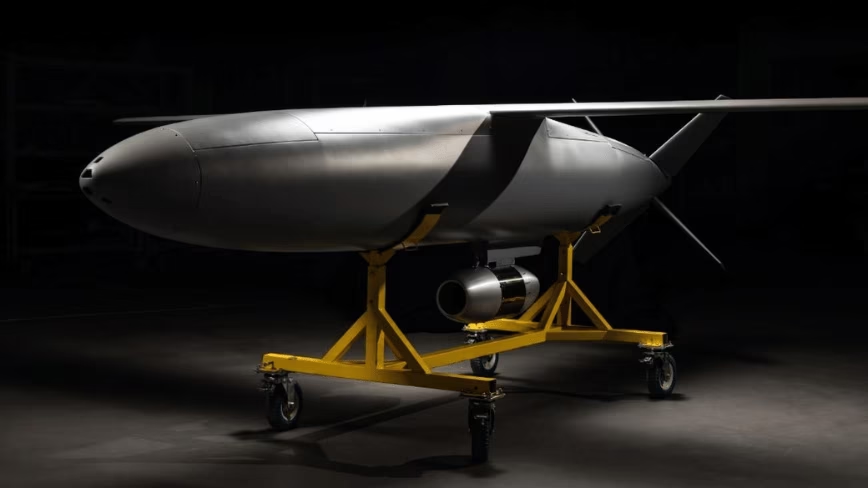
Covenant’s flagship weapon system, Anthem

A defence company nobody had heard of on Tuesday opened a 105,000 square foot missile factory in Texas on Wednesday.
Covenant came out of stealth this morning. It announced Anthem, a long-range weapon system it says is designed for production in the thousands, along with more than $250m raised across three rounds and roughly $150m in orders already booked.
The company is headquartered in Washington, DC. It has factories in three countries.
The pitch is quantity
Covenant frames the problem as a stockpile problem rather than a technology one.
“When you look at our adversaries, you see thousands of hardened targets, beyond the range of current capabilities,” said Michael Kaufman, co-founder and chief executive. “Anthem was built to credibly hold those targets at risk in a prolonged conflict. If our stockpiles run thin, so does our deterrence.”
The company says Anthem delivers its payload and range at a fraction of the cost of comparable legacy systems. Most of its parts are commercial off-the-shelf, and Covenant says it has secured long-term agreements for the rest. Production draws on local supply chains across allied nations.
Covenant also built its own mission planning and command-and-control software. That allows coordinated launch in mass, according to the release. The company describes Anthem as an end-to-end system, transported, stored, launched and reloaded with what it calls minimal strain on the customer.
It has already flown 200 times
Anthem first flew in August 2025. Covenant says the team has flown it more than 200 times since, including multiple flight tests with the US Army at home and abroad.
Its website says the aircraft flies weekly.
Kathleen Hicks, the former US deputy secretary of defense and now an adviser to the company, tied the approach to the Pentagon programme she ran.
“In the first Replicator Initiative, we focused the Pentagon on moving fast to scale delivery of small, inexpensive autonomous systems,” she said. “That same focus is needed to drive production and delivery of affordable capabilities at higher ranges and larger payloads. Covenant has built Anthem in direct alignment with Replicator’s principles.”
Three factories, three countries
The Texas plant opened today. Serial production starts in the first quarter of 2027 and ramps toward 5,000 units a year.
A second facility of 110,000 square feet sits in Saxony, Germany, backed by a European supply chain. A third, at 32,000 square feet, is in northern Israel.
The release datelines the American site to Dallas. Congressman Jake Ellzey, who represents Texas’s sixth district, places it in Grand Prairie.
“When Covenant looked across the country for a place to build, they found what we already know about North Texas. We have the workers, engineers, and innovators to get the job done,” Ellzey said. “From the first time I met with the Covenant team, it was clear they understood the mission at hand and the threat we face. They will be a strong addition to our defense community, and I’m happy to welcome them to Grand Prairie.”
Abby Denburg, Covenant’s president and chief growth officer, framed what comes next.
“Emerging from stealth and announcing our production plans marks Covenant’s next phase,” she said. “Now the measure of our success is execution: delivering mission-critical capability to our customers on time, at scale, and with the performance they expect.”
What the Pentagon has signed
Covenant puts its order book at roughly $150m. That covers qualification work, research and development, and multiple production contracts. The company expects more awards before the end of the year, and says certain customers restrict public disclosure of their contracting activity.
Two US arrangements are named. The Army holds an Other Transaction Agreement with Covenant for an accelerated test and qualification programme. That mechanism lets the Pentagon buy outside standard federal acquisition rules.
The Navy’s Rapid Capabilities Office has contracted Covenant to adapt the ground-launched Anthem into a maritime variant. The company values that work at roughly $70m with a cost-share component. It also funds Defense Exportability Features design work, intended to speed export to allies and partners.
Who paid for it
The $250m arrived across three rounds. Andreessen Horowitz led, alongside Founders Fund, Lux, 8VC, Aleph and Lightspeed.
“American Dynamism is about backing founders taking on the missions that matter most to America’s national security and rebuilding the West’s long-range strike arsenal is at the top of that list,” said David Ulevitch, a general partner at Andreessen Horowitz. “Covenant has the technical depth and the urgency the mission requires, and the company has already proven it in the air, not on paper.”
Ulevitch is one of five partners who put their names to a $1.1bn hardware fund the firm closed in August.
Mike Garcia, a former US representative and another Covenant adviser, made the production argument directly.
“We don’t lack advanced weapons, we lack enough of them, and that’s a production question as much as technology one,” he said. “Anthem is Covenant’s answer, a missile designed from day one to be built in the numbers a real fight demands.”
What the release does not say
Covenant gives no range figure. It gives no payload weight, no speed, no unit price and no dimensions.
The words heavy and long-range appear throughout without a number attached to either. The company’s website lists range, payload and scale as its three headings and puts no values under them.
No customer outside the US Army and Navy is named. The release refers to signed contracts in the United States, Europe and abroad without identifying any of them.
The company it joins
Covenant lands in a crowded field with a great deal of money in it.
In August Castelion raised $1bn at a $13bn valuation to mass-produce hypersonic strike weapons, on a similar argument that the constraint is manufacturing rather than engineering. Hadrian, which builds automated factories for the Pentagon and its suppliers, raised $1.37bn at close to $8bn. Andreessen Horowitz backed both.
Europe has its own version. Munich’s Helsing, Europe’s largest defence startup, raised $1.8bn at an $18bn valuation in July, selling sovereignty to European governments.
Covenant’s German plant is the part European readers should watch. A 110,000 square foot facility in Saxony, on a European supply chain, is an American company building strike weapons inside the European industrial base rather than exporting them into it.
What to watch
Whether the Texas line hits its Q1 2027 start, and whether the ramp toward 5,000 a year follows.
Whether Covenant releases performance figures. A weapon sold on range and payload has published neither.
And who the European and other customers turn out to be. The company says the contracts are signed.
Get the TNW newsletter
Get the most important tech news in your inbox each week.


