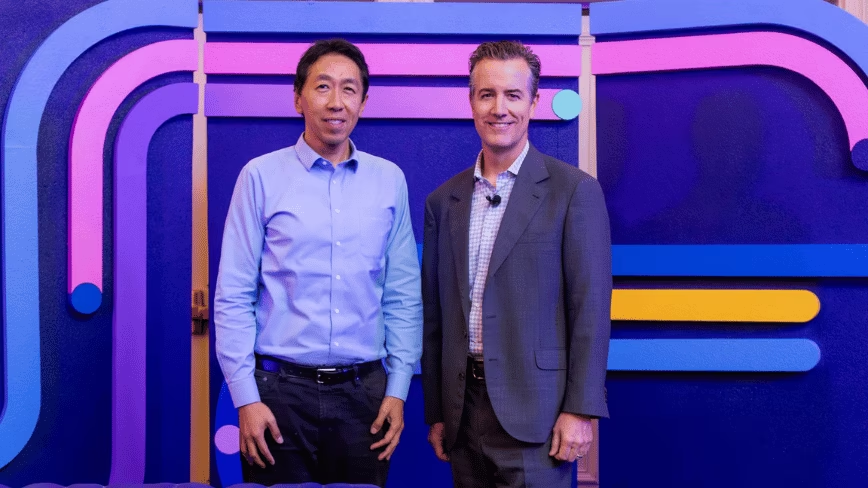
Coursera Chairman Andrew Ng and CEO Greg Hart

Andrew Ng helped give the AI industry its vocabulary, from “AI is the new electricity” to “agentic AI.” His new company bets against the phrase everyone else is using: that AI will take your job.
Ng has founded LearnVector, an AI-native learning startup, and Coursera is backing it with $100m, first reported by Axios. The plan is AI agents that act as personal tutors. They adapt to each learner and drill with them until the learner can prove they have mastered a skill.
The premise rejects the layoffs narrative outright. Amazon, Meta and Block have all pinned recent job cuts partly on AI. Ng thinks that framing is wrong.
“Conventional wisdom holds that AI will replace people, and I believe in the opposite,” Ng told Reuters. AI will make workers more productive and create fresh demand for skills, he argues, rather than a “job apocalypse.”
What the money buys
The $100m gives Coursera roughly a one-third stake in LearnVector. That implies a valuation of about $300m for a company with no product yet.
It is a meaningful bet. The sum is close to 13% of the $790m in cash Coursera held at the end of March. The first LearnVector courses are due in early 2027.
The target is white-collar workers and other adults, not schoolchildren or university students. Ng plans to sell to corporations, governments and higher education. The pitch is teaching people the skills that keep them useful as AI automates parts of their work.
The part worth reading twice
Ng is not an outside founder Coursera happened to back. He co-founded Coursera in 2012 and still chairs it. This is a deal between a company and its own leadership.
Coursera says it handled that properly. A special committee of independent directors reviewed the terms and approved the investment unanimously.
“We had an opportunity to invest at the formation of a brand new company from one of the world’s foremost experts on AI,” Coursera chief executive Greg Hart told Axios. “That was incredibly appealing.”
The structure is disclosed and the process holds up. It still deserves stating plainly. A $100m related-party investment is not an everyday line item.
Why not just a chatbot
The obvious question is what LearnVector does that a chatbot cannot. A student can already ask any assistant to explain a concept.
Hart’s answer is persistence and rigour. A one-shot answer, he argues, engages a learner less than a system built around a serious view of the skill being taught.
Whether that holds up is unknown, because the product does not exist yet. Ng told Reuters he is still working out course offerings, pricing and the interface. LearnVector also runs on foundation models from a variety of third parties. The differentiator, for now, is Coursera’s content and its data on how people learn, not the AI itself.
Into a sceptical market
The company launches into real doubt about AI in education. Teachers, students and parents are still working out how AI helps learning without fuelling cheating. School AI policies remain patchy.
Targeting adults rather than classrooms sidesteps the sharpest version of that fight. It lands instead in the reskilling debate, where the evidence is mixed. Some studies question whether AI is driving job cuts at all, and adoption often spreads wide without going deep.
The backdrop is a labour market already nervous about AI. Workers report being penalised for using AI honestly. Recruiters are pivoting to specialised AI roles as their own jobs shift. Layoffs keep arriving with AI cited as the reason.
Ng’s pitch is that this anxiety is the market. If AI keeps changing what work requires, someone has to teach the new skills, and he wants that to be a tutor rather than a search box. It is an optimistic reading of a moment many people are living as loss, and it echoes his message to graduates entering the AI economy. Andrew Ng gets until 2027 to show the tutor works.
Get the TNW newsletter
Get the most important tech news in your inbox each week.


