TL;DR
Coinbase went offline for seven hours on Friday after an AWS data centre overheated in Virginia, capping a week in which the exchange cut 700 jobs and reported a 394 million dollar quarterly loss.

Coinbase logo
 Credit: Coinbase
Coinbase went offline for seven hours on Friday after an AWS data centre overheated in Virginia, capping a week in which the exchange cut 700 jobs and reported a 394 million dollar quarterly loss.TL;DR
Coinbase cut 700 jobs on Monday. It reported a 394 million dollar quarterly loss on Thursday. On Friday, a data centre overheated in Virginia and the exchange went dark for seven hours. The company that told its remaining engineers that AI could do weeks of work in days spent the end of the week unable to process a single trade because a building got too hot.
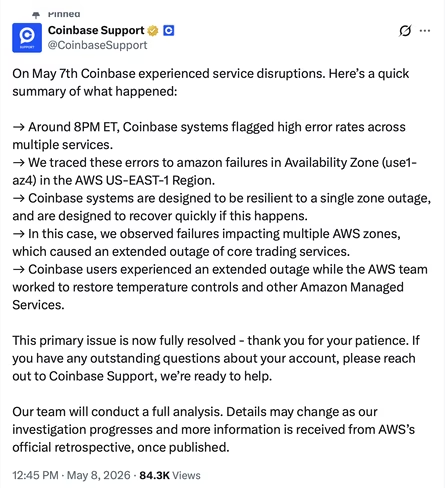
The outage, which Coinbase attributed to a thermal failure at an Amazon Web Services facility in Northern Virginia, suspended all trading, transfers, and core exchange functions from approximately 9 a.m. Singapore time on Friday until around 4 p.m. The company’s retail-facing app also experienced degraded performance. Coinbase said the issue originated in a single AWS availability zone, use1-az4, in the US-EAST-1 region, but that failures spread across multiple zones, overwhelming the resilience mechanisms designed to handle a single-zone loss.
AWS’s US-EAST-1 region, located in Northern Virginia, is the oldest and most heavily used of Amazon’s cloud regions. It is the default region for many AWS customers and hosts a disproportionate share of the internet’s infrastructure. When it fails, the consequences extend far beyond any single customer.
The overheating affected not only Coinbase but also CME Group and FanDuel, according to reports. AWS said temperatures rose inside a single data centre, causing power-related disruptions to EC2 instances and EBS storage volumes. The cooling system capacity took longer than expected to restore.
Denmark has paused grid connections for new data centres as AI infrastructure overwhelms the country’s power grid, and the thermal failure in Virginia illustrates the same underlying problem from the opposite direction: data centres generate enormous amounts of heat, and when the systems designed to remove that heat fail, the servers shut down. US utilities are planning to spend 1.4 trillion dollars by 2030 to power AI data centres, but the investment is focused on electricity supply, not on the cooling infrastructure that prevents the electricity from turning into the kind of thermal event that took Coinbase offline.
This is the second major AWS outage in seven months. In October 2025, a DNS failure in the same US-EAST-1 region lasted 15 hours, affected more than 2,500 companies, and generated an estimated 1.1 billion dollars in economic losses. That outage was caused by two automated systems updating the same data simultaneously. This one was caused by a building overheating. The failure modes are different. The outcome, a significant portion of the internet going offline because of a single physical location, is the same.
The timing of the outage transformed a bad week into a historically bad one. On Monday, chief executive Brian Armstrong announced the elimination of 14 per cent of Coinbase’s roughly 5,000 employees, approximately 700 positions. The layoffs were framed not as a retreat but as a restructuring around AI capabilities.
“Non-technical teams are now shipping production code and many of our workflows are being automated,” Armstrong wrote. The company introduced a “no pure managers” policy, replacing middle management with “player-coaches” who both manage and contribute technically. The restructuring is expected to save 120 to 150 million dollars annually at a cost of 50 to 60 million dollars in severance.
Oracle cut up to 30,000 employees in March to fund AI data centre expansion, and Coinbase’s layoffs follow the same template that has now become standard across the technology industry: fire people, cite AI, promise the remaining workforce will be more productive. Armstrong went further than most executives, warning publicly that mass AI-driven layoffs were coming to “every company.”
On Thursday, the company reported first-quarter results. Revenue fell 31 per cent year over year to 1.41 billion dollars, missing the consensus estimate of 1.48 billion dollars. Transaction revenue declined approximately 40 per cent to 756 million dollars. The company posted a net loss of 394 million dollars, or 1.49 dollars per share, against expectations of a small profit. Unrealised losses on crypto assets accounted for 482 million dollars of the damage. The stock, already down 15 per cent for the year, fell a further 3 per cent in pre-market trading on Friday.
The single bright spot was market share. Coinbase reported an all-time high 8.6 per cent of global crypto trading volume, and derivatives volume rose 169 per cent year over year. The exchange is gaining share in a shrinking market, a position that is encouraging for the long term and irrelevant to a quarterly earnings report that shows a company losing nearly 400 million dollars.
Coinbase’s outage is a concentrated example of a structural problem that extends across the technology industry. The exchange processes billions of dollars in transactions through infrastructure it does not own, in buildings it does not control, subject to physical conditions it cannot influence. When a cooling system fails in a data centre in Virginia, a customer in Singapore cannot trade.
The concentration of critical services on a small number of cloud providers has been a growing concern among regulators and industry analysts. AWS, Microsoft Azure, and Google Cloud control the vast majority of global cloud infrastructure. For exchanges that handle financial assets, the dependency creates a category of risk that no amount of software resilience can fully mitigate: the risk that the physical building where the servers live will fail in a way that the software was not designed to anticipate.
Coinbase said its systems were designed to be resilient to a single availability zone outage. The problem, as the company acknowledged, was that failures spread across multiple zones. The design assumption, that failures would be contained, did not hold. This is the recurring lesson of cloud outages: the systems are designed for the failures that engineers can model, and the failures that actually occur are the ones that exceed the model.
Big Tech companies reported more than 650 billion dollars in combined AI capital expenditure in the first quarter, with AWS contributing a significant share. Amazon is spending aggressively to expand its cloud infrastructure to meet AI demand. The question the Coinbase outage raises is whether the expansion is prioritising capacity over resilience, adding more servers without proportionally investing in the cooling, power redundancy, and physical infrastructure that keeps those servers running when conditions deviate from the plan.
Coinbase has been here before. The exchange has a documented history of outages during periods of high market volatility, though this particular outage was caused by infrastructure failure rather than traffic spikes. The October 2025 AWS outage also affected Coinbase. The pattern, a crypto exchange going offline at moments when its customers most need access, is a recurring source of user frustration and regulatory scrutiny.
The company said it would conduct a full analysis and that details may change as its investigation progresses and more information is received from AWS’s official retrospective. The language is careful, appropriate, and entirely standard for a company that has just experienced a significant service failure. It does not address the structural question: whether a crypto exchange that processes billions of dollars in assets should be entirely dependent on a single cloud provider’s ability to keep a building cool.
Armstrong spent the first half of the week telling his employees that AI was the future and that Coinbase would be leaner, faster, and more automated. By Friday afternoon, the future looked like seven hours of blank screens, frozen accounts, and a support team fielding complaints about a problem that originated in a building the company does not own, in a state where it has no employees, running on hardware it has never seen. The cloud is someone else’s computer. This week, it was also someone else’s thermostat.
Get the most important tech news in your inbox each week.


