The deal, Cognizant’s fourth major acquisition in 18 months, is designed to plug a specific gap in its AI builder strategy: the ability to design, build, and run the physical data centre infrastructure that enterprise AI actually runs on.
Cognizant has agreed to acquire Astreya, a San Jose-based IT managed services firm specialising in AI infrastructure and data centre operations, for approximately $600 million, the company confirmed to Reuters. The deal is expected to close in the second quarter of 2026, pending regulatory approvals.
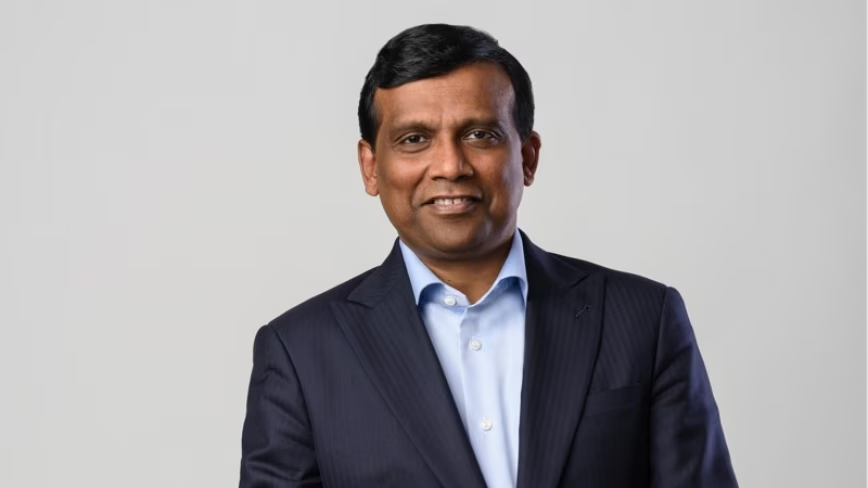
The acquisition is the most operationally specific move yet in Cognizant’s AI pivot under CEO Ravi Kumar S, who took the role in January 2023 and has spent the intervening period reshaping the company around what he calls an ‘AI builder strategy’: helping enterprise clients not merely adopt AI tools but architect, deploy, and scale production-grade AI systems.
“By acquiring Astreya and its proprietary AI tooling and production-grade infrastructure platform, which is complementary to Cognizant’s AI builder stack, we will be even better-positioned to help clients architect their platform-led AI systems and operationalise them at scale,” Kumar said.
What Astreya brings?
Founded in 2001 in Silicon Valley, Astreya has spent two decades building operational expertise in exactly the unglamorous layer of enterprise IT that most AI coverage ignores: the physical and logical infrastructure that connects AI compute to the businesses that use it.
The company employs more than 2,200 IT professionals across 33 countries, with a particular concentration in data centre management, network operations, cloud infrastructure, and digital workplace services for large enterprises.
Its customer base skews heavily towards technology companies, the same hyperscalers and enterprise tech firms whose AI ambitions are driving the current wave of infrastructure investment.
Its service offering spans network and data centre management with 24/7 monitoring, IT asset lifecycle management, cloud infrastructure services including migration and optimisation, and AI-driven automation tooling it describes as ‘AI-first’ managed services.
The company has been building proprietary AI agents and automation frameworks on top of its managed services, positioning itself not merely as a labour-arbitrage outsourcer but as a technology platform for infrastructure operations.
Revenue figures for Astreya vary across sources, as the company is privately held and does not publish audited financials. ZoomInfo and RocketReach both cite a figure of approximately $560 million in annual revenues, which would make the $600 million acquisition price a modest premium to trailing revenue, reflecting the value Cognizant is placing on Astreya’s proprietary tooling and its customer relationships rather than simply its headcount.
The Astreya acquisition continues an acquisition cadence that Kumar has maintained with unusual consistency since taking the helm. In 2024, Cognizant acquired Thirdera, a ServiceNow specialist, for $430 million, and Belcan, a digital engineering firm focused on aerospace and defence, for approximately $1.3 billion, its largest deal in years.
In November 2025, it announced the acquisition of 3Cloud, one of the largest independent Microsoft Azure services providers, in a deal that would add more than 1,000 Azure engineers and 1,500 Microsoft certifications to Cognizant’s bench. Financial terms for 3Cloud were not disclosed.
Each acquisition maps to a specific gap in Cognizant’s AI builder stack. Thirdera deepened its ServiceNow workflow automation practice. Belcan brought engineering R&D capabilities for complex physical systems. 3Cloud extended its Microsoft Azure and AI deployment bench. Astreya fills the infrastructure operations layer: the ability to design, build, and run the data centre and network fabric that production AI systems require.
The pattern reflects a deliberate attempt to move Cognizant away from the commoditised labour arbitrage model that has characterised Indian IT outsourcing for two decades, and towards a higher-margin, IP-enriched services model.
Cognizant was named as one of OpenAI’s first two Codex enterprise partners in April 2026, embedding the AI coding agent across its global delivery workforce of roughly 350,000 associates. The company has also embedded Claude across its entire workforce through Anthropic’s Claude Partner Network, making it one of the most AI-embedded large IT services firms by headcount.
The strategic rationale for the Astreya deal is rooted in a specific problem that large enterprise AI deployments consistently run into: the gap between a working AI model and a running AI system at scale. Building a model, or licensing one, is now relatively straightforward for a large organisation.
Running it reliably in production, managing the data centre connectivity, network latency, hardware provisioning, monitoring, and operational automation required to deliver consistent performance, is considerably harder, and considerably more expensive to staff organically.
That gap is where Astreya has operated for two decades. Its clients include some of the world’s largest technology companies, and it has been building automation and AI-agent tooling on top of its managed services infrastructure at a moment when demand for exactly that capability is accelerating.
Cognizant’s Q3 2025 revenues reached $5.4 billion, up 7.4% year on year, with its Products & Resources segment, boosted significantly by Belcan, growing at 12.6%. The company has guided for continued revenue acceleration into 2026, and the Astreya deal strengthens the infrastructure services revenue line that underpins that guidance.
For the broader IT services market, the deal is a signal of where the battleground has shifted. Accenture, Infosys, TCS, and Wipro are all pursuing variations of the same strategy: acquiring specialised capability to move up the AI value chain before the window closes.
The race is not simply for AI talent, it is for the operational infrastructure expertise and proprietary tooling that turns AI from a pilot into a production system. Astreya, at $600 million, is Cognizant’s bet that it can own that layer.
Get the TNW newsletter
Get the most important tech news in your inbox each week.


