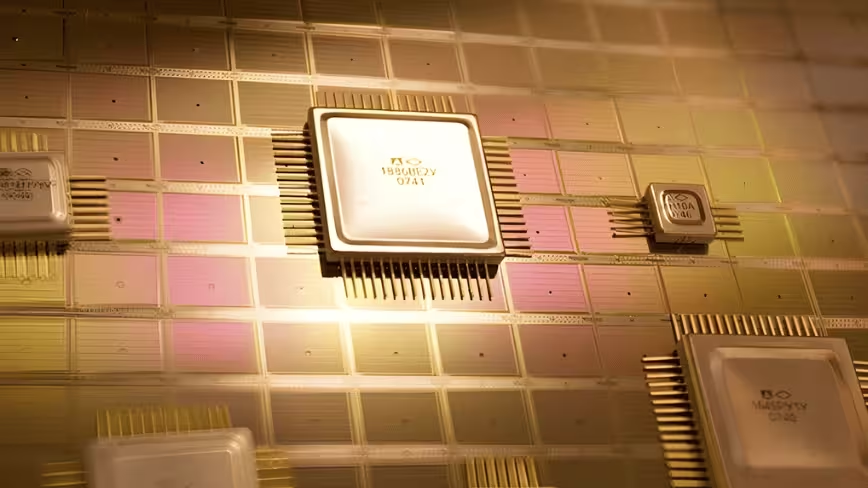
Nexchip Semiconductor is China’s third-largest pure-play foundry, a sentence that until recently would not have led to a Hong Kong listing. It does now. The Hefei-based, state-backed chipmaker is seeking to raise up to HK$6.98 billion, or roughly $890 million, in a share sale that adds to a sudden rush of Chinese semiconductor companies floating in a market that had been quiet for years.
The terms are set. Nexchip is offering 216.2 million shares at a maximum price of HK$32.30 each, with trading expected to begin on 10 July. The listing is a dual one, pairing Nexchip’s existing Shanghai presence with a Hong Kong float that opens the company to international capital it cannot easily reach at home, which is much of the point of being in Hong Kong at all.
The company sits behind only SMIC and Hua Hong Semiconductor in China’s foundry hierarchy, and its origins explain a good deal about it. Founded in 2015 as a joint venture between Hefei’s government-owned investment arm and Taiwan’s Powerchip Technology, Nexchip is a creature of China’s industrial policy, the kind of firm built to absorb state ambition and domestic demand rather than to chase the bleeding edge of chipmaking.
The money is going into capacity. Nexchip is building a Phase IV facility in Hefei’s Xinzhan High-Tech Zone, a 35.5 billion yuan investment, around $5.1 billion, designed to produce 55,000 wafers a month at the 28nm and 40nm nodes.
Equipment installation is planned for the fourth quarter of this year, with full production targeted for the second quarter of 2028, a timeline that says as much about the patience of state financing as about engineering.
Those are mature nodes, not the advanced geometries that dominate the headlines, and that is deliberate. Mature-node chips run cars, appliances, industrial equipment, and the unglamorous logic that fills most electronics, and they are exactly the segment where US export controls bite least and Chinese self-sufficiency goes furthest.
Nexchip plans to put more than half the proceeds toward developing its 22nm platform, a careful step up the ladder rather than a leap. The strategy mirrors that of its larger domestic rivals, which have concentrated investment on capacity Beijing can fund and equip without running into the most stringent American restrictions, building scale where the politics allow it rather than chasing the nodes where they do not.
A slice of the spending is earmarked for production tied to artificial intelligence applications, the phrase now obligatory in any Chinese chip prospectus. It points at the demand pulling the whole sector forward.
China’s AI build-out has become a meaningful driver of its exports, with semiconductors and data-centre components doing much of the work, a dynamic visible in the country earning roughly $500m an hour from exports at its peak.
The listing is also a market story as much as a company one. After a thin stretch, Chinese AI and chip firms are floating in Hong Kong again, drawn by reopening investor appetite and a policy push to channel capital into strategic industries. Self-driving firm Momenta’s $752m Hong Kong IPO ran on the same current, and the pipeline of mainland tech names heading to the city has thickened noticeably.
Nexchip’s filing acknowledges the obvious risks alongside the growth, from the price competition that defines mature-node foundries to the geopolitical exposure that comes with being a state-backed Chinese chipmaker in a market watched closely from Washington. None of that has dimmed the appetite.
The shares price soon, trading starts on 10 July, and the listing will read, either way, as another data point in a question the market keeps asking: how much capital Hong Kong can route into China’s chip ambitions, and how fast.
Get the TNW newsletter
Get the most important tech news in your inbox each week.


