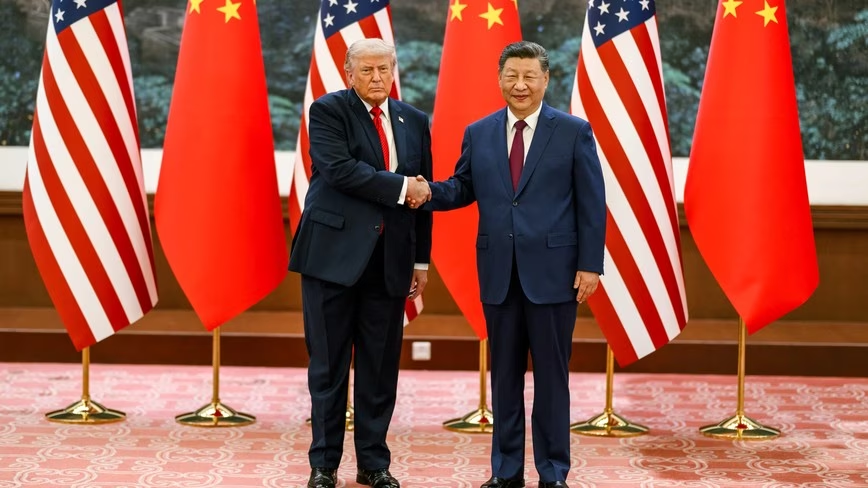
Donald Trump and Xi Jinping at the Great Hall of the People in Beijing, 14 May 2026

China is weighing how hard to hit back at new US limits on its access to AI chips, days before Xi Jinping meets Donald Trump, Bloomberg News reported.
The US Commerce Department released the interim rules on Monday. Overseas data centres now need US approval to give large amounts of computing power to Chinese firms. Shipments of advanced chips to Singapore, Malaysia, Thailand, Indonesia and Brazil also need a licence.
There are exceptions. Chinese firms can still use computing power for content recommendation systems, and they can still rent capacity in US data centres, according to Bloomberg.
On Tuesday, China’s foreign ministry said it would take necessary measures to protect its rights and interests. Spokesperson Guo Jiakun accused the US of abusing export controls.
“It runs counter to the consensus reached between the two sides,” Guo told a regular press briefing in Beijing.
Xi and Trump are due to meet this week on the sidelines of the APEC summit in Shenzhen. It will be their third meeting this year. The two governments are also expected to hold their first dialogue on AI safety.
The rules could strain an unwritten bargain behind the trade truce. Under it, Washington holds off on new tech curbs, and China keeps critical minerals flowing to the US. US officials have complained that rare-earth magnet shipments are arriving too slowly, Bloomberg reported.
Beijing also has a deadline it can use. After Xi and Trump met in Busan last year, China suspended its ban on gallium, germanium and antimony exports to the US. That suspension ends on 27 November, so China could restore the ban simply by letting it lapse.
The curbs target a large source of Chinese computing power. The Institute for Progress, a Washington think tank, had forecast that nearly a third of China’s advanced compute would come from renting overseas data centres by the end of 2027.
Chinese AI stocks fell on Tuesday. Minimax dropped as much as 6.5% and Z.ai fell 6.8%, while chipmaker SMIC rose as much as 9%, Bloomberg reported.
The rules follow the resignation of Jensen Huang, who had been the industry’s loudest critic of chip controls on China. Brian Wong, an assistant professor at the University of Hong Kong, expects a targeted response rather than an end to the truce.
“It puts the tactical pressure on Beijing ahead of the Shenzhen meeting to demonstrate it will not be bullied into submission,” Wong told Bloomberg.
Get the TNW newsletter
Get the most important tech news in your inbox each week.


