 Credit: Mikel Martinez de Osaba via Canva
Inner Mongolia signed 12 green computing projects worth 186.46 billion yuan on Saturday, about $27.49bn. It also broke ground on a platform to sell Chinese AI services abroad. The state news agency Xinhua reported both from Hohhot, the regional capital. The conference that hosted the signings was held on the Cilechuan Grassland.
China builds the data centres that run its AI in its rural west, on land that used to carry livestock. Two reports this month describe what that looks like. Agence France-Presse visited Guizhou. The South China Morning Post reported from Ulanqab.
What was signed in Hohhot
The projects involve Volcano Engine, ByteDance’s cloud arm, alongside Cambricon Technologies and China Telecom. They cover green intelligent computing centres, token factories, and manufacturing for computing-power and electricity equipment.
Construction also began on a service platform for digital services going global. It sits in the Hohhot Area of the China (Inner Mongolia) Pilot Free Trade Zone. It will connect overseas developers with Chinese AI models and green computing resources. Services include compliance assessment, computing-power scheduling, token measurement, cross-border settlement and developer support.
How much compute is already there
Horinger New Area in Hohhot holds 62 computing centres with a total capacity of 150,000 petaflops. Of that, 143,000 petaflops is intelligent computing capacity, Xinhua reported, citing local authorities. One petaflop is a quadrillion calculations per second.
Neighbouring Ulanqab has reached 172,000 petaflops of operational capacity. Intelligent computing accounts for more than 95% of it.
Daily token calls in China rose from about 100 billion in early 2024 to 140 trillion in March 2026, on official figures cited by Xinhua.
What Ulanqab looks like now
For generations Ulanqab meant windswept pastureland. Its Mongolian name means “red cliff pass”. Cattle grazed there and potatoes thrived under long hours of sunlight. The economy hinged on the cool, strong breezes off the Yinshan range.
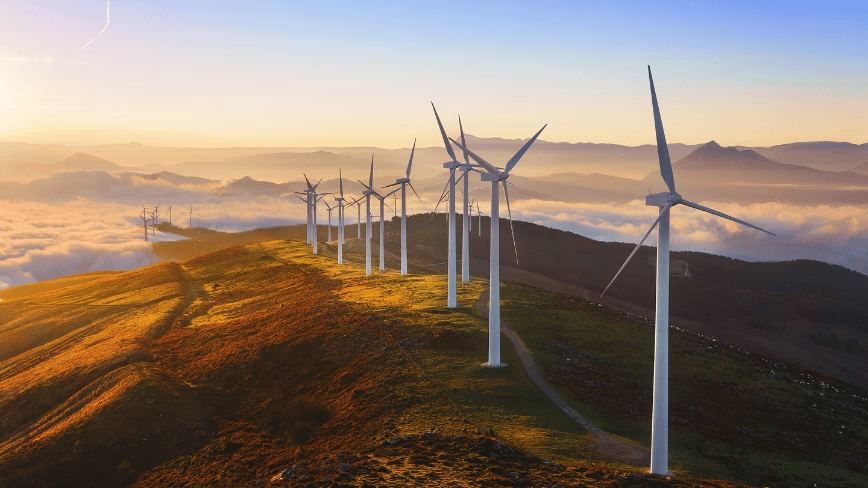
Giant wind turbines now stand next to livestock across those sloping grasslands, Ben Jiang reported for the Post on Monday.
Earlier this month the Chinese renewable energy company Envision Group brought its Galaxy Campus online there. At its heart is a 120,000 square metre data centre. A company statement puts that at roughly the area of 20 standard football pitches. The design allows for up to one million AI accelerators, and planned power capacity runs to over two gigawatts.
The electricity is the argument
Hohhot has an average annual temperature of 7C. More than 200 days a year are cool enough for direct outdoor air cooling, which cuts cooling costs by over 20%. Power runs at about 0.36 yuan per kilowatt hour. At that price a large GPU cluster can save roughly 50 million yuan a year.
Those figures come from a promotional release issued by the Hohhot City Integrated Media Center. The same release says wind power reaches some sites through a dedicated 41-kilometre line rather than the public grid. It puts the city’s green electricity use above 80%.
Training a large model on tens of thousands of GPUs can consume over 100 million kilowatt hours a year. China Mobile’s Hohhot Intelligent Computing Center paid about 290 million yuan for electricity in 2025. The release puts that at more than 70% of its operating expenses.
The policy has a name
In 2021 the Chinese government called its strategy Eastern Data Western Computing. Much of the digital infrastructure serving the eastern seaboard now goes up in the less populated rural west. Agatha Cantrill reported the details for AFP on 19 August.
China has demanded that data centres draw 80% of their power from renewable sources by the end of this decade. Guizhou and Inner Mongolia have massively expanded solar and wind capacity. That suits operators trying to meet the commitment, said Simeng Deng, a senior analyst at Rystad Energy. Meta went the other way this summer and left the RE100 pact.
Renewables also overproduce at times, a problem known as curtailment. Server farms “can be an engine to digest or absorb the surplus of renewable power generation”, Deng said. Beijing started taxing solar batteries this year, for the first time in a decade.
A clock tower in Guizhou
In the hilly southwestern province, a cluster of European-style buildings emits a low, permanent hum. It comes with a clock tower and a multi-arched bridge. It is Huawei’s largest data centre. Dozens more have gone up in Guizhou in recent years, including sites run by Apple and Tencent. China Telecom bought Huawei Kunpeng servers in a $1.7bn deal in June.
When AFP visited Guian New Area last month, street vendors were catering to data centre workers on their lunch break. A roadside banner nearby called for “promoting high-quality development”.
“It used to be a barren mountain, but since the area has developed, transportation has become more convenient, trade has picked up, business opportunities have emerged,” local shopkeeper Shu Peihua told AFP.
A vendor selling savoury pancakes, who did not give his name, counted two new universities since the facilities went up. Another resident, Li Xixiu, said the centres brought the main road. “All the villagers in our neighbourhood now find jobs nearby, unlike before, when they had to go to other places,” Li said.
Researchers are less sure
Data centres do not necessarily create a “huge spillover effect” on local jobs, said Andrew Stokols of Singapore Management University. Both in China and elsewhere, he added, “immediate benefits have been elusive”.
Guizhou has averaged annual GDP growth of 7.4% over the past decade. Its wage growth over the same period was second to last nationwide, according to the Taiwan-based Research Institute for Democracy, Society and Emerging Technology.
“This contrast suggests that while data centers drive heavy investment in land and equipment, their impact on boosting local per capita income remains limited,” DSET researchers Cartus Bo-Xiang You and Angela Glowacki told AFP by email.
Building has left Guizhou with one of the country’s heaviest debt burdens. In 2024 it ranked 30th among Chinese provinces for debt to revenue and 27th for debt to GDP, on DSET figures.
Nobody is stopping it
In Europe and the United States, data centre construction often meets local resistance. China controls dissent tightly, especially around central government policy.
American opposition stalled about $130bn of projects in three months, and the companies behind them have gone on a charm offensive. In Europe the obstacle is the grid rather than the neighbours, which has pushed 63% of new data centre capacity out of the five established markets.
What the grassland is worth
A report published on Monday put a price on the land itself. Rangelands Rising launched at the UN Convention to Combat Desertification COP17 summit in Ulaanbaatar, Mongolia.
Rangelands cover more than half the planet’s land surface, the report says. It values the benefits they generate at $21tn to $47tn a year and counts 500 million pastoralists who manage them. It says crop expansion, urban encroachment and fragmentation are taking grazing land. The report does not discuss data centres.
What has not been said
Envision has not named the accelerators going into the Galaxy Campus. That matters, because export controls set what a Chinese site can install. It has not said how much of the campus draws power today, what it cost, or who buys the compute.
The petaflop totals from Hohhot and Ulanqab describe capacity that is running. The two gigawatts at the Galaxy Campus is a plan.
Get the TNW newsletter
Get the most important tech news in your inbox each week.


