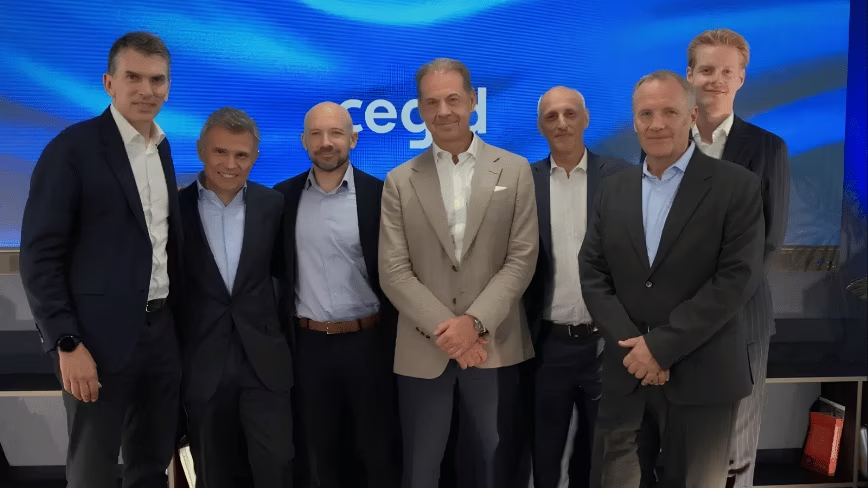
Left to right: Bruno Vaffier, Mathieu Perrymond, Jonathan Galore, Christian Lucas, Pierre Cesarini, Christian Pedersen and Rico Adlor-Andersen.

Silver Lake is merging two companies it already owns.
Cegid and Silae are both French. Both are majority-owned by the American private equity firm. On Wednesday they announced their intention to merge.
The deal is expected to value the combined group at more than €10bn in enterprise value. Silver Lake will remain the majority shareholder. Christian Pedersen, newly appointed chief executive of Cegid, will run the group.
What each company does
Cegid sells cloud business management software to small and medium-sized businesses and to accountants. It was founded in Lyon in 1983. Its products cover accounting, tax, treasury, ERP and retail. It recently bought Shine, which gives very small businesses and the self-employed a business account, invoicing, accounting and payroll.
Silae does payroll and human resources, and has done so for fifteen years from Aix-en-Provence. It serves more than 6,000 partners. Those are accounting firms and HR integrators. It produces over 8 million payslips a month for close to a million businesses in France.
Between them, the announcement says, the two handle the accounting, tax, finance and payroll of 2 million end-customers. They also serve more than 15,000 chartered accountancy firms. Together they generate more than 13 million payslips across Europe every month.
The pitch is integration
The stated logic is connecting products that currently sit apart.
The companies name three things. Deeper integration between payroll and the production software accountants use. Shine services activated inside the mySilae platform. New treasury and cash forecasting tools.
They also say the merger lets them spend more on research and development. It would assemble one of Europe’s largest developer teams, at 1,400 people.
Christian Lucas is chairman of both companies and a managing partner at Silver Lake. He framed the deal as the end of one project and the start of another.
“This combination is an exciting milestone. It marks the successful culmination of a decade-long journey we’ve been on first with Cegid and later with Silae, as well as the start of an even more exciting one. Together, Cegid and Silae can offer a unique end-to-end suite of software and AI-powered products serving the SMBs and their professional advisors who are the dynamic heart and soul of the European economy.
“Silver Lake has been an unwavering supporter and long-term investor in both companies, helping transform two French leaders into European champions through sustained investment in technology and talent. Since our initial investment, revenues and headcount have more than tripled in size, with one-third of revenue now generated internationally, underscoring how local excellence can drive global opportunity. We are very much looking forward to continuing to support the combined group and its leadership team into the future for the long term.”
The new chief executive comes from IFS
Pedersen joins from IFS. He was most recently its chief innovation officer, and before that its chief product officer, where he led the development of IFS Cloud.
Earlier he was chief product officer and senior vice president at SAP. He spent nearly fourteen years at Microsoft, including a spell running the enterprise ERP business. He started at Navision, the Danish business software company Microsoft bought in 2002.
“I am delighted to join this ambitious project,” Pedersen said. “Together as one integrated European platform, we can accelerate innovation and unlock the full potential of AI for customers across interconnected accounting, payment, payroll and HR data. My focus will be to continue turning this vision into truly differentiated, highly value-add solutions for businesses, chartered accountants, and their clients.”
Pierre Cesarini will continue to lead Silae inside the combined group. He put the emphasis on the plumbing.
“For fifteen years, Silae has focused on making payroll and HR straightforward, compliant and reliable for our partners and clients. The real value of this merger lies in the product integration: connecting payroll and HR natively with accounting, e-invoicing, digital finance and payments, so that firms and the businesses they serve work on a single platform with data flowing seamlessly across it while preserving the central role of accountants in their relationships with clients.”
Who else stays
Bruno Vaffier takes a general management role alongside Pedersen. Rico Adlor-Andersen continues to lead Shine.
The group will also create a body for the accounting profession spanning Cegid, Silae and Shine, called the Comité Experts-Comptables. Mathieu Perrymond will chair it. Jean-Michel Aulas, Cegid’s founder and honorary chairman, will sit on it.
The regulatory clock
Two things have to happen first. The merger needs consultation with employee representative bodies. It also needs approval from the relevant regulatory authorities.
Subject to both, the companies expect to close in the first half of 2027.
France’s e-invoicing reform entered into force this month, with a more demanding phase due in 2027. The companies position the combined group as a partner for French small businesses going through it.
The number the release does not give
The announcement carries an enterprise value and no revenue figure.
The Financial Times reported that the combined companies are expected to have annual revenue of about €1.6bn, or roughly $1.9bn. Against a €10bn enterprise value, that is a little over six times revenue.
Silver Lake bought into Cegid in 2016 and Silae in 2020. It says revenues and headcount at both have more than tripled since. A third of revenue now comes from outside France.
Why now
The companies give one reason. AI, and the investment it demands.
CNBC’s Kai Nicol-Schwarz set the deal against a difficult year for software. Shares fell on fears of a so-called SaaSpocalypse before recovering in May. The concerns have not gone away.
The worry, as the market reads it, is that AI erodes the value of software sold by the seat. The answer here is scale and data. Put payroll, accounting, invoicing and payments on one platform, then build on what flows between them.
Newer companies make the opposite argument. Wonderful, eighteen months old, raised $550m at $5bn last week. It sells enterprises an AI layer that sits over whatever they already run.
Buyers are moving too. Meta is switching to Slack because of its agent ecosystem, while European governments buy for control instead.
A busy fortnight for French technology
The deal lands in the middle of an unusual run.
Mistral raised €3bn at €21bn on Tuesday. That is the largest equity round a European technology company has ever closed. Pasqal, the neutral-atom quantum company, began trading on Nasdaq a week earlier. Europe ordered a €388m supercomputer from Bull, the French state-owned champion it bought from Atos in March.
The release calls the combined group a national technology champion. On the numbers it would be one of France’s largest software companies. It would also stay owned, as both halves are now, from California.
Get the TNW newsletter
Get the most important tech news in your inbox each week.


