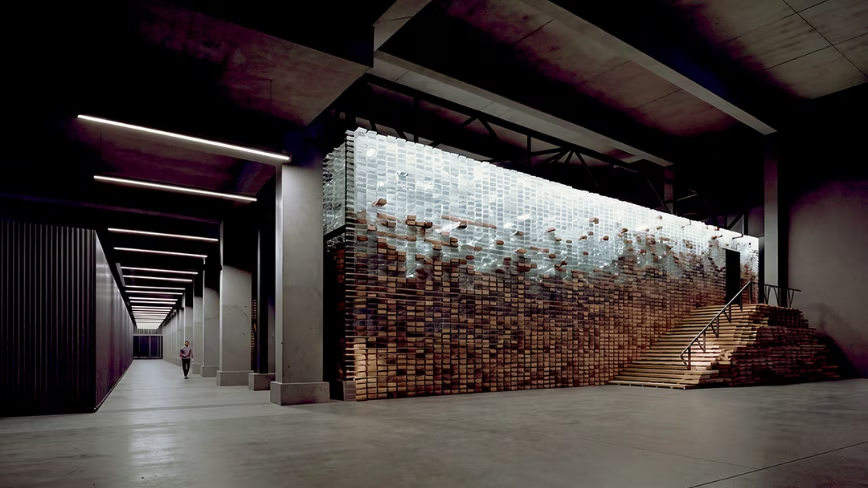
An architect’s visualisation of the LUMI-AI data centre in Kajaani, Finland.

Europe is buying another AI supercomputer, and this one is headed to Kajaani in northern Finland. LUMI-AI is a €387.8 million system, roughly $449 million, that will be built by Bull, the French supercomputer maker that the French state bought outright five months ago.
The order is the sixth AI Factory procurement contract signed by the EuroHPC Joint Undertaking, the body coordinating Europe’s publicly funded supercomputing infrastructure.
The cost is being split evenly between EuroHPC and the LUMI AI Factory consortium, which is where the political logic behind the project becomes clearer. Finland, Czechia, Denmark, Estonia, Norway and Poland are all contributing to a machine that will sit on Finnish soil but be available to researchers and companies across the consortium.
In practical terms, the new system is expected to deliver roughly ten times the AI capacity of the existing LUMI supercomputer, while nearly doubling its conventional high-performance computing capability. Deployment is scheduled for the second half of 2027, which may sound distant for an AI system, but is fairly standard for a major supercomputer procurement.
The hardware is more revealing than the headline price. LUMI-AI will use AMD Instinct MI430X accelerators and sixth-generation EPYC processors with 256 cores, built around Bull’s BullSequana XH3500 architecture.
There are two pieces of the system that give it a stronger European identity than simply assembling an American-designed machine on European soil. Bull is supplying its BXI interconnect, which links the nodes together, as well as its patented warm-water direct liquid cooling technology, both of which were developed in France.
The wider supplier list also reflects an effort to keep more of the infrastructure within Europe. IBM Storage Scale will provide the storage layer, while Nokia is supplying the data centre networking, bringing a Finnish company into a system that will be installed in Finland.
“LUMI-AI marks an important milestone for European AI and Bull’s leadership in energy-efficient, complex AI infrastructures,” said Emmanuel Le Roux, the company’s chief executive. Anders Jensen, who runs EuroHPC, presented the purchase as the sixth step in a broader sequence of AI infrastructure investments rather than an isolated project.
Bull’s ownership makes the deal particularly significant. Atos completed the sale of its Advanced Computing business to the French state on 31 March, in a transaction with an enterprise value of up to €404 million, including €104 million in earn-outs, making the French government the company’s sole shareholder.
The business generated around €700 million in revenue in 2025 and operates Europe’s only supercomputer manufacturing plant in Angers. It also builds the systems used to model France’s nuclear deterrent, giving the business a strategic importance that goes well beyond the commercial supercomputing market and helps explain why the French government was unwilling to see it disappear into foreign ownership.
Kimmo Koski, who runs CSC, the Finnish research organisation that will host LUMI-AI, described the new system as a continuation of what the existing LUMI consortium has already built rather than a project starting from scratch. That existing track record is part of the reason six countries are prepared to pool funding around a facility located in a country that only one of them actually hosts.
The arrangement fits a pattern that has been taking shape across Europe for the past two years. EuroHPC selected its first seven AI Factory sites in December 2024, followed by six more in October 2025, and procurement contracts have been signed progressively since then.
The gigafactories were supposed to take that effort to another scale, with a €30 billion programme covering seven much larger sites. Progress on that part of the strategy has been slower, however. The gigafactory programme has been struggling with delays that have frustrated some of the partners it needs, while the projects themselves are considerably more complicated than building an individual supercomputer at an established site.
Even the AI Factories that are now being procured remain relatively small compared with what the biggest private technology companies are building. A €387.8 million supercomputer represents only a fraction of the investment behind a single hyperscaler campus, so Europe’s response to that imbalance has so far relied heavily on pooling resources between governments rather than trying to match the private sector project for project.
Kajaani also has an advantage that many potential European sites cannot easily reproduce. Finland has abundant relatively cheap, low-carbon electricity and a climate that makes cooling large computing installations considerably easier, and the country has spent years developing the infrastructure needed to turn those conditions into a competitive advantage for data centres and supercomputing. With Germany’s Jupiter now joining the European supercomputing landscape, LUMI remains one of the continent’s most established large-scale systems.
The decision to buy from a state-owned supplier is perhaps the clearest indication of how much the European approach has changed. Three years ago, government ownership of a major supercomputer manufacturer would have been an unusual detail in a procurement story.
Now France owns the vendor, six governments are helping finance the machine, and the accelerators at its core are still made by an American company. That combination captures both the progress Europe has made towards technological sovereignty and the parts of the stack where it remains dependent on foreign suppliers.
The contract is now signed, the site is established, and the hardware has been chosen. The real test will come when LUMI-AI is deployed in the second half of 2027, when Europe will find out how much of its AI infrastructure strategy can translate from coordinated procurement into computing capacity that researchers and companies can actually use.
Get the TNW newsletter
Get the most important tech news in your inbox each week.


