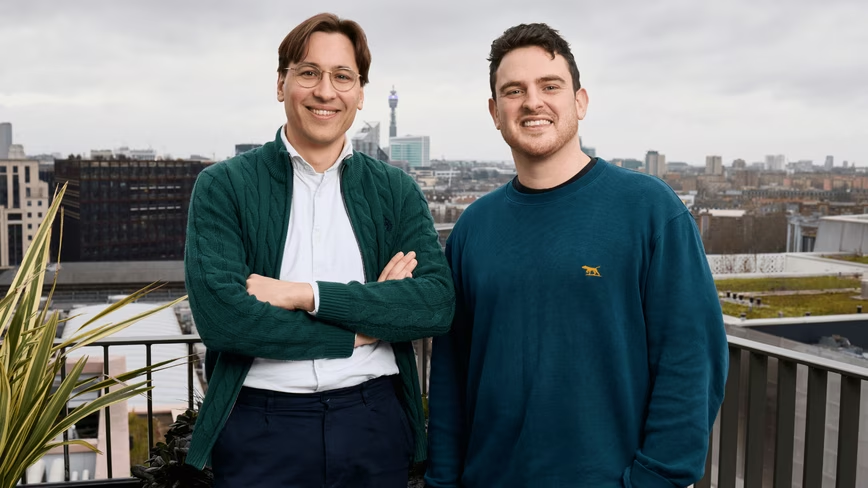
Callosum co-founders Jascha Achterberg (left) and Danyal Akarca

Callosum has raised $100m, six months after leaving stealth with a tenth of that, and the round includes money from the British state. Bloomberg reported the raise, describing the UK’s public AI fund as a backer.
The Cambridge company came out of stealth in February with $10.25m led by Plural, the fund founded by former Wise executive Taavet Hinrikus, alongside the government research agency ARIA and angels including Charlie Songhurst, Stan Boland, and John Lazar. Talks about a much larger round were reported in May, at up to $100m, or roughly £75m.
What Callosum sells is orchestration rather than silicon. Its software distributes an AI workload across mixed hardware, Nvidia, AMD, Google, and whatever else is in the rack, routing each part of a task to the chip and model that handle it best instead of assuming a homogeneous grid of GPUs.
The company claims that on complex agentic work, such as autonomous computer use, this delivers twice the accuracy, seven times the speed, and a quarter of the cost of a conventional GPU setup.
The founders are Danyal Akarca and Jascha Achterberg, who met while doing PhDs at Cambridge and have published in Nature journals, with stints at Intel and Google DeepMind between them. Their pitch is a direct bet against the prevailing architecture: “Big labs are currently betting that one model will rule them all,” one of them said at launch. “We think that’s wrong.”
The state’s involvement is the part worth reading twice. In April, Callosum became the first equity investment made by the UK’s Sovereign AI Unit, a £500m vehicle chaired by James Wise and launched with backing from technology secretary Liz Kendall and chancellor Rachel Reeves.
Neither the cheque size nor the equity stake was disclosed at the time, and it has not been disclosed since, a gap that has already drawn parliamentary attention. Six other companies in the same announcement, among them Cosine, Prima Mente, Cursive, Doubleword, Twig Bio, and Odyssey, received up to a million GPU hours each on national supercomputing capacity rather than cash.
“The UK enjoyed a depth of talent across universities and labs like DeepMind,” Akarca said of the decision to build in Britain, calling it the natural place for the company. Ministers have been unusually keen to say the same thing in public: Kendall’s line at the launch was that the government is “betting on Britain”.
Callosum is arriving at a moment when the economics of inference have become the industry’s central problem rather than a footnote. Model training costs are concentrated in a handful of companies, but the bill for running models sits with everyone, which is why Nvidia’s software moat has come under pressure from an unusual direction this year.
It is also not the only British company selling a cheaper way to run AI. Velaura raised $110m for low-power inference chips, and UK AI startups collectively are now valued at $256bn, according to a recent industry count.
The company’s framing borrows from neuroscience, which is not a marketing flourish in this case. The corpus callosum is the bundle of fibres connecting the brain’s two hemispheres, and the founders’ argument is that intelligence emerges from separate systems coordinating rather than from one very large one scaling further.
Whether that holds as an engineering thesis is still an open question in the field. It is, however, a considerably easier thesis to fund in Britain than a plan to build a frontier model, given the capital gap between UK investors and the American labs.
Several things about the round remain unpublished. Bloomberg’s report did not disclose a valuation; the full investor list has not been confirmed by the company, and it is not clear how much of the $100m came from the Sovereign AI Unit as against private funds.
Companies House filings should settle the ownership question in the next quarter, which is a slower answer than a press release but a more reliable one. Callosum had not published a statement of its own at the time of writing.
Get the TNW newsletter
Get the most important tech news in your inbox each week.


