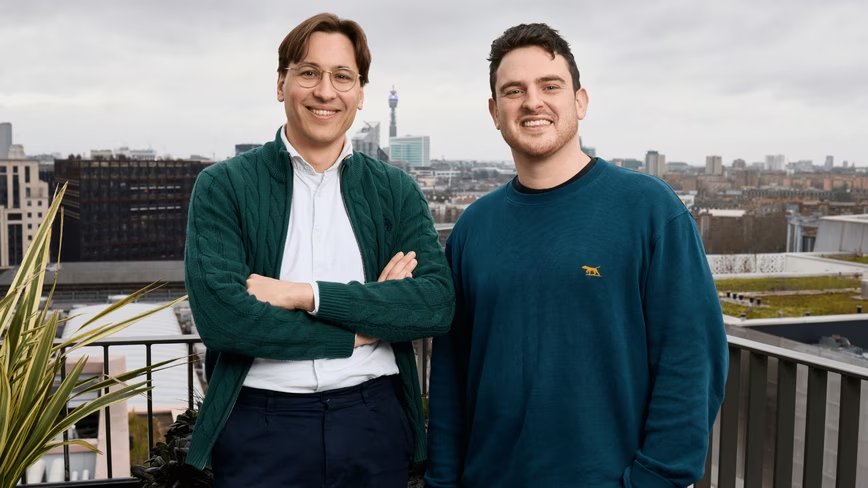
Callosum co-founders Jascha Achterberg (left) and Danyal Akarca

London-based AI software startup Callosum has closed a $10.25 million funding round led by European early-stage venture fund Plural, marking a notable bet on multi-chip AI infrastructure at a time when venture capital remains heavily concentrated in a narrow set of compute platform plays.
The round includes participation from angel backers such as Charlie Songhurst, serial investor and former Microsoft strategy lead, Stan Boland of autonomous-vehicle tech firm FiveAI, and John Lazar, former engineer and fellow of the UK’s Royal Academy of Engineering.
Callosum’s software sits at the intersection of AI orchestration and heterogeneous hardware scheduling.
Rather than relying on large homogeneous GPU clusters, Nvidia’s architecture dominates this space, the company’s tooling seeks to balance and coordinate AI workloads across diverse processors, including alternative accelerators and cloud-native chips.
This could allow enterprises to reduce costs and avoid vendor lock-in as models scale.
The funding will primarily support research and development, expansion into the U.S. market, and exploration of bespoke hardware integrations that align with the company’s multi-chip strategy.
Although modest compared with outsized rounds in generative AI and hardware startups, the capital reflects growing investor interest in infrastructure that underpins more efficient and flexible compute.
Callosum has also been linked with the UK’s Advanced Research and Invention Agency (ARIA) initiatives.
ARIA’s Scaling Inference Lab, a government-backed testbed for emerging compute technologies, lists several early UK projects including the startup, highlighting broader state support for alternative AI stack innovation.
The core challenge ahead for Callosum will be proving tangible performance gains in real-world enterprise deployments. Nvidia’s grip on the AI compute market remains formidable, and heterogenous workloads have historically faced adoption friction due to ecosystem lock-in and developer inertia.
Yet the funding round underscores a discrete shift in how investors and governments think about diversifying the base of AI infrastructure beyond monolithic GPU deployments.
Get the TNW newsletter
Get the most important tech news in your inbox each week.
Also tagged with


