TL;DR
BYD predicts China will reach 80% EV penetration as gas car sales plunge 39%, but faces the Pentagon’s 1260H list and Hungary labour scrutiny.
Executive vice president Stella Li says domestic demand is double what BYD can deliver, but the company's May sales were essentially flat year on year and a New York watchdog's labour abuse allegations at its Hungary factory remain unresolved
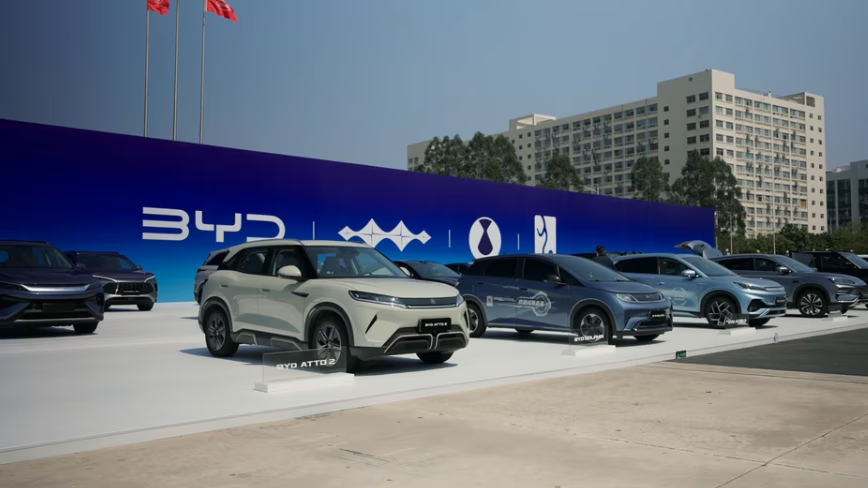
BYD
 Credit: iMoD Official
BYD predicts China will reach 80% EV penetration as gas car sales plunge 39%, but faces the Pentagon’s 1260H list and Hungary labour scrutiny.
BYD’s executive vice president Stella Li told CNBC on Monday that China’s EV market will push to close to 80% penetration, a bullish forecast that contrasts sharply with rival Nio, whose chief executive William Li said last month that the industry’s “golden era” was over. The prediction arrives on the same day the Pentagon added BYD to its 1260H list of Chinese military-affiliated companies, a designation that prohibits the Department of Defense from contracting directly with listed entities starting 30 June and from procuring their products through third parties a year later.
The penetration rate for hybrid and battery-only vehicles in China has already reached record levels. New energy vehicles accounted for 62.9% of new passenger car sales in May, according to the Chinese Passenger Car Association, up from roughly half in 2024. Sales of petrol-powered cars plunged 39% year on year in the same month, with the CPCA citing higher oil prices driven by ongoing hostilities in the Middle East as a key factor in the collapse.
The US electric car penetration rate remains at roughly 10%, according to the International Energy Agency’s Global EV Outlook published in May, while the global figure sits at approximately 25%. The gap between China and the rest of the world is widening. US tariffs of 100% on Chinese-made electric cars have restricted local sales, and the IEA noted that with the end of EV tax credits, there is expected to be “virtually no government financial support for the purchase of electric cars” in the United States in 2026.
Li said domestic demand for BYD’s EVs now stands at roughly double what the company can currently deliver, a claim that sits uneasily alongside the data. BYD sold 376,990 vehicles in China in May, a figure that was essentially flat year on year, arresting an eight-month streak of declining domestic sales but hardly suggesting a supply-constrained market. BYD’s first-quarter net profit fell 55% to 4.09 billion yuan as a fierce price war compressed margins, and revenue dropped 12% to 150.2 billion yuan.
Li attributed the demand surge to BYD’s second-generation Blade Battery and flash charging technology, unveiled in March, which is capable of charging from 10% to 70% in five minutes. BYD plans to install roughly 20,000 flash charging stations across China by the end of 2026. The technology represents a genuine engineering achievement, but whether it is driving demand at the levels Li describes has not been independently confirmed.
Li said the next phase of competition in China’s EV market will centre on driver-assist features. BYD expanded insurance coverage on 28 May for users of its L2+ driver-assist system, covering both intelligent parking and urban Navigate on Autopilot functions, a move Li said could boost customer utilisation by five percentage points to at least 95%. The company also revealed the Xuanji A3, China’s first automotive-grade 4nm driving chip delivering 700 TOPS of computing power, at the same event.
For now, Li said BYD would largely use Nvidia’s driver-assist chipsets even as the automaker employs roughly 7,000 engineers for semiconductor development. That workforce is a fraction of the more than 869,600 people BYD employed at the end of 2025, according to its annual report, a headcount that itself represents a reduction of nearly 100,000 from the prior year as automation displaced production line workers.
Leon Cheng, head of the mobility practice at Asia-focused consultancy YCP, offered a more cautious reading. “The question is not only whether BYD can maintain its leadership in China,” he told CNBC, “but whether it can defend its position globally as more Chinese EV players compete aggressively in export markets.” BYD has struggled to grow domestically, turning instead to overseas markets where exports rose more than 80% year on year to a record 160,644 units in May.
The export strategy brings its own complications. Li said BYD aims to locally produce 75% of cars sold in Europe, but the company’s Hungary factory construction has been dogged by allegations from New York-based watchdog China Labor Watch of forced labour conditions, including seven-day working weeks, 14-hour shifts, and withheld wages. Li denied the allegations. The European Commission said the case falls under the jurisdiction of Hungarian labour authorities, who have not published findings.
The Pentagon’s 1260H designation does not impose sanctions directly, but it complicates BYD’s already limited US presence at a moment when the company is trying to project confidence about its technological superiority. BYD faces 100% tariffs on its vehicles in the United States, and its American units filed a legal challenge in the US Court of International Trade in January arguing the duties are invalid. The designation adds regulatory scrutiny to a company that is simultaneously predicting market dominance at home and navigating labour scandals, falling profits, and geopolitical headwinds abroad.
Get the most important tech news in your inbox each week.


