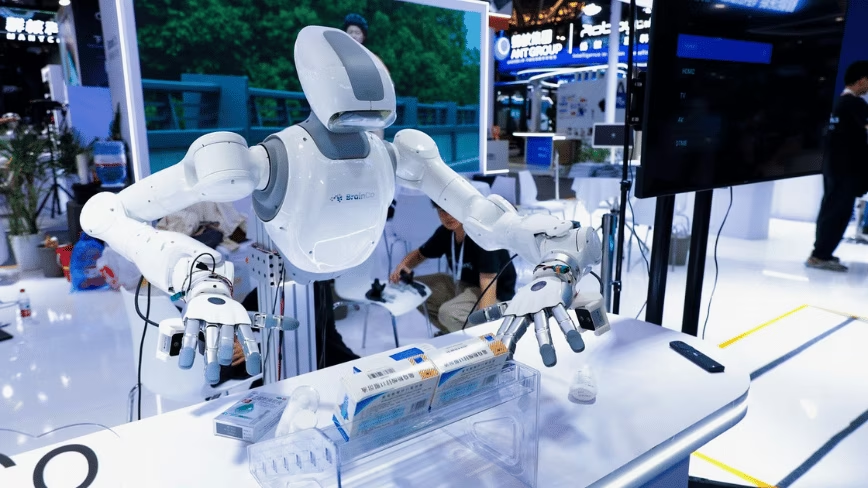
 Credit: BrainCo
Picture a lightweight headset. You think about picking up a cup, and a robot arm reaches out and does it. No button, no voice command, no movement. BrainCo drew crowds with that demo at the World AI Conference (WAIC) in Shanghai, the South China Morning Post reported.
BrainCo calls its Brain-Controlled Robot AI Platform the world’s first integrated brain-to-robot system. That claim is the company’s own.
How it works
The platform runs in three steps, BrainCo said in a statement. An EEG headset reads the wearer’s brain signals. AI decodes them into a control intent, such as “grab that.” The system turns that intent into robot commands. The whole loop takes under 200 milliseconds.
In the demo, a mind-controlled arm grasped a cup and picked up an apple. BrainCo says the platform works with off-the-shelf robots, from humanoids to robotic arms to four-legged “dogs.” That lets it slot into robotics labs without special hardware.
The data problem
BrainCo also showed a tool aimed at one of embodied AI’s biggest bottlenecks: a shortage of good training data. Teaching a robot to fold laundry or handle fragile objects takes huge amounts of it.
Its Embodied AI Data Collection Solution uses a wheeled, dual-arm rig and a precision glove to capture human demonstrations. It also records the operator’s EEG. That logs not just what the hands do, but what the brain tells them. The aim is a steadier supply of real-world training data.
A decade of brain-reading
Founded in 2015, BrainCo built its name on BCI for medical rehabilitation. Its prosthetic hands and legs read nerve and muscle signals. This is its push into robotics.
“A decade of BCI research has given us the ability to decode what a person intends to do and translate that into machine action,” said Nyx He, a partner and senior vice president. The launch lands as firms race to build brain-computer interfaces and embodied AI, and China pushes hard on both.
Get the TNW newsletter
Get the most important tech news in your inbox each week.


