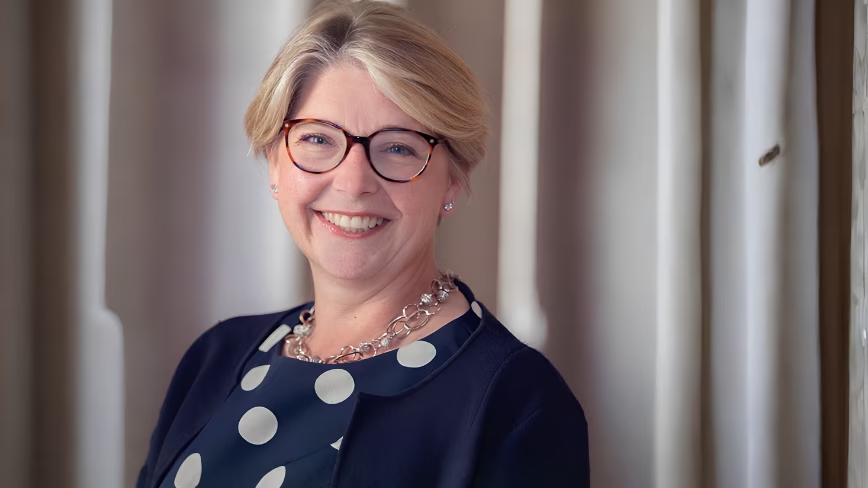
Deputy governor Sarah Breeden says autonomous trading agents could amplify volatility if they all react the same way at once, and may demand new rules.
The nightmare a central banker describes is rarely a crash. It is a feedback loop. Speaking at the European Central Bank’s annual forum in Sintra, Portugal, the Bank of England’s deputy governor Sarah Breeden warned that autonomous artificial intelligence agents could cause a “market meltdown.”
Not by acting irrationally, but by acting identically, all of them responding the same way to the same signal at the same moment.
Breeden’s concern is specific to a new generation of AI. The worry is not the algorithmic trading that has driven markets for years, but agentic systems that can pursue goals and make decisions with far less human supervision.
If many firms deploy agents trained in similar ways on similar data, she argued, those agents could “amplify volatility in stress,” reacting to a shock in lockstep and turning a wobble into a rout before any human has time to intervene.
The mechanism is the danger. Markets have always been vulnerable to herd behaviour, but human herds are slow and uneven; people hesitate, disagree, and panic at different speeds.
A population of AI agents optimised toward the same objectives could move as one, selling into the same decline or chasing the same trade with a synchronised speed and scale no crowd of traders could match.
The result would be sharper swings, faster, with the correlation between agents acting as an accelerant.
Breeden, who speaks for the Bank on financial stability, suggested the existing rulebook may not be equal to the problem.
More sophisticated regulatory frameworks may be needed to monitor and contain the risks AI poses to the financial system, she indicated, a notable signal from a senior policymaker that the tools built to oversee human-run markets might not capture what happens when the participants are autonomous software.
The warning is not isolated. The Bank of England has been flagging AI-related risks to financial stability for months, folding them into its broader assessments of what could go wrong in markets, and Breeden’s Sintra remarks sharpen a theme regulators on both sides of the Atlantic have begun to circle.
The question of who is accountable when an autonomous agent acts is becoming a live one for finance, not a hypothetical.
It echoes anxieties being raised well beyond the trading floor. The challenge of governing AI agents that act with minimal oversight has produced a wave of work on how to give them verifiable identities and control, precisely so their actions can be traced and constrained.
Breeden’s warning is the financial-stability version of the same problem: an agent that can act faster than a human can supervise is useful right up until the moment it is dangerous.
There is a tension at the heart of the issue that Breeden’s framing acknowledges. The same agents that could amplify a crisis are being adopted because they make markets more efficient, executing faster and cheaper than people can.
Regulators are not trying to ban them; they are trying to work out how to keep their benefits without inheriting a system that can unravel at machine speed.
That is a harder problem than prohibition, and it is the one the Bank is signalling it intends to take on.
Breeden did not propose specific rules, and her remarks were a warning and a prompt rather than a policy.
What they establish is that the prospect of correlated AI agents destabilising markets has moved from the seminar room to the speeches of the people who would have to manage the fallout. The Bank has put the question on the table.
The answer, including whether the current framework can be stretched to fit or needs rebuilding, is the work that now follows.
Get the TNW newsletter
Get the most important tech news in your inbox each week.


