A team of BioNTech alumni thinks cancer screening has been stuck in the past, and it has raised $25M to do something about it.
Bios Life has emerged from stealth with a plan to replace one-off screening with continuous, AI-driven surveillance, and a data alliance with Tempus to power it.
The seed round is well syndicated for a launch. It was led by Redmile, Vsquared Ventures and Kindred Capital, alongside a group of healthcare and technology investors from across the United States and Europe, giving the Boston company real backing from day one.
The audience it is chasing is large and, it argues, badly served. The company points to more than 40 million Americans who are either cancer survivors or at heightened risk, two groups it says are left with fragmented, reactive care that only kicks in once something has gone wrong.
The stakes it cites are sobering. Bios Life notes that more than 40% of people will be diagnosed with cancer in their lifetime, and that a large share of those diagnoses come late, at stage three or four, when treatment is harder and outcomes worse.
Its answer is a shift from episodes to a continuum. Rather than a scan every year or two, the company wants to maintain what it calls a digital twin for each patient, a continuously updated model of their biology that turns disjointed screening into lifetime monitoring.
Delivery is meant to be virtual-first. Bios Life plans to run the service through an online care platform staffed by licensed clinicians across the US and in partnership with cancer centres, with a launch slated for the second half of 2026 and a waitlist already open.
The technology rests on some serious genomics. The company holds commercial rights to the Nucleotide Transformer, a genomics foundation model from BioNTech-InstaDeep that it says is among the most cited and downloaded in the field, able to read genetic signals down to a single nucleotide.
The Tempus alliance is what gives the models something to learn from. Under the multi-year deal, Bios Life can use Tempus’ de-identified, multi-modal oncology datasets to train and validate its predictive systems, the fuel any medical AI needs to be credible.
Genetics rounds out the picture. Through Tempus-owned Ambry Genetics, a specialist in hereditary cancer testing, Bios Life plans to fold genetic screening into its platform, blending inherited risk with the lifestyle and clinical data it tracks over time.
Its clinical backers frame the moment as overdue. Duke’s Kevin Oeffinger argued that screening has been at a “relative standstill” for decades and that an AI-enhanced virtual model could be a “game changer” for high-risk groups, a strong claim from an academic advisor.
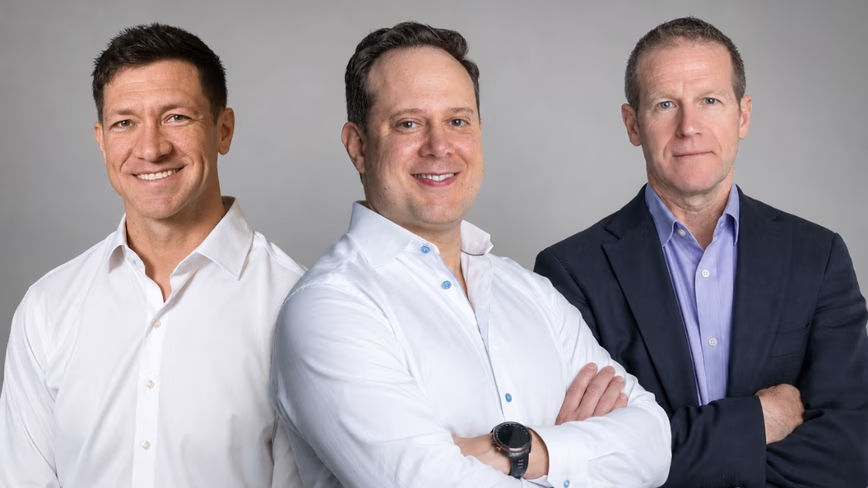
The founders’ pedigree is the pitch’s backbone. Chief executive Ryan Richardson was BioNTech’s chief strategy officer and chaired its AI arm InstaDeep, and he is joined by fellow BioNTech and InstaDeep veterans, the crowd that rode the mRNA and genomics-AI wave.
The technology already spots breast cancer from a scan and, in some studies, has come closer than a biopsy at assessing rare tumours, so the underlying momentum is real.
Founder-led health-AI bets are having a moment, too, with heavyweight operators leaving big jobs to build data-driven medicine of their own, and Bios Life fits that pattern of pedigree meeting patient data.
The caveats, in health especially, deserve top billing. The platform has not launched, AI risk prediction has to be clinically validated before anyone should trust it, and continuous surveillance carries its own hazards, from false alarms and over-screening to the anxiety and cost of chasing findings that may never have mattered.
That is the tension the whole field is living with, where the hype around AI health tech has run ahead of the results.
Bios Life has the team, the data partner and the money; what it has to earn now is proof that lifelong surveillance genuinely helps patients rather than simply watching them more closely.
Get the TNW newsletter
Get the most important tech news in your inbox each week.


