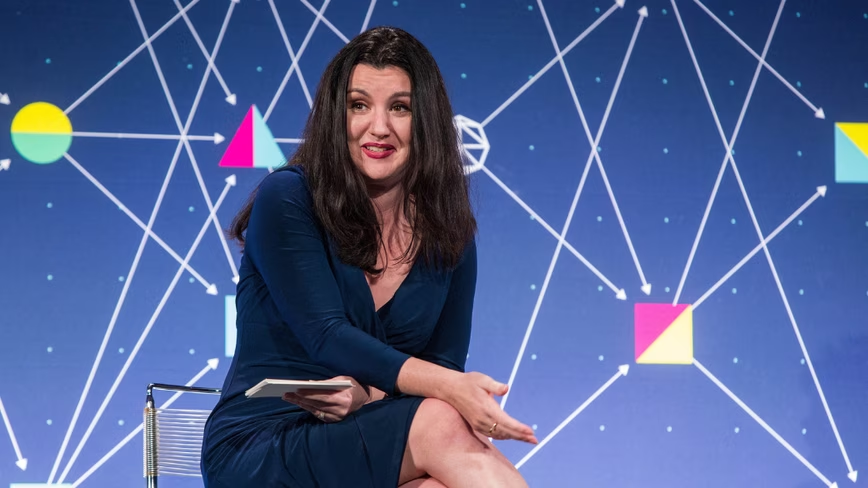

ChronicleBio opens a sign-up link on 11 August for mobile blood draws at patients’ homes. The first 250 people pay nothing. After that the test costs $400, charged at cost. “The whole point for us is not to make money,” co-founder Fidji Simo told Fortune, which first reported the plan. “It’s to collect data so we can find cures.”
Participants get a research-grade report back, plus repeat tests over time. The trucks also reach people who cannot get to a clinic at all. Many patients with severe chronic illness are bedridden, which is precisely why they rarely show up in medical datasets.
The company launched in August 2025 with Simo, chief executive Rohit Gupta and executive chairman Rishi Reddy. It has raised $15 million and moved its lab to Menlo Park, California a few weeks ago. Gupta previously ran biobanking centres at Stanford and UCSF. ChronicleBio targets POTS, ME/CFS and long COVID, conditions that affect around 300 million people worldwide on its own count.
The missing internet of biology
Simo’s framing is blunt. “If you look at LLMs, they work so well because the internet existed,” she said. “We are missing the internet of biology.” Electronic health records, she argues, are noisy and describe paperwork rather than biology.
So ChronicleBio is building the corpus itself. In its first year it took 890 blood draws from 709 patients across Utah, Arizona, Texas and India. Its biobank now holds more than 3,500 tubes. From those it has pulled 153 terabytes of data, roughly three times the 45 terabytes GPT-3.5 trained on.
The models come off the shelf. Simo says the company runs a combination of OpenAI and Anthropic systems. National projects such as the NIH biobank have chased similar scale on genomics. “Analyzing 150 terabytes of data would have been either impossible or would have taken years, and now it takes us minutes,” she said.
Five diseases hiding inside one
The scientific bet is about subgroups. Drug trials fail, the argument runs, because pharma cannot tell which patients a compound will help. So it doses everyone carrying the same label. ChronicleBio says it has already found five sub-diseases inside POTS. Some look immune-driven, others mitochondria-driven, yet the symptoms are identical. None of them have names yet.
The company plans to start testing existing drugs on its own patient population before the end of 2026, then work with biotech partners on new ones. AI is already being aimed at the trial bottleneck from the recruitment side. Simo points to C&EN reporting on faltering long COVID trials as the problem she wants to fix.
None of it is proven yet. The five sub-diseases are a company claim, not a peer-reviewed finding, and no results have been published. Drug testing has not started. $15 million is small change next to pharma R&D budgets.
The $400 test also lands in a crowded consumer blood-testing market, where Neko Health and others already compete. Simo’s answer is that hers is a research-grade test for complex chronic conditions. Participants, meanwhile, hand over biological data in exchange for a report.
Why the money was never there
Simo has POTS herself. She spent a decade running the Facebook app at Meta, took Instacart public, then joined OpenAI in 2025 as chief executive of applications. Greg Brockman absorbed most of her remit when she stepped down in early July, and his wife has POTS too. Simo now describes herself as “physically the worst I’ve ever been.”
Her funding argument is sharper than her product one. Chronic fatigue syndrome scores worse than cancer on disability measures, she notes, yet the research money behind it is “absolutely pathetic”. She gives two reasons. It mostly affects women. And it disables people without killing them. Onset usually comes between the ages of 20 and 40.
She is not the only OpenAI alumnus to walk out toward biology. Researcher Miles Wang left to work on drug discovery as well, and the reasoning tends to rhyme. “I think if AI accomplishes everything but doesn’t cure disease, that would be a very sad state of affairs,” Simo said. Collecting the blood is the easy part.
Get the TNW newsletter
Get the most important tech news in your inbox each week.


