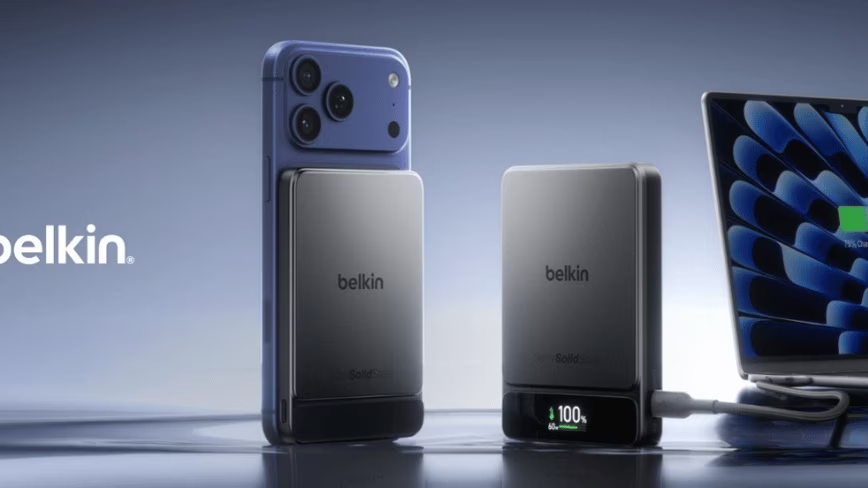
Belkin’s first two UltraCharge Pro power banks with BoostSolid Cell, announced at IFA 2026 in Berlin.

The car industry keeps calling this battery chemistry a decade away. Belkin has just put it in a $69.99 power bank.
The company announced three product lines at IFA 2026 in Berlin on Thursday. They arrived as three separate releases, covering portable power, trackers and chargers, and audio. The headline part is the UltraCharge Pro range, built on what Belkin calls BoostSolid Cell.
Read the description carefully, though. BoostSolid is semi-solid-state, not solid-state. Belkin says the cell adds a gel-like layer alongside the liquid electrolyte. That is a different thing from removing the liquid altogether. The gel buys a slimmer package and, Belkin argues, a safer one.
What the chemistry is actually for
The safety pitch is the more interesting half. Belkin says the architecture cuts the risk of thermal runaway, fire and swelling. It holds stable charging from 0 to 40C. Dual analogue and digital temperature sensors sample the cell every 250 milliseconds, then cut power if it strays outside limits.
The company also says the design meets the UL2056:2025 safety standard and TSA carry-on guidance. That is not marketing garnish. Airlines spent the past two years tightening rules on lithium cells in cabin baggage. A power bank that cannot fly is a power bank nobody buys.
Belkin claims the cells last up to three times longer than rival power banks. Its own footnote defines that as retaining up to 80% capacity after 1,000 charge cycles. The five-year figure then assumes you fully charge and discharge the thing once every two days. Read against that assumption, the claim is a cycle-life number rather than a promise about calendar years.
Two power banks, two price points
The UltraCharge Pro Slim Magnetic is the striking one. Belkin puts it at 8.8mm thick and no bigger than a credit card, holding 5,000mAh. It offers Qi2-certified 15W magnetic wireless charging and a 22.5W USB-C port. It costs $69.99 and lands in September in black and sand.
The 10,000mAh model with a display goes to $89.99. It pushes up to 60W over USB-C Power Delivery. Belkin says that takes an iPhone 17 Pro to 50% in about 24 minutes, and refills the pack itself in roughly two hours. A screen reports battery percentage, wattage, charging direction and thermal status.
Belkin is not first here. The Verge notes that BMX, Kuxiu and Zens all shipped semi-solid-state packs before it. What Belkin brings is distribution. The price also sits inside what people already pay for a good power bank.
The contrast with the car industry is hard to miss. LG Energy Solution told us in August that solid-state cars are a decade away. The problems live in large-format cells, not small ones. Accessories are where new chemistry gets its first public outing, and the same is true further up the stack.
Belkin stops selling AirTag holders and starts selling tags
The second release covers SureFind, Belkin’s first own-brand trackers. The company has spent years selling cases and loops for other people’s tags, and has now built its own.
Every SureFind product carries certification for both Apple Find My and Google Find Hub. That dual certification is the point. A household running a mix of iPhones and Androids has until now had to pick a tracking network and stay in it. A tag that works on both sides settles the argument about whose phone finds the luggage.
SureFind Spot starts at $14.99. The Card, at $26.99, carries an IP68 rating and slips into a wallet or passport holder. The Loop Cable Tag, at $24.99, hides a USB-C to USB-C charging cable inside the carry loop. It ships only in the Americas, Australia and New Zealand, and Asia-Pacific. A Wallet Stand with RFID blocking follows in October at $39.99.
The same release adds two conventional lithium-ion power banks with retractable cables, an 11,000mAh at $59.99 and a 22,000mAh at $99.99. It also brings a magnetic ring stand, plus four new colours of the 30W compact charger matched to Apple’s MacBook Neo finishes.
Cheap noise cancellation, and a pair for children
The audio release brings three SoundForm products. Isolate is the flagship at $59.99. It carries hybrid active noise cancellation Belkin rates at up to 45dB, 32 hours of total battery, Bluetooth Multipoint, and three sizes each of ear tips and wing tips.
Dot drops to $39.99 with ANC or $34.99 without. Play is the odd one out. It is a pair of over-ear headphones for children aged five and up at $49.99, with ANC and an optional 85dB volume limiter. Built-in soundscapes called Seashore, Brain Beats and Pink Noise are meant to help with homework. Belkin rates it at 62 hours with ANC off.
Mashable already lists Play at $39.99 on Amazon. That is ten dollars under the price in Belkin’s own release, so the recommended prices will not survive contact with retail for long. Amazon has been moving the other way on its own hardware, raising device prices by 60% as memory costs bite.
Accessories as a proving ground
None of this is a landmark on its own. A power bank is a power bank, and Belkin has been making them since the 1980s.
What the launch marks is where new battery chemistry actually reaches consumers first. The cells are small. The failure modes are survivable. The regulatory bar is a safety standard rather than a type approval. Berlin this week has been full of the same pattern, from a smart ring with payments to earbuds that record you. The cars come later.
Get the TNW newsletter
Get the most important tech news in your inbox each week.


