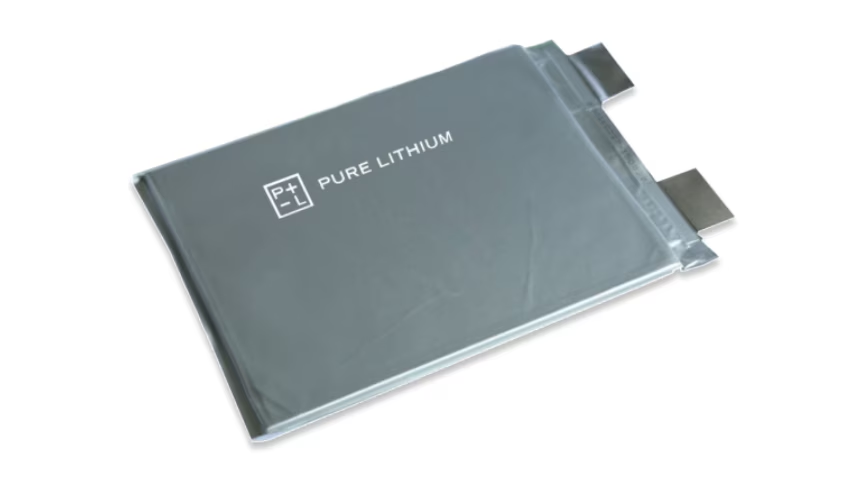
Pure Lithium battery
 Credit: Pure Lithium
Pure Lithium says a laboratory cell with no graphite anode completed 9,315 charge and discharge cycles with almost no capacity loss, a result no third party has validated. The EU wants to process 40% of its own strategic raw materials by 2030 and cap any single country at 65%, while China processes more than 90% of the world’s graphite.
A Chicago startup says its battery ran 9,315 charge and discharge cycles with almost no capacity loss. Pure Lithium announced the result on 27 August. There is no graphite in the cell.
The caveats are large and belong first. It is a laboratory cell, no third party has validated the figure, and the energy density of the tested cell has not been disclosed, InsideEVs reported.
What the company removed is the anode material. Instead of graphite it deposits lithium metal straight onto a copper current collector, forming the anode during manufacturing.
The claim that follows is commercial. “It’s half the weight and double the energy density of the battery that we’re all using today,” chief executive Emilie Bodoin told Bloomberg in June.
Graphite does no electrochemical work. It is a host that holds lithium ions between charges, and it takes up room and adds weight while doing it.
It is also the most concentrated part of the supply chain. More than 90% of the world’s graphite is processed in China, US government data shows.
Europe has known this for years. Both natural and synthetic graphite sit on the EU’s list of strategic raw materials.
The targets attached to that list are specific. By 2030 the bloc wants to process 40% of its own annual needs, and no more than 65% of any strategic material should come from a single third country.
On graphite that is arithmetic nobody has solved. The distance between 90% and 65% is four years away.
Europe’s answer has been to make its own. Talga is developing a graphite mine in Swedish Lapland, Vianode is synthesising it in Norway, and CarbonX in Delft is building a replacement anode material.
Pure Lithium is proposing something else. Not a European graphite supply, but a battery that does not need graphite at all.
That bet is not unique to Chicago. LionVolt in the Netherlands is building lithium metal anodes too, among the frontier chemistries Europe turned to after Northvolt collapsed.
Which is the honest summary. One company has a very good laboratory result and a pilot line it is still building, and a continent has a deadline.
Get the TNW newsletter
Get the most important tech news in your inbox each week.


