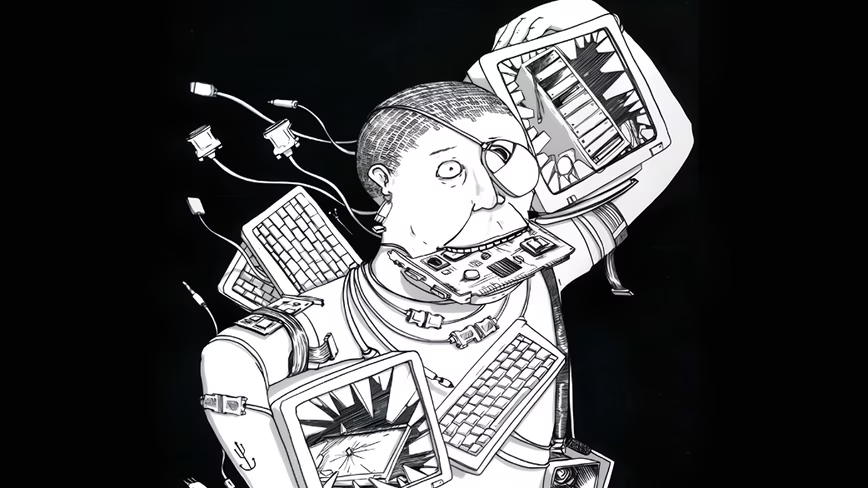
Ink illustration associated with the Autistici/Inventati project
 Credit: Autistici/Inventati
Autistici/Inventati, an Italian nonprofit that has hosted email, websites, mailing lists, and blogs for activists since 2001, is closing down.
The collective said it will discontinue all services and help users retrieve their data, eleven days after the United States listed it as a Specially Designated Global Terrorist.
The designation was announced by the State Department on 26 August. The Treasury’s Office of Foreign Assets Control added the organisation to the Specially Designated Nationals list the same day, under section 1(b) of Executive Order 13224 as amended by Executive Order 13886, giving an address in San Giuliano Terme in the province of Pisa.
OFAC issued Counter Terrorism General License 36 alongside it, authorising the wind-down of transactions involving the collective, a window reported to close on 25 September.
Washington’s stated grounds are that the collective supplied digital infrastructure, tools and services to violent antifa cells and other groups the US treats as extremist.
Accounts of the release name Rose City Antifa and the Informal Anarchist Federation among them, and the collective’s own summary of the allegations refers to infrastructure provided to sanctioned organisations including the PKK.
A/I rejects the characterisation, describing its work as digital self-defence tools for activists, individuals and associations, and saying that antifascism and anticapitalism are not terrorism.
An SDGT listing is not the same instrument as a Foreign Terrorist Organization designation, a distinction the collective itself has pointed out.
It freezes any US-held assets and bars US persons from dealing with the listed entity, and the SDN entry carries a secondary sanctions risk notation, which is the part that reaches non-US institutions: foreign banks and companies that keep dealing with a listed entity can find themselves exposed in turn.
In practice, that notation does most of the work.
What followed the listing is the part with implications well beyond this one organisation. First, the PayPal account was suspended on 27 August. The following day, the autistici.org domain stopped resolving after the .org registry, Public Interest Registry, placed it in serverHold, and the collective’s NoBlogs platform was hit by a cyberattack.
On 1 September, Banca Etica suspended the bank account as a precautionary measure. None of that required an Italian court, or any court.
The Italian interior ministry has said it is under no obligation to implement US sanctions domestically, and Banca Etica publicly criticised the designation while nonetheless freezing the account.
That gap, between what European law compels and what European intermediaries do anyway, is what the SDN listing’s secondary sanctions risk notation is designed to produce. A registrar, a payment processor and a bank each concluded independently that the exposure was not worth carrying.
“The possibility that our work may cause legal and financial consequences to those who are close to us leaves us no choice,” the collective said, framing the closure as a decision taken to protect users and volunteers rather than a concession on the substance.
The scale of what disappears with it runs to roughly 16,000 mailboxes, 1,500 websites, 5,500 mailing lists and 10,000 blogs.
A/I ran on donations, refused cryptocurrency, made decisions by consensus, and restricted its services to users who signed up to an explicitly antifascist, antiracist, and antisexist policy.
It was, by any measure, small. It was also one of the few non-commercial hosts in Europe that activists and journalists in hostile jurisdictions had used for two decades.
For everyone else, the mechanism is the story. European debates about cloud dependency as a political risk have mostly concerned hyperscalers and where data physically sits.
This case ran through the layer underneath: a registry, a payment rail and a bank, none of them American, all of them responsive to American designations.
It is a practical demonstration of the argument that regulating only the top layer of the internet misses where the leverage actually sits, and it lands while the EU is still assembling its own tech sovereignty package.
Users have been told to back up what they can, with the collective warning that services may cut out without notice before the wind-down period ends.
Get the TNW newsletter
Get the most important tech news in your inbox each week.


