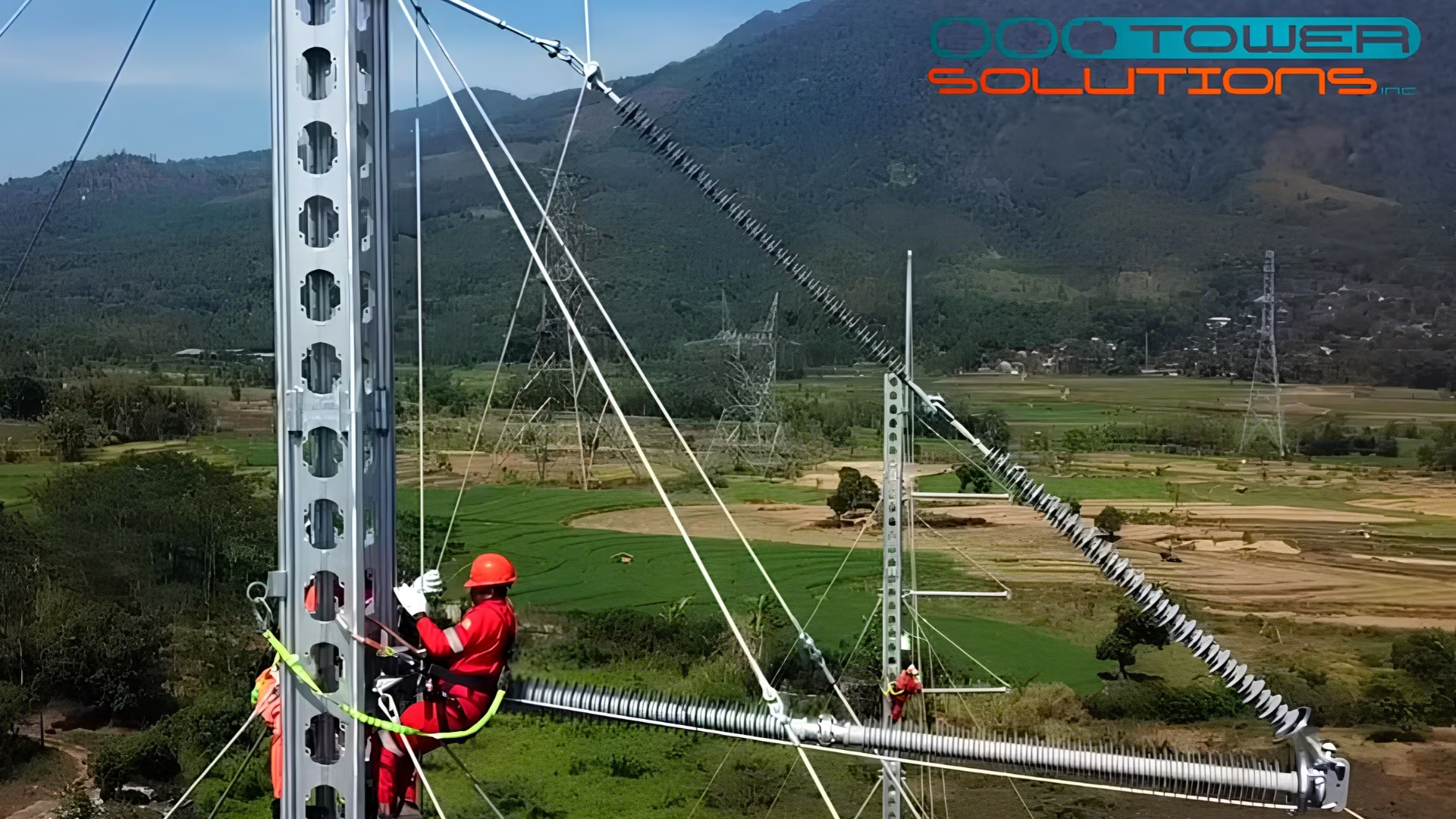
An emergency restoration tower being installed on a transmission line.
 Credit: Tower Solutions
For most people, electricity goes unnoticed until it stops. Across Australia, power networks face growing pressure from extreme weather, rising demand and aging infrastructure.
The Bureau of Meteorology released its Annual Climate Statement 2025 in February 2026. It found that Australia experienced its fourth-warmest year on record. A 2025 CSIRO report also identified extreme heat, high winds and heavy rainfall among the major climate hazards. These threaten critical infrastructure, including energy networks. This raises an important question: how quickly can electricity be restored when infrastructure fails?
The Anakie collapse
The risks became clear on February 13, 2024. That day, a severe storm caused six transmission towers to collapse near Anakie in Victoria. More than one million customers lost power. Over 531,000 were off supply at its peak, according to the Victorian Government’s Network Outage Review.
A July 2025 investigation by Energy Safe Victoria found that the towers had been properly maintained. Extreme winds, reaching 175 km/h, caused structural overload. The incident, alongside current events in November 2026, demonstrates how a single weather event can damage critical infrastructure and trigger widespread power disruptions.
Pressure on the network is also set to grow. Around 10,000 kilometers of new transmission will be needed by 2050 to connect new generation, the Australian Energy Market Operator’s 2024 Integrated System Plan states. As new infrastructure is built to serve a growing economy, much of the existing network continues to age. With limited redundancy and contingency planning, a single failure may leave little backup when a line goes down.
Rebuilding takes months
Traditionally, utilities have often responded to failures after they happen. Rebuilding collapsed towers can take months. After the Anakie collapse, permanent replacement towers were not completed until the end of 2024, the network operator reports.
Diesel generators can provide stopgap power, but they are costly and do not repair the transmission line itself. Meanwhile, every hour a line is down, utilities may lose revenue from electricity they cannot deliver. Homes, businesses, and essential services face disruption.
Restore first, rebuild later
Ciro Pasini is founder and president of Tower Solutions, a North American provider of emergency restoration towers with a presence in Adelaide. He believes Australia would benefit from a different approach. The idea is to restore power first and rebuild properly later. Temporary towers allow electricity to flow again while operators investigate damage and redesign lines for changing weather.
“Australia doesn’t need to start from scratch,” he explains. “This is technology that has already been proven in other parts of the world.”
The company’s system is housed in a 20-foot high-cube shipping container holding two fully equipped emergency restoration towers. It also holds everything needed to erect them, from bolts and tools to insulators. Ciro Pasini states that with properly trained crews, the towers can be erected within hours.
“Restoring the power first buys the utility time to properly re-engineer the line, rather than rushing a permanent fix,” notes Nick Pasini, project engineer at Tower Solutions Australia.
Some towers remain in place for up to five years while permanent reconstruction is completed.
Tower Solutions has worked across Asia, Europe, and South America, according to Ciro Pasini, and is now in discussions with Australian utilities and contractors. Its team sees Australia’s economic growth and expanding transmission network as a natural fit for the technology.
Beyond emergencies, the towers could also support projects such as connecting renewable energy sites to the grid. The challenges driving that interest, from aging networks to more extreme weather, are not unique to Australia and are being felt in many countries.
A shift in mindset
Adopting new approaches may require a shift in mindset. Utilities have traditionally been conservative, Ciro Pasini notes, and new technologies can be slow to gain acceptance. Contingency planning may need to become a standard part of network management rather than an afterthought, with emergency equipment ready before it is needed. Openness to technology already proven elsewhere could help utilities prepare without reinventing existing systems.
“As much as we think of power as a commodity, nothing happens without it,” Nick Pasini remarks.
The public also has a role to play. For Nick Pasini, communities are the ones who feel the impact of extended blackouts most directly, from disrupted businesses to essential services going offline.
Greater awareness of the options available could give them a stronger voice in encouraging governments and utilities to invest in resilience. When households understand that faster restoration is possible, they may also be more likely to ask why it is not already in place.
Preparation is not about preventing every disaster. Extreme weather will continue to test Australia’s networks, and some damage may be unavoidable. What matters is ensuring that communities are not left without power for extended periods when it happens.
For utilities, contractors, and governments alike, that means treating restoration capability as part of the network itself, not an emergency purchase made after the fact. The time to build that resilience is before the next major disruption, not after it.
Get the TNW newsletter
Get the most important tech news in your inbox each week.


