
 Credit: Unsplash
Grand View Research puts the enterprise agentic AI market at $24.5 billion by 2030.
On the other hand, MarketsandMarkets estimates the AI agents’ market size at $52.62 billion over the same horizon.
Both start from a mid-single-digit-billion base and both land on a compound growth rate near 46%. When two credible forecasters agree that closely on the slope and differ by more than a factor of two on the destination, the interesting information is in what each of them is counting.
The Forecasts Agree on the Slope and Not on the Size
A forecast range is a decent proxy for how well a category has been defined, and agentic AI is currently defined differently by everyone measuring it.
Grand View Research tracks enterprise deployment specifically. The firm projects this enterprise deployment’s growth from $2.6 billion in 2024 to $24.5 billion by 2030 at a 46.2% compound rate. MarketsandMarkets draws a wider boundary around agent software generally that runs from $5.26 billion in 2024 to $52.62 billion in four years at 46.3%. Same six years, near-identical growth rate, two different universes.
Convergence on the rate is the stronger signal. Absolute market sizes are hostage to definitions, while growth rates tend to survive them.
Whether shared infrastructure genuinely removes rebuild cost is testable, and the test is uncomfortable for the category. If the claim holds, the share of agent budgets going into integration work should be falling. Most evidence on enterprise deployment points the other way.
Where the Spend Actually Lands
Follow agent budgets and they break into four layers: data, execution, identity and payments. Only one of them has a settled standard.
Gartner produces the largest figures in circulation on the demand side. It projects that machine customers will control roughly $30 trillion of purchases by 2030, with AI agents commanding $15 trillion in business-to-business purchases as soon as 2028. McKinsey’s narrower estimate, covering consumer commerce mediated by agents, lands between $3 trillion and $5 trillion by 2030.
The supply side looks less like new money than money changing hands. Gartner puts $234 billion of enterprise application software spend at risk from agentic AI, which describes displacement rather than creation.
Payments is where finance enters. Stripe and Tempo launched the Machine Payments Protocol in March 2026 with more than 100 integrated services, Mastercard shipped Agent Pay for Machines in June, and Coinbase contributed x402 to the Linux Foundation in April. Four standards, four sets of incumbents, no consolidation.
Market venues took the opposite route. Binance exposed market data and trading to compliant agents through an MCP endpoint on August 20, 2026 rather than building a proprietary connector, a bet that the connection layer is now commodity infrastructure and the competition happens elsewhere.
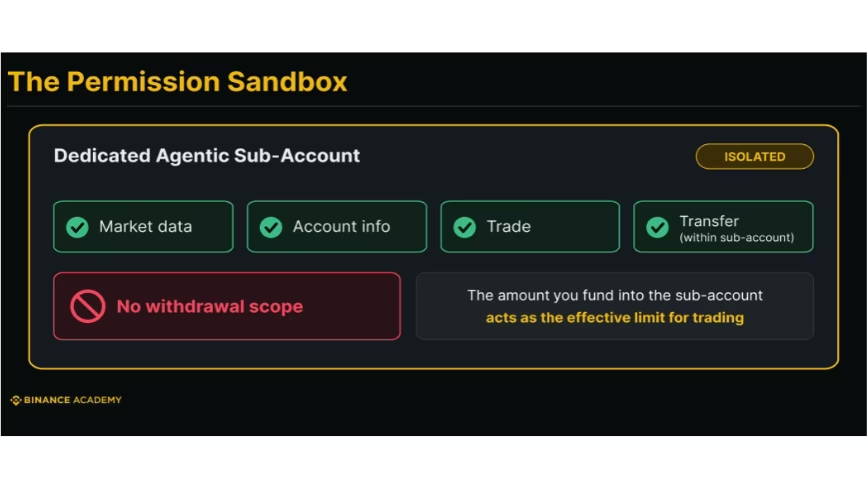
“AI agents are becoming another way people interact with financial markets, but they need the same reliable data, infrastructure and controls that users and developers expect today,” says Jeff Li, VP of Product at Binance. “That makes it easier to create AI-driven financial applications without having to recreate the underlying infrastructure each time.”
Whether shared infrastructure genuinely removes rebuild cost is testable, and the test is uncomfortable for the category. If the claim holds, the share of agent budgets going into integration work should be falling. Most evidence on enterprise deployment points the other way.
The Adoption Curve Measures Intent, Not Deployment
The protocol numbers are the most current data the category has and they are easy to misread.
Anthropic counted more than 10,000 active public MCP servers in December 2025 and roughly 97 million monthly software development kit downloads by March 2026 against about 100,000 in the month of launch. A May census found 15,926 repositories carrying the mcp-server topic on GitHub. In contrast, 9,652 latest-version records sat in the official registry.
Then the correction. Stacklok’s 2026 survey of senior technical leaders found 29% of software organizations running MCP in limited production and 12% in broad production, so roughly 41% in production of any kind, with security ranked as the leading barrier ahead of cost and legacy integration complexity.
That security concern is documented rather than speculative. Only 8.5% of MCP servers implement the OAuth 2.1 standard the specification makes mandatory for remote deployments, and 53% expose credentials through hard-coded configuration values.
Downloads and repository counts measure how many engineers tried something. Production deployments measure how many finished, and the distance between those two numbers is the category’s actual maturity. A widely circulated claim of 78% enterprise production adoption was later withdrawn by the team that published estimates in that range.
The Same Analysts Are Forecasting the Failures
The firms producing the growth curves are also producing the attrition numbers, which is the most useful thing about them.
Gartner predicts that more than 40% of agentic AI projects will be canceled by the end of 2027 on escalating costs, unclear business value or inadequate risk controls. It also estimates that of the thousands of vendors describing themselves as agentic, only around 130 are real, with the rest rebranding assistants, robotic process automation and chatbots.
The payments layer carries a matching caution. Chainalysis recorded more than 100 million cumulative x402 transactions on Base across three quarters as of the first quarter of 2026, while noting that much of that growth came from memecoin farming and that mass adoption remains distant. CoinDesk reported in March 2026, citing Artemis, that daily volume on the protocol was running near $28,000 across roughly 131,000 transactions, an average payment of about $0.20, and that roughly half of observed transactions appeared to be self-dealing or wash trading.
Both readings can be true at once. A standard can be settled, well engineered and adopted by the largest platforms in software, and still be waiting for the demand that justifies the build.
The Number Worth Watching
The forecasts describe a destination and the field data describes a starting line, and the two sit further apart than the headline figures suggest.
What settles the argument is not download growth or registry entries. It is the share of deployments that survive their first budget review, and that number will not be published for another year.
Get the TNW newsletter
Get the most important tech news in your inbox each week.
Contributed article. Not produced by the TNW newsroom and does not reflect the editorial stance of TNW.


