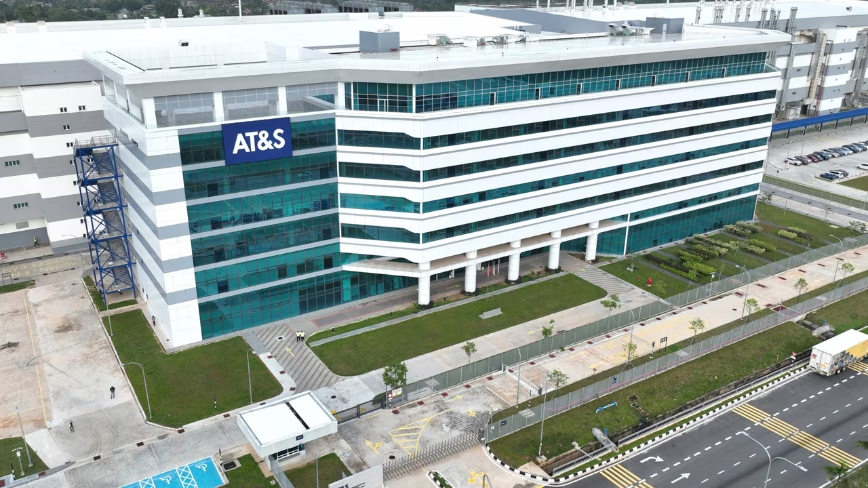
AT&S, the Austrian maker of printed circuit boards and chip substrates, will spend between €1.5bn and €2bn expanding capacity for the high-end IC substrates that AI and high-performance computing chips are built on, the company said. The plan spans its plant at Kulim in Malaysia and its facility at Chongqing in China, and it is anchored by an agreement with AMD and a second, unnamed technology company.
Substrates are the unglamorous layer of the AI supply chain, the engineered base that carries a processor and connects it to the board around it. As chips grow more complex, the substrate becomes harder to make and more valuable, which is why a specialist supplier is willing to commit up to €2bn to producing more of it. The capacity is aimed squarely at the same AI and HPC demand driving everything further up the chain.
In Malaysia, the money will install additional capacity at the existing Kulim plant and bring a previously unused building at the site’s second plant into production.
The Chongqing expansion is being driven by growing demand from what AT&S described as a key customer. The company framed both as a response to orders it can already see rather than a speculative build-out.
That distinction shows up in how the spending is financed. AT&S said the €1.5bn to €2bn is fully supported by long-term customer commitments, though it noted those commitments remain subject to final negotiation and execution. It is the kind of structure that lowers the risk of overbuilding: the capacity is being added against contracts rather than against a forecast.
For Malaysia, the expansion deepens a position the country has been building as a node in the AI hardware chain, downstream of chip design and upstream of the data centres that consume the finished parts. Kulim, in the northern state of Kedah, already hosts AT&S substrate production that began ramping in recent years, and the additional capacity extends a bet the company and the country have been making together.
The two-country footprint is its own signal. Splitting the expansion between Malaysia and China lets AT&S serve customers on both sides of an increasingly divided semiconductor map, where Western chipmakers and their suppliers have grown wary of concentrating advanced capacity in any single jurisdiction.
Kulim gives it a base inside South-East Asia’s growing chip cluster; Chongqing keeps it close to Chinese demand. Building in both is a hedge as much as an expansion.
The AMD anchor matters for the same reason substrates do. AMD’s data-centre and AI accelerators are among the products driving demand for exactly the high-layer-count substrates AT&S makes, and a named commitment from a customer of that size is what turns a capacity plan into a financed one. The second, unnamed partner suggests the demand is not resting on a single buyer.
AT&S did not give a firm split of the spending between the two sites or a completion date for the new capacity. What it has set out is the headline figure, the AMD anchor, and the demand it says justifies both.
Get the TNW newsletter
Get the most important tech news in your inbox each week.


