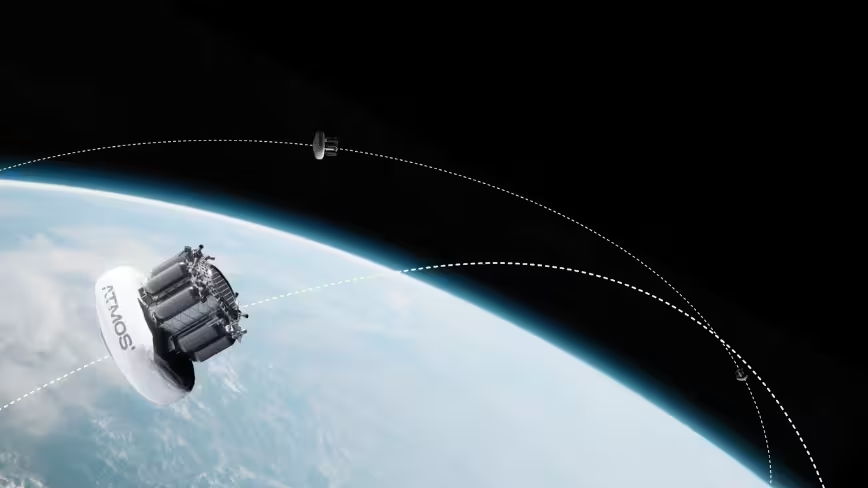
A year after flying and recovering the continent’s first private re-entry capsule, the German-French startup is moving from demonstration to operations. Three PHOENIX 2 vehicles, a new defence entity, and a next-generation 1-tonne capsule are all funded by the round.
ATMOS Space Cargo, the European company developing orbital transport and re-entry vehicles, has closed a €25.7 million Series A round. The raise is co-led by Balnord and Expansion Ventures, with Keen Defence and Security joining as a strategic co-investor.
The European Innovation Council participates through its Accelerator programme via blended financing, a combination of grant and equity. Returning investors include OTB Ventures, High-Tech Gründerfonds, APEX Ventures, Seraphim, Faber, E2MC, Kirch Ventures, Lennertz & Co., Mätch VC, MBG Baden-Württemberg, and Tech Horizons.
The company is based across Lichtenau, Germany and Strasbourg, France, and was founded by CEO Sebastian Klaus.
The round arrives approximately one year after ATMOS flew and recovered its first prototype re-entry capsule, PHOENIX 1, as part of SpaceX’s Bandwagon-3 rideshare mission in April 2025.
That mission, the first private orbital return mission by a European company, validated the Inflatable Atmospheric Decelerator (IAD) technology at the heart of the PHOENIX system: an inflatable structure that functions simultaneously as a heat shield and aerodynamic brake, enabling controlled atmospheric re-entry without ablative materials and with greater payload-to-mass efficiency than traditional capsule designs.
The data from PHOENIX 1 informed the design of PHOENIX 2, which is now ready to fly.
PHOENIX 2 is a free-flying spacecraft with integrated propulsion, power, and thermal management, capable of mission durations from hours to several months in Low Earth Orbit. Its payload capacity is 100 kilograms.
The Series A will fund an initial fleet of three PHOENIX 2 vehicles, operated as a phased mission campaign rather than individual one-off flights, a deliberately structured approach to establishing operational cadence, reducing programme risk, and giving commercial and institutional customers a repeatable service to plan against.
Recovery operations are already being prepared near Santa Maria in the Azores, under a commercial re-entry licence issued by Portugal’s national communications authority (ANACOM-09/2026-AE, granted March 2026), the first such licence issued by an EU member state for the controlled return and recovery of a dedicated commercial spacecraft.
Alongside the operational campaign, ATMOS is launching ATMOS WORKS, a dedicated entity focused on governmental and defence customers. The dual-use architecture of the PHOENIX platform, able to carry and return sensitive hardware and data securely, execute time-critical operations, and support in-orbit demonstration and validation, makes it directly relevant to European defence and intelligence requirements.
The entry of Keen Defence and Security as a co-investor in the round signals institutional confidence in this direction. ATMOS says it will announce further details on ATMOS WORKS separately.
Development of PHOENIX 3 has also begun. The next-generation vehicle is designed for a payload capacity of approximately one metric tonne, roughly ten times that of PHOENIX 2 – with a 15-metre inflatable atmospheric decelerator.
The scale-up is intended to address larger payload classes, aggregated multi-customer missions, and future institutional and security requirements.
CEO Klaus has previously noted that the IAD architecture can theoretically scale to around 25,000 kilograms before the combined mass of the gas and inflation system becomes prohibitive relative to the heat shield.
The strategic context for the round is unmistakable. Europe currently has no sovereign, repeatable ability to return payloads from orbit.
NASA’s Dragon capsule services US customers through a separate supply chain; the only other returning capsule system widely available to European researchers is the Chinese Shenzhou, with all the access and political complications that implies.
ATMOS is the only European private company with a demonstrated re-entry and recovery operation, making its position in the market structurally difficult to replicate quickly.
The EIC’s participation, alongside defence-oriented investors, reflects a view that orbital return is not just a commercial logistics play but a component of European strategic autonomy in space, the ability to reach orbit and come back, independently, from European territory.
ATMOS’s first PHOENIX 2 mission will fly as part of a SpaceX Falcon 9 rideshare, carrying Space Cargo Unlimited’s BentoBox microgravity platform, the first of a seven-mission programme announced in November 2025.
A launch window has not been publicly confirmed.
Get the TNW newsletter
Get the most important tech news in your inbox each week.


