TL;DR
Asus listed the 2026 ROG Zephyrus G16 with an RTX 5080 at $4,799. The 2025 model with a more powerful RTX 5090 sells for $4,599 on Amazon.
The 2026 ROG Zephyrus G16 pairs Intel's Panther Lake CPU with a weaker GPU at a higher price, while the previous generation with a faster chip sits discounted on Amazon
ROG
 Credit: Asus
Asus listed the 2026 ROG Zephyrus G16 with an RTX 5080 at $4,799. The 2025 model with a more powerful RTX 5090 sells for $4,599 on Amazon.
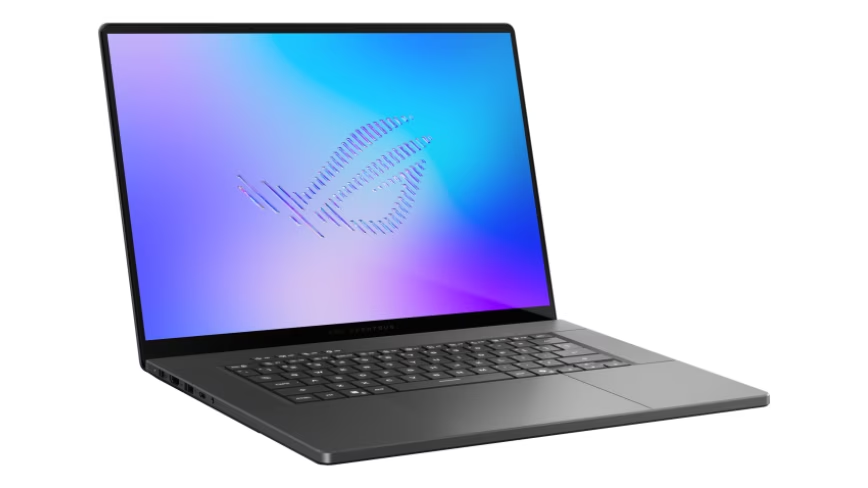
Asus has quietly added an RTX 5080 configuration to the ROG Zephyrus G16 (2026) in the US, and the price is $4,799. That is $200 more than the 2025 ROG Zephyrus G16 with a more powerful RTX 5090 GPU and 64GB of RAM, which is currently available on Amazon and Newegg for $4,599. A newer laptop with a weaker graphics card costs more than its predecessor with a stronger one.
The new model pairs Nvidia’s GeForce RTX 5080 with Intel’s Core Ultra 9 386H, the first Panther Lake processor to ship in a gaming laptop. It comes with 64GB of LPDDR5X RAM, a 1TB PCIe 4.0 NVMe SSD, and a 16-inch 2.5K OLED display running at 240Hz with 1,100 nits peak brightness. Asus lists the GPU’s total graphics power at up to 160W in manual mode, 20W more than the RTX 5070 Ti variant that was previously the only US option.
The RTX 5080 is not a small upgrade over the 5070 Ti. It carries 16GB of GDDR7 VRAM compared to the 5070 Ti’s 12GB, and independent benchmarks show it delivering roughly 15 to 23 per cent better gaming performance depending on resolution. The RAM also doubles from 32GB to 64GB in this configuration.
But the RTX 5080 is not the RTX 5090. Nvidia’s top-end laptop GPU carries 24GB of VRAM and roughly 10 per cent more gaming performance than the 5080, according to benchmarks run on Blackwell-generation hardware. In the 2025 Zephyrus G16, that faster GPU came paired with Intel’s Arrow Lake Core Ultra 9 285H and 64GB of RAM for $4,599 at third-party retailers.
The $4,799 price tag for the 2026 model represents an $1,100 jump over the RTX 5070 Ti configuration of the same laptop, a 29 per cent increase. Some of that premium is justified by the GPU upgrade and doubled memory. But the fact that a buyer can walk onto Amazon today and get last year’s model with a superior GPU at a lower price makes the value proposition difficult to defend.
There is context that partly explains the pricing. The $4,599 figure for the 2025 RTX 5090 model comes from third-party sellers on Amazon and Newegg, not from Asus’s official store. Best Buy listed the 32GB configuration of the same laptop at $4,400 at launch, and it has since been discounted to $3,799.
The comparison is not strictly apples to apples, but the practical result for buyers is the same: the older, faster machine costs less wherever you find it.
Intel’s Panther Lake platform is also new, and new silicon carries a price premium. The Core Ultra 9 386H is built on Intel’s 18A manufacturing process, the company’s first sub-2nm node, and brings 16 cores across three tiers: four performance cores, eight efficiency cores, and four low-power cores. Whether that CPU upgrade justifies a $200 surcharge over a laptop with a better GPU is a question each buyer will answer differently.
The broader hardware market is working against consumers as well. DDR5 memory prices have surged dramatically in 2026 as Samsung, SK Hynix, and Micron redirected production capacity from consumer DRAM to high-bandwidth memory for AI data centres. A 64GB kit of LPDDR5X that cost under $120 a year ago now runs between $300 and $500.
That cost is being passed through to every laptop that ships with high-capacity memory.
Asus has already faced scrutiny over pricing in its RTX 5080 product line. The ROG NUC 16 mini PC launched at $4,400 in China last month with only a 2.3 per cent benchmark improvement over its predecessor, prompting backlash from buyers who expected more from a $1,200 year-over-year price increase. The Zephyrus G16’s pricing follows the same pattern: meaningful component upgrades that do not fully account for the cost jump.
For buyers who prioritise raw GPU performance, the arithmetic is clear. The 2025 ROG Zephyrus G16 with the RTX 5090 delivers more graphics horsepower for less money, even if its CPU is a generation behind. The 2026 model’s appeal rests on the newer Panther Lake processor, the silver colour option, and the assumption that the 2025 stock will eventually sell out.
Asus has not commented on the pricing disparity. The company’s US store now lists three Zephyrus G16 configurations for 2026, ranging from the RTX 5070 Ti at $3,699 to the RTX 5080 at $4,799. The RTX 5090 variant of the 2026 model has not yet been listed in the US, but early pricing from other markets suggests it will exceed $5,000.
Get the most important tech news in your inbox each week.


