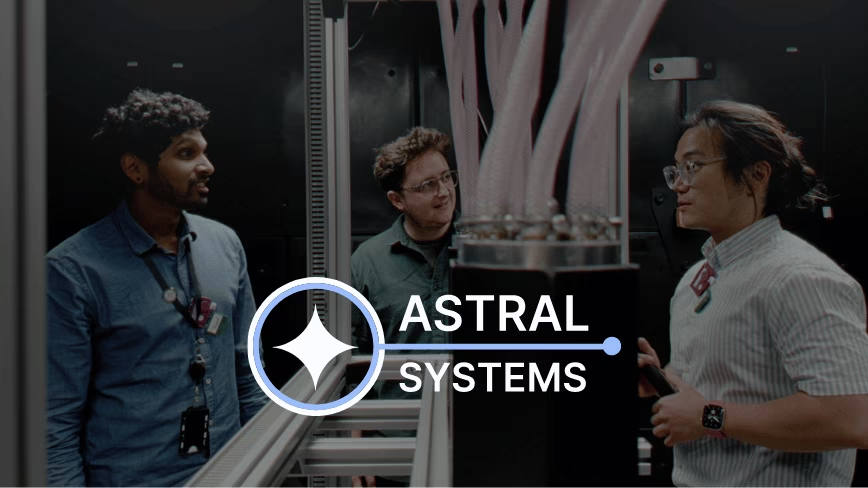
 Credit: Astral Systems
Bristol fusion startup Astral Systems has raised £23mn to scale the medical isotopes that cancer scans depend on. The Astral Systems £23M round backs a rare fusion company that already runs reactors and earns revenue.
Most fusion companies promise clean power in a decade or two. Astral Systems is trying something different, and getting paid for it now.
The Bristol startup has closed the first tranche of a £23mn Series A led by Mercia Ventures. The round takes its total funding past £28mn.
The money will scale production of radioactive isotopes used to diagnose and treat cancer. It is a market with a fragile supply chain and almost no UK source.
Tees River, Daphni and Blast Club joined the round. Returning backers Speedinvest and Playfair also took part, in a strong year for UK venture funding.
A supply chain few people know is broken
More than 50 million cancer scans and treatments each year rely on radioisotopes. Reactors make these by bombarding raw materials with neutrons.
Most of those reactors are decades old. They sit in a handful of countries, and the UK makes almost none of these isotopes itself.
The risk is not theoretical. In 2009 and 2010, reactors in Canada and the Netherlands went offline at the same time, and hospitals across Europe and North America ran short.
What Astral actually built
Astral was founded in 2021 by chief executive Talmon Firestone and chief technology officer Tom Wallace-Smith. Its reactor uses a design it calls multi-state fusion.
The device combines different fusion states in one unit. That produces intense neutron beams, which it then uses to make isotopes.
Unlike most of the sector, Astral is already running. It operates three commercial fusion facilities and has signed research contracts worth more than £3mn.
With McMaster University and a Brazilian nuclear research institute, it is working on two isotopes for targeted cancer therapy, Actinium-225 and Lead-212. It wants at least one on the market by early 2027.
Why a former power station
The new capital funds a site at the old Berkeley Power Station in Gloucestershire. The decommissioned plant comes with grid connections and nuclear-grade infrastructure.
Astral plans to run several next-generation reactors there at full capacity by the end of 2026. It aims to reach profitability in 2027 and to grow from 23 staff to more than 40.
Two senior scientists have joined to support that push. NASA Laureate Theresa Benyo is now chief research officer, alongside chief scientist Mahmoud Bakr.
A crowded race
Astral is not alone in chasing the isotope gap. In the US, SHINE Technologies has raised more than $1bn and runs a large facility producing Lutetium-177.
Niowave, also US-based, uses electron accelerators instead. Both are further ahead commercially, but neither serves the UK market.
Astral argues its technology can make a wider range of isotopes at a modular scale. The wider fusion field, by contrast, is still pouring billions into the distant promise of power.
“We are rewriting how we approach fusion and, in doing so, redefining what it means to be a fusion company,” Firestone said.
Lee Lindley, who led the deal at Mercia, framed the appeal as commercial rather than scientific. He called Astral “a perfect example of the bold ideas that Mercia likes to back.”
The bottom line
The wider prize is large. The global nuclear medicine market was worth $17.77bn in 2024 and could reach $34.51bn by 2030, according to Grand View Research.
The question now is execution. Astral has to scale novel reactors at an old power station while hitting its 2027 profitability target.
If it works, the first commercial chapter of British fusion may begin not in clean power, but in cancer care.
Get the TNW newsletter
Get the most important tech news in your inbox each week.


