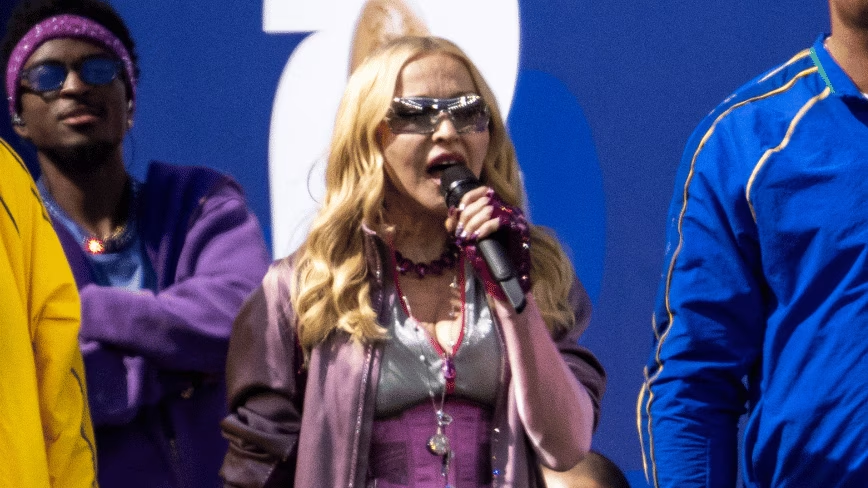
Madonna performs at the FIFA World Cup Final between Spain and Argentina on July 19, 2026, at MetLife Stadium.
 Credit: Daniel Torok / The White House (Public Domain)
Australia will bar wholly AI-generated tracks from its official music charts from Monday. The song that prompted the rule was still sitting at number four on Tuesday.
The Australian Recording Industry Association set the test in a statement. A track qualifies only if “humans wrote the song and performed the lead vocal and the primary instruments”, among other requirements.
Rod McGuirk reported the change for the Associated Press. AI-generated music will also be ineligible for the ARIA awards.
The song that forced it is a Madonna cover
An Australian producer made a variation of “Like a Prayer” using AI-generated vocals and drums. It has spent 16 weeks in the Australian top 20.
The track peaked at number two on ARIA’s top 20 Australian singles chart in May. It was fourth on Tuesday, the day the ban was announced.
Rachit Agarwal named the producer as the DJ Josh Fawaz at Digital Trends, and reported the track has passed 48 million Spotify streams. Fawaz added generative AI credits only after listeners raised it, according to that account. The AP does not name him.
The line is the voice, not the software
Read the test closely and it is narrower than a ban on AI. Producers can still use AI for mastering, drum machines and auto-tune, Digital Trends reported.
What a human has to do is write the song and perform the lead vocal and the main instruments. That is a rule about performance, not about tools.
It also draws a line straight through the track that caused it. The Madonna variation used AI for vocals and drums, and only one of those two would disqualify it.
ARIA is arguing about licensing as well
Eligible music must also be made using legal AI services. Songs have been reaching streaming platforms built with tools apparently trained on artists’ work without permission.
“The ARIA Charts will always remain a transparent measurement of the music Australia consumes, but a chart that rewards unlicensed AI output would undercut the very basis of the recorded music we exist to represent,” chief executive Annabelle Herd said.
That word, unlicensed, is doing work. A German court ruled in July that Suno broke copyright law, the first such finding in Europe.
Herd said the changes reflect an intent to stay dynamic and promote the human nature of artistry in a fast-moving space.
This is an industry body, not a government
ARIA cannot stop anyone releasing an AI track, streaming it or selling it. It controls a chart and an awards ceremony.
The rules follow principles the International Federation of the Phonographic Industry published in July. Those say a track must be “substantially human made” to qualify for official charts anywhere.
So Australia is applying an industry standard rather than writing its own. The federation represents the recording industry worldwide, which means other national charts have the same text available.
The accounts differ on what happens to songs already listed
The AP reports the ban as applying from Monday, with no mention of anything retroactive.
Digital Trends reports that a chart position can be adjusted after the fact if a song is later found to be mostly AI-made, and that ARIA might ask for an award back. It also says artists can challenge an exclusion.
Those two accounts are hard to reconcile while the Madonna variation sits at number four. Whether it stays there past Monday is the first practical test of the rule.
Platforms got here before the charts did
Streaming services have spent the year building labels rather than bans. Apple Music will tag AI songs and has made the underlying credits mandatory.
Spotify badges AI artist profiles and keeps them out of recommendations. TIDAL strips royalties from AI tracks it catches.
A chart is a different instrument. It does not touch what people can hear, only what counts as a hit, and the ARIA awards attach money and attention to that count.
The industry does not agree with itself
Dr Dre said this week that he uses AI in the studio and called it no threat, arguing that people who struggle to create are the ones who feel threatened.
Alexis Weaver, a composer and lecturer at the Sydney Conservatorium of Music, called the ARIA move a wonderful step forward. She told the Australian Broadcasting Corporation that the debate is exceptionally fraught and very emotional for a lot of musicians.
“It can be quite hard to avoid AI tools in the current landscape,” Weaver said. There is a way to use them while still steering the ship and making the main creative choices, she added.
Not everyone in Australian music is treating it solemnly. The duo Peking Duk re-recorded their 2014 hit “High” using AI so that Australian radio would play it, and posted about the situation on Instagram, Digital Trends reported.
Band member Adam Hyde called AI-generated music a way of removing the human experience from life, according to the same report.
Both positions fit inside ARIA’s rule, which is probably the point of writing it that way.
Europe has the same problem and no equivalent rule
AI music reached the charts earlier this month, with the artists using it no longer hiding the fact.
No European chart body has published a comparable eligibility test. The IFPI is based in London and its principles apply worldwide, so the text exists and nobody here has adopted it yet.
The Official Charts Company in the UK, and the national bodies behind the German, French and Dutch charts, are all working from the same federation guidance.
What to watch next
The first thing is Monday, and whether the Madonna variation drops off the chart or stays on it.
The second is who copies the text. Sweden barred an AI-made song from its charts earlier this year, according to Digital Trends citing the BBC, and a national chart adopting the IFPI wording in full would be the first real precedent.
The third is enforcement. ARIA has written a test about who performed a vocal, and it has not said how it will find out.
Get the TNW newsletter
Get the most important tech news in your inbox each week.


