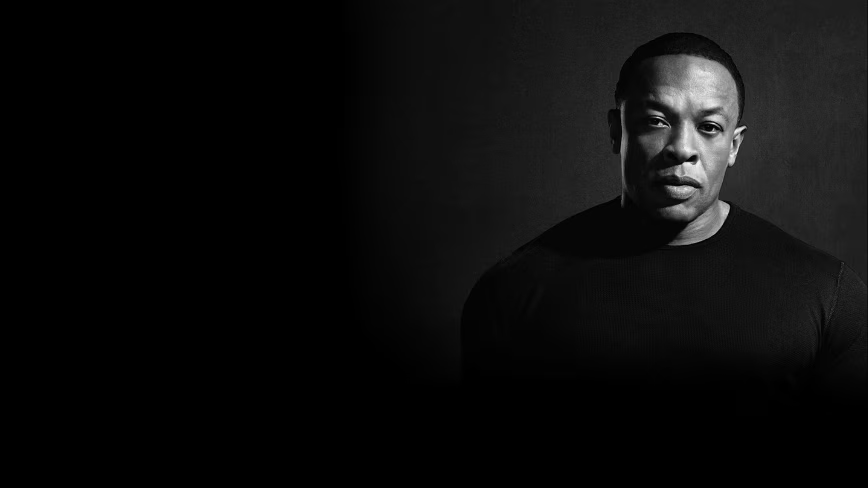
Portrait of Dr. Dre, co-founder of Beats by Dre

Dr Dre says he is using AI in the studio, and that he does not see it as a threat.
The producer said so in an interview with the New York Times, published on Sunday. His longtime business partner Jimmy Iovine sat alongside him and went further.
“I think the only people that see it as a threat are the people who have trouble creating,” he said.
The argument he makes
Dre reached for the same comparison musicians have made about every new machine.
“I had a discussion with a few people a few days ago,” he said. “They were against AI and I’m like, OK, you sound like the person that would have been against the drum machine when it came out. Or synthesizers, right?”
“It’s a new tool for creativity. Some people are afraid of learning new things,” he said, in quotes reported by Variety.
“I’m embracing it. I can’t wait to see what’s going to happen with this.”
How he says he uses it
Dre described using AI as a tool to see what it would do with something he had just made.
He did not go further than that. Tom Bedford noted for TechRadar that this leaves a wide range open, from generating whole tracks down to separating stems or organising files.
Asked what he had most recently put to a chatbot, Dre said it was how to put on muscle and lose fat at the same time. That was it.
Iovine goes further
The former Interscope head backs AI in music without qualification. “I’m very pro-A.I. in music creation. I don’t see the downside at all,” he said.
“There will be some crappy music. There’s crappy music now.”
Talented musicians could make better records with access to the tools, Iovine argued, in comments summarised by Digital Trends. He also said AI companies have terrible communication skills.
Digital Trends drew the distinction the pair are relying on. Mass-producing disposable songs is one thing. An experienced producer treating the software as one part of a longer process is another.
The closet producers
Iovine named one other producer using AI. “So is Timbaland, another brilliant producer,” he said. “By the way, there’s a lot of closet AI producers out there.”
Dre agreed that some artists are using it and do not want to say so.
Timbaland has not been in the closet for a while. He is one of the names TNW covered when AI music reached the charts and the artists using it stopped hiding. David Guetta and Grimes have also said they use it.
Who is saying this
Dre is 61, real name Andre Romell Young, and came out of N.W.A before founding the Aftermath label. He co-founded Beats with Iovine, and is its chief executive under Apple.
Apple bought Beats in 2014 in a deal worth more than $3bn. Dre sold a collection of music income streams and other assets to Shamrock Holdings and Universal Music Group for more than $200m in 2023.
He joined the Forbes billionaires list for the first time this year, with an estimated net worth of $1bn.
Apple is about to start labelling
Apple Music said it will begin labelling songs derived from AI platforms later this year. Dre runs Beats for the same company.
Spotify moved first, tagging the profiles of artists that appear to be AI-generated as AI Personas. It has moved slower than its rivals on everything else, TechRadar noted.
A coalition including the RIAA, IFPI, the Grammys and SAG-AFTRA started pushing last month for an industry-wide labelling programme, modelled on the parental advisory sticker.
The platforms are building walls
Deezer says AI now accounts for more than half the music it receives, and that most of it is fraud. It has since shipped a remix tool that uses none, and a free detector that will scan a listener’s Spotify and Apple Music playlists for slop.
Tidal will strip royalties from fully AI-generated tracks and tag what it catches. Qobuz has said it is working on its own approach.
Bandcamp went furthest, banning music generated wholly or in substantial part by AI.
And the labels are in court
Round Hill Music sued Suno and Anthropic this month, accusing both of scraping hundreds of its songs to train models without permission.
All three majors have sued Suno. It settled with Warner Music Group last year and later struck a licensing deal with BMG, which is itself suing Anthropic over what it calls widespread and systematic infringement.
A hack last month showed how Suno was really built, on millions of scraped songs. It raised at a $5.4bn valuation in June, more than doubling its worth in six months.
None of this touches Dre’s catalogue
The new rules target tracks made wholly by machines, and Dre’s back catalogue predates all of it.
No AI tag is going on California Love, as TechRadar put it. Straight Outta Compton is not getting demonetised.
What the platforms allow is still moving, though. Every one of these policies is months old.
He is not the first legend to weigh in
Mick Jagger said in July that AI is fine for musicians, as long as it does not sound like him.
That is roughly where the industry has landed. Tools yes, impersonation no, and a fight over the training data underneath.
What neither of them addressed
Dre did not say which models he uses, or whether anything he has released contains AI-assisted work.
Neither man addressed the training-data question, which is what almost every lawsuit is actually about. Nor did they say what should happen to the artists whose recordings ended up in the models.
The New York Times headlined the interview: Dr. Dre and Jimmy Iovine think AI is good for music. Apple Music’s labels arrive later this year.
Get the TNW newsletter
Get the most important tech news in your inbox each week.


