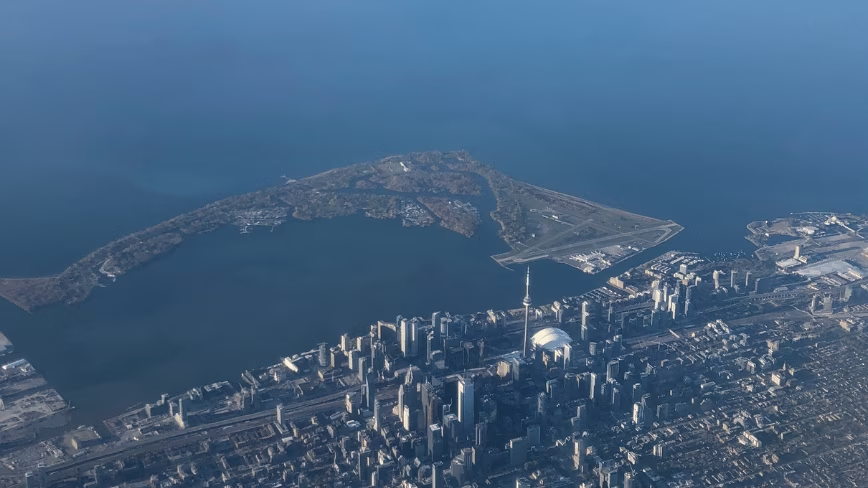
Toronto on the shore of Lake Ontario. US users of Apple Maps now see the lake labelled Lake America.

John Ternus became chief executive of Apple on Tuesday. The first public decision of his tenure was to rename a Canadian lake. It was also not his decision to make.
Apple Maps now shows Lake Ontario as “Lake America” to users in the United States. Mark Gurman reported the change for Bloomberg on Tuesday evening. Canadian users still see Lake Ontario. Everyone else sees both. The rollout began on Ternus’s first day and was still spreading across desktop and mobile on Wednesday.
Who actually made the call
Tim Cook stood down as chief executive on Monday, but he did not leave. He is now executive chairman. Bloomberg reports that he keeps responsibility for Apple’s relationship with the White House and with other governments.
That matters here more than anywhere. Interior Secretary Doug Burgum told Fox Business on Monday that President Donald Trump had “reached out to Apple directly”. The request therefore arrived at the top of the company, on the day the top changed hands. It landed in a portfolio the outgoing chief executive still holds.
We reported on Tuesday that Ternus also inherits a services chief with more of Apple under him than anyone except the new boss.
Apple declined to comment to Bloomberg and has said nothing publicly about why it made the change. The succession we reported on Tuesday was framed around products and artificial intelligence. This was the part nobody put in a memo.
What Trump ordered
Trump signed the executive order on 27 August, days after trade talks with Canada collapsed. It gives the Interior Department 30 days to change the name in the Geographic Names Information System. That federal database sets the standards for official US maps.
The order reaches federal agencies and nothing else. It cannot bind Canada, other countries, individual US states, or private companies. New York’s governor Kathy Hochul has said her state will keep calling it Lake Ontario.
The dispute underneath it is tariffs. Washington has imposed 50% duties on $20bn of Canadian goods, and Ottawa has promised dollar-for-dollar retaliation.
Google went first, on 29 August, citing its long-standing policy of following official government sources. Apple has never explained its reasoning at all. Both companies renamed the Gulf of Mexico last year on the same basis, and Mexico sued Google over it.
The company that said no is winning
MapQuest refused. “We’re not changing it,” the company posted. It then rebuilt the tool it made during the Gulf of Mexico row, which lets people rename the lake themselves.
The response was extraordinary for a 30-year-old service most people had written off. Appfigures recorded roughly 80,000 iOS downloads across the US and Canada on Sunday. The daily average earlier in August was about 500. Google Play went from around 1,000 a day to 20,000 on Saturday.
Sensor Tower put global downloads at 184,000 for the week beginning 24 August. That is more than ten times the week before. MapQuest says usage climbed to about 50 times normal levels, and that 30 August was its best day in a decade.
It reached number one among free apps in both the US and Canadian App Stores, as Sarah Perez reported for TechCrunch. Doug Berger, its general manager, said people had spoken with their downloads and wanted a map with names they recognised.
The irony is not small. MapQuest sits at the top of Apple’s own App Store because it refused to do what Apple did.
The name Apple replaced
Lake Ontario is the smallest of the five Great Lakes and the name is older than either country. It appears in the records of the Second Continental Congress in 1776, a week after the colonies declared independence, and in the Treaty of Paris that ended the war in 1783.
Accounts of its origin differ. Prime Minister Mark Carney traced it to the Wendat word Ontarí:io, which he rendered as “the lake is beautiful, the lake is big”. Other accounts give the Huron oniatarí:io as “lake of shining waters”, or the Haudenosaunee Skanadario as “beautiful water”. What is not disputed is that the name is Indigenous and predates the province it is often assumed to be named after.
Three of the five Great Lakes carry Indigenous names. Huron and Superior are French.
Canada is not playing
“Canadians also know that naming reality means calling it Lake Ontario, then, now and always,” Carney wrote.
Ontario Premier Doug Ford compared the order to a sketch show and had a physical sign installed at the lake reading “Lake Ontario. Now and Always”. Trump has posted AI-generated video of himself kicking over a Lake Ontario sign and replacing it.
A Reuters/Ipsos poll found that most Americans oppose the change. Canada has answered in other ways too, with reports of shops and streets quietly dropping American names as the trade fight drags on.
What it costs to comply
Apple has spent this week under closer scrutiny than usual. It handed over the chief executive’s office and set Ternus’s pay at a $3m salary against a $55m equity target. It holds its first event of the new era on 9 September, where a foldable iPhone is expected.
Into that week it inserted a decision with no product logic and no stated reasoning, on a request that arrived from the president personally, in an area the previous chief executive still runs. Google at least published a policy to point at. Apple published nothing.
The measurable result so far is that a mapping service nobody had thought about since the 1990s is the most downloaded free app in two countries.
Get the TNW newsletter
Get the most important tech news in your inbox each week.
Also tagged with


