 Credit: Apple
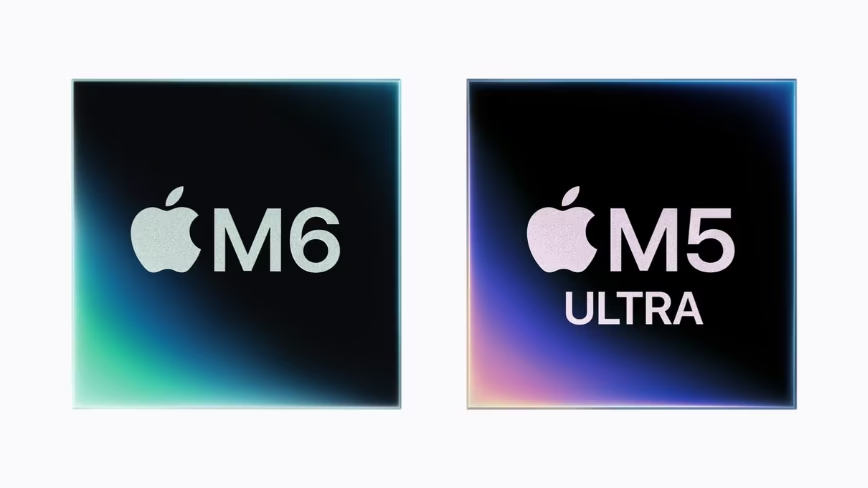
Apple has introduced the M6 in a new Mac mini and the M5 Ultra in a new Mac Studio, its first 2nm chip and its first quad-die M-series design respectively. The M5 Ultra supports up to 512GB of unified memory at 1.2TB/s.
The Mac mini question is settled. TNW reported this morning that it was unclear whether the machine would get an M5 or an M6, and Apple has answered with the M6, its first 2-nanometre chip.
The specification is a step up. A 12-core CPU built from two super cores, four performance cores and six efficiency cores, alongside a 12-core GPU and what Apple calls a Dual 16-core Neural Engine.
The claims are Apple’s own and they are large. It says the M6 has the world’s fastest single-threaded performance, roughly 30% more peak GPU compute for AI than the M5, and up to 170GB/s of memory bandwidth.
The shape of the launch was reported here in June. TNW wrote that Apple would ship a base M6 with no Pro or Max versions, using an M5 Ultra as a stopgap in a new Mac Studio, which is exactly what happened.
That Ultra is the more unusual machine. It is the first quad-die M-series part, joining two dual-die M5 Max chips through UltraFusion at more than 4.4TB/s between them.
The specification runs to 36 CPU cores and 80 GPU cores. It also carries up to 512GB of unified memory at 1.2TB/s, which Apple says is half again as much bandwidth as the M3 Ultra.
One sentence in the announcement matters more than the rest. Apple says the machine can run models with hundreds of billions of parameters entirely on device.
The memory figure lands in an awkward market. Half a terabyte of unified memory arrives during a DRAM shortage that has already emptied Mac shelves and pushed prices up across the industry.
For European buyers the interesting consequence is legal rather than technical. A model running locally means prompts, documents and customer data never leave the building.
That answers a problem TNW has argued is political rather than technical, which is European organisations processing sensitive material on infrastructure they do not control.
It is not sovereignty, though. The chip is designed by an American company and fabricated in Taiwan, so local inference settles where the data sits, not who supplies the compute.
Still, for a hospital, a law firm or a ministry that cannot lawfully put its files in someone else’s cloud, a desk-sized box running a very large model is the most practical thing Apple has shipped in years.
Get the TNW newsletter
Get the most important tech news in your inbox each week.
Also tagged with


