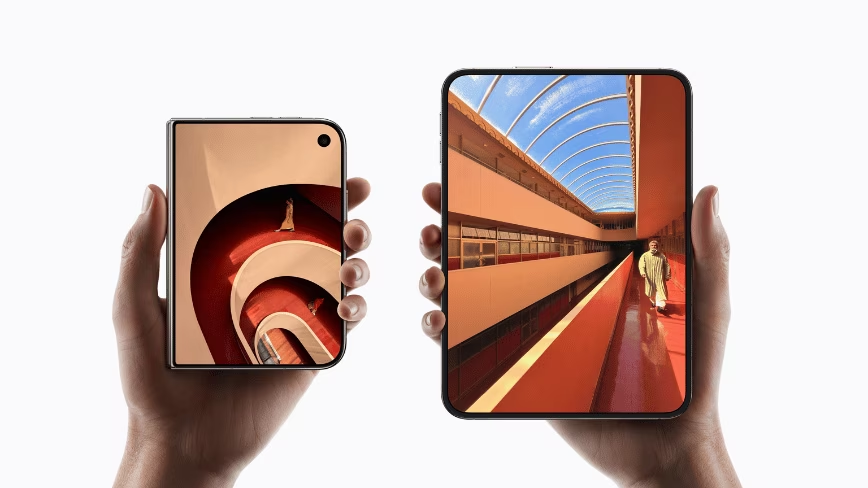
iPhone Duo’s 5.4-inch outer display, left, and its 7.6-inch inner display.

Apple has made a foldable iPhone. It is called the iPhone Duo, it opens to 7.6 inches, and it starts at $1,999.
The price is the news. Analysts expected $2,500. Samsung, which has had this category almost to itself for seven years, sells its Z Fold8 Ultra at $2,099.
Apple arrived last and priced below the incumbent.
What was announced
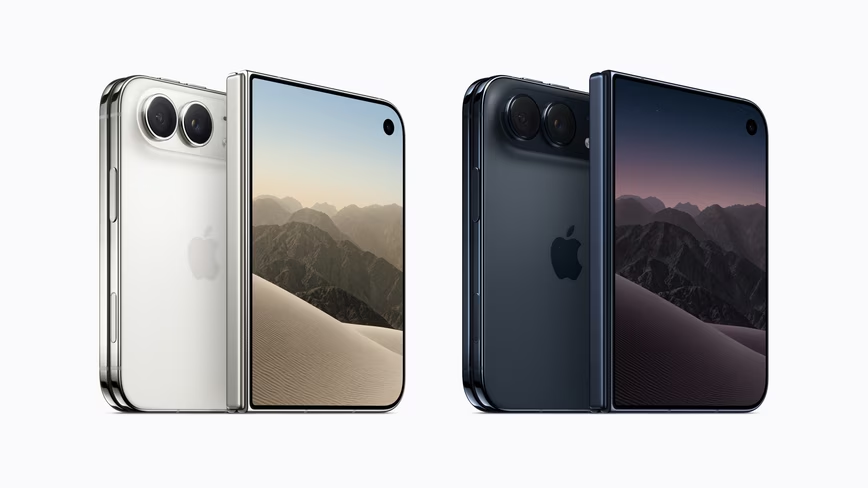
Apple unveiled the Duo on Wednesday. Pre-orders open on 16 October in more than 70 countries, with the phone arriving on 23 October and in 28 more markets from 30 October. Storage runs from 256GB to 2TB. There are two colours, star white and night sky.
Closed, the outer display is 5.4 inches and carries 90% of the screen area of an iPhone 18 Pro. Open, the inner display is 7.6 inches and 50% larger than an iPhone 18 Pro Max. Both share an aspect ratio, which is what makes content scale between them.
You are not paying for the chip
Here is the detail worth pausing on. The Duo runs the A20 Pro, the same chip as the iPhone 18 Pro announced the same morning.
That phone starts at $1,199. So the $800 difference buys the hinge, the second display, the titanium and the dual battery. It does not buy faster silicon.
Apple pairs it with a custom vapour chamber and a chip package it says is inspired by its M-series work, claiming up to 35% better sustained performance than the iPhone 17 Pro. A new display engine drives both screens at once.
The price undercut
We reported in August that IDC expected $2,500 and more than 10 million units in the first year. Nabila Popal, a senior research director there, described the buyers as a very elite set of consumers.
Apple came in $500 under that. Our own August preview put the range at $2,000 to $2,500, so the Duo landed at the very bottom of it.
Against Samsung the gap runs the other way. IDC expected Apple to price $400 above the Z Fold8 Ultra. It went $100 below.
That is unusual in this particular year. Memory prices have pushed component costs up all year, and Omdia argued in August that phones had undergone a structural repricing.
Ternus makes his first pitch
This is the first product launch under John Ternus, who became chief executive on 1 September, and he took the Duo himself.
“iPhone Duo is the most transformational change to iPhone since the original. With an entirely new design and intuitive experiences, it shows what’s possible when hardware and software are engineered together and redefines what it means to use a foldable phone,” he said.
He is a hardware engineer, and the Duo is a hardware argument.
The hinge and the crease
Every foldable has failed on the fold. Apple has spent its engineering budget accordingly.
The hinge uses more than 100 components to control opening and closing and to support the centre of the display. Its cover is 3D-printed titanium, micro-blasted against the mirror-polished grade 5 titanium body. Support ribs stiffen the structure, and ceramic fibre inserts in the antenna splits add rigidity.
The display stack is the other half. A nano-texture finish cuts glare and reflections and, Apple says, minimises how visible the crease is. Under a scratch-resistant coating sits a custom polymer cover Apple claims is up to 40% stiffer than industry alternatives. High-strength glass sits above and below the folding panel.
The adhesives are the clever part. Apple says they let the layers glide past one another like the pages of a book, relieving bend stress rather than resisting it. A titanium plate at the bottom adds durability.
Ceramic Shield 2 on the front resists scratches three times better than the previous generation. Ceramic Shield covers the back. The rating is IP68.
Touch ID is back
Face ID does not appear. Touch ID is built into the side button instead, working open or closed, and the Duo can also be unlocked with an Apple Watch.
Our preview predicted that, reasoning that a folding phone has nowhere sensible for the Face ID array. The FaceTime camera now sits under the inner display and hides when not in use.
Europe will grade the crease
Two things land differently here. Start with the energy label, which every smartphone sold in the EU has carried since June 2025. It shows a repairability class, a battery endurance figure and a rating for surviving repeated drops. Regulation 2023/1670 exempts displays that roll and unroll. It does not exempt ones that fold.
So the Duo faces the same 800-cycle battery minimum and seven-year spare parts obligation as any handset, and Apple must publish a durability grade for the most expensive phone it has made. Its iPhone 17 Pro Max is class C for repairability and class B for repeated free fall. Samsung’s Galaxy Z Fold 7 beat it on both free fall and battery cycles.
The second is Siri AI, which footnote 3 says “will not be available initially in the EU.” Apple gives no reason and no date. That matches the iPhone 18 Pro and both new watches, announced the same day.
Two batteries, one system
There is a high-energy battery on each side, run as one through Apple silicon and what the company calls energy rebalancing algorithms.
Apple quotes up to 31 hours of video playback on the inner display, 44 hours on the outer, and 24 hours of use per charge with both used equally. Charging reaches 50% in around 20 minutes wired, or 30 minutes on MagSafe or Qi2.
The Duo is eSIM-only worldwide, with no physical SIM tray in any market. Apple says that is what freed the space.
iOS moved to the side
Apple rebuilt the interface rather than stretching it.
Lock Screen controls, the Dock and app navigation all move to the side, freeing vertical space. Open, the inner display shows two Home Screen pages beside a vertically scrolling Today View. The status bar shrinks to a circular element in a corner. The Dynamic Island now runs vertically down the side of both displays.
Split View puts two apps side by side on an iPhone for the first time. Users can open two windows of the same app, swap quickly between them, and save pairs to return to. StandBy now works on either display even when the phone is not charging.
Netflix, Zoom and Slack have already adapted. The Duo is also the first iPhone to take an Apple Pencil, on either display, arriving later this year.
Cameras that use the second screen
The rear system pairs a 48MP Fusion Main camera, with zero shutter lag and an integrated optical-quality 2x telephoto, with the same 48MP Fusion Ultra Wide as the iPhone 18 Pro. It shoots 4K120 in Dolby Vision.
The new ideas come from having a screen on the back. Duo Preview shows subjects a live preview on the outer display so they can check their own framing. Duo FaceTime lets people beside you join a call on that screen instead of crowding in. Smart Take uses on-device AI to fire the shutter when it sees people posing. Kid Cue plays Peanuts animations to get children to look up.
Camera Control returns, alongside a new Siri Camera mode that lets Siri see what the user sees.
What to watch
Whether the hinge survives two years rather than a demo.
What durability class Apple publishes on the European label, and how it compares with Samsung’s.
And whether $1,999 was about cost or about share. Apple has raised prices on almost everything else this year. On the one product where it had no incumbent position, it did the opposite.
Get the TNW newsletter
Get the most important tech news in your inbox each week.
Also tagged with


