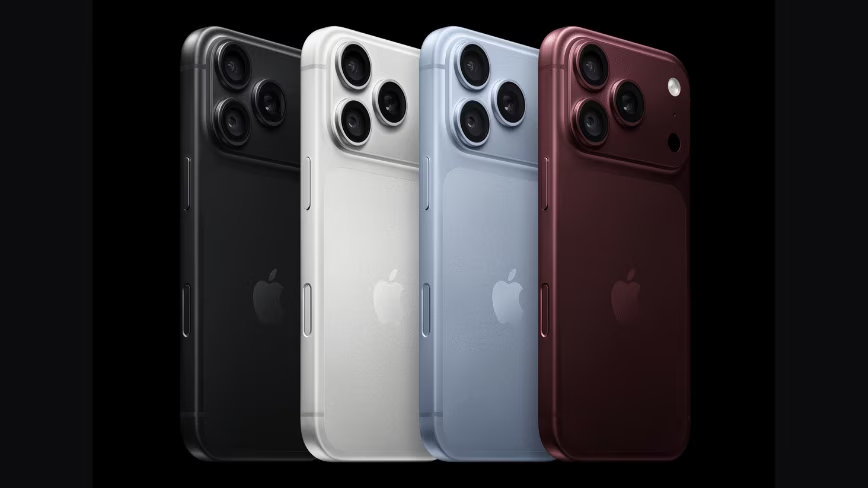
iPhone 18 Pro is available in black, silver, glacier and burgundy.

Apple has announced the iPhone 18 Pro and iPhone 18 Pro Max. The headline feature is a camera that can change its aperture, which no iPhone has done before.
Two of the phone’s flagship features will not work in Europe at launch.
Apple announced both models on Wednesday. Pre-orders open on Saturday 12 September and the phones arrive on Friday 18 September. The Pro starts at $1,199 and the Pro Max at $1,299.
What Europe does not get
The detail is in the footnotes rather than the announcement.
Siri AI is the rebuilt assistant Apple has spent the year previewing. It “will not be available initially in the EU on iOS, iPadOS, and watchOS.” Features that depend on it will not work either. Apple says it is “working hard to find a path forward that preserves its users’ privacy and security.” It gives no reason and no date.
Apple Reference Image, the new photo-authentication feature, is also restricted. EU users cannot capture reference images at launch. They can develop and view them on iOS, iPadOS and macOS 27. In China the feature is absent entirely, which Apple attributes to regulatory requirements.
So a European buyer pays the same $1,199 and gets a phone whose assistant and whose authenticity feature are both incomplete on day one.
The camera can change its aperture
This is the genuine first.
The 48MP Fusion Main camera uses six laser-cut blades and a new rotor mechanism to move between apertures. It can widen to ƒ/1.48 for low light. Apple says it adjusts automatically for depth of field and lighting. Photographers can also set any of the four apertures by hand.
There is an API, so third-party camera apps can reach the full aperture range.
A new Pro controls panel in the Camera app adds manual shutter speed, white balance and aperture, plus a histogram. Photographic Styles gains texture and grain controls. Cinematic effects can now be applied after capture, to video shot at up to 60fps. Time-lapse records in 4K Dolby Vision HDR. Audio Mix can isolate music.
A camera that signs what it sees
Apple Reference Image is the more interesting idea, and it is aimed squarely at the problem of AI-generated pictures.
The new sensor signs every pixel it captures. In Reference mode, that signed sensor data goes to Private Cloud Compute, which produces what Apple calls an unalterable reference image. It sits in Photos next to the edited version, like a digital negative. Anyone can compare the two and see what changed.
APIs let third-party apps display those reference images. Apple also says it will support the SynthID standard, in a software update later this year. That standard flags images made or edited with AI.
Apple names photojournalists first among the people it thinks need this. The feature is opt-in.
A20 Pro, and a vapour chamber doing the real work
The A20 Pro is built on a 2-nanometre process. Apple claims 50% more memory bandwidth than the A19 Pro. There is a 6-core CPU with integrated Neural Accelerators. The 7-core GPU is up to 40% faster. A Dual 16-core Neural Engine carries 32 cores in total, for double the AI processing power.
The thermal design is the part worth reading twice. Apple has moved the memory out of the chip’s thermal path. The die and the memory now sit side by side, in packaging Apple says is borrowed from its M-series work. That lets the chip attach straight to a vapour chamber with three times the surface area of the one in the iPhone 17 Pro.
Apple claims up to a 40% gain in sustained performance as a result. Peak numbers are easy. Sustained numbers are what a phone actually delivers.
Both models carry the N1 wireless chip for Wi-Fi 7, Bluetooth 6 and Thread. The C2 modem is new, and Apple says it uploads meaningfully faster than the C1X while using 15% less energy. It supports mmWave in the US.
Battery, and the SIM tray dividend
Apple quotes up to 36 hours of video playback on the Pro and 45 hours on the Pro Max. Both figures are for eSIM-only models.
That is not a footnote. Removing the physical SIM tray freed space for a bigger battery, worth two extra hours of video playback. eSIM-only models go to 12 markets, including the US, Canada, Japan and Mexico. Europe is not among them, so European buyers get the smaller battery and the lower number.
Charging is 50% in around 15 minutes wired, or 30 minutes wirelessly. On the Pro Max, Apple says five minutes of wired charging buys around seven hours of video.
Our preview called the hardware
We wrote in August that the Pro models were expected to keep their designs. Four things were expected to change: an A20 Pro on 2nm, Apple’s own C2 modem, a variable-aperture main camera and a smaller Dynamic Island.
All four arrived. The Dynamic Island is smaller and now shows three Live Activities at once, while still handling Face ID.
That piece also carried a reported price rise of roughly $300 on the Pro line, which we flagged as a rumour. Apple has not published a comparison with last year’s prices. Treat any figure for the increase as unconfirmed until someone checks it against the old list.
Why the price matters this year
Phones are getting more expensive because memory is.
We reported on Tuesday that DRAM contract prices are still rising, and that European device shipments are falling as a result. Omdia said in August that the phone market has undergone a structural repricing. Buyers adjust to higher prices, and manufacturers set the next ones from that base.
Apple has been the exception throughout. It raised prices and grew anyway, on both Macs and iPhones, while rivals cut their entry-level ranges.
The first launch of the new era
This is the first iPhone launch under John Ternus, who became chief executive on 1 September. He is a hardware engineer. This is a hardware-led announcement: a mechanical aperture, a new thermal design and a bigger battery.
The software story is thinner. Siri AI ships as a beta, in English only, with five more languages in October. Some Apple Intelligence features that run on Apple’s servers carry daily usage limits. Expanded access “will be available for a fee in the future,” the company says.
Greg Joswiak, Apple’s marketing chief, framed the launch around the hardware.
“With iPhone 18 Pro, we’ve made advancements to the areas our users care about most: camera, performance, battery, and intelligence. And we didn’t just make incremental improvements in these areas, we took huge leaps forward to create the best Pro iPhone we’ve ever made,” he said.
What to watch
When Siri AI reaches the EU, and on what terms. Apple has given no date.
Whether the vapour chamber holds up. A 40% sustained gain is the boldest claim in the release and the easiest to test.
And whether Apple Reference Image gets adopted outside Apple. It only becomes a standard if other apps and other platforms read it.
Get the TNW newsletter
Get the most important tech news in your inbox each week.
Also tagged with


