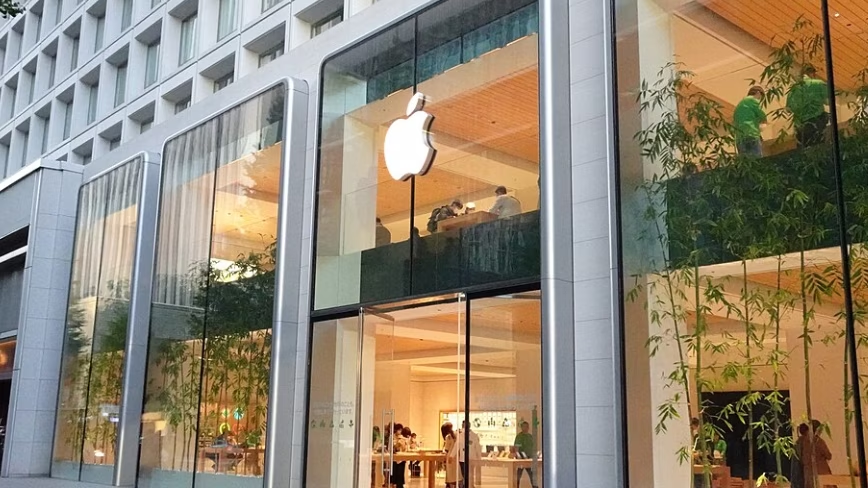
The exterior of Apple Marunouchi, located in Marunouchi, Chiyoda-ku, Tokyo
 Credit: RuinDig/Yuki Uchida, CC BY 4.0, via Wikimedia Commons
Apple has trained its own large language model for the Chinese market with Alibaba’s support, a striking break from the company’s usual habit of leaning on other people’s models.
According to a Reuters report, Apple is the first foreign firm Beijing has approved to offer a proprietary AI model in mainland China, a rare concession in a market that guards its algorithms closely.
The model will power Apple Intelligence on the iPhone, iPad, Mac and Vision Pro sold in China, with a rollout expected in the coming months.
It is the payoff of a partnership that Alibaba chairman Joe Tsai confirmed publicly back in February 2025, and that has taken most of the time since to clear the country’s regulators.
For a company that prizes control over every layer of its products, the arrangement is a curious one. Apple has trained the model, but the intelligence underneath is not entirely its own.
This is the same firm that has been quietly testing Chinese memory chips as the global component crunch bites, and it is now making a similar bet on Chinese software.
The division of labour is telling. Alibaba’s Qwen model is folded into the Chinese version of Apple Intelligence, while Baidu’s technology handles search.
In other words, the two features users lean on most, the assistant that answers questions and the search that finds things, are powered by China’s own champions rather than by Cupertino.
For a firm that famously builds its own chips, designs its own software and resists outside dependencies wherever it can, that is quite the reversal.
Regulatory reality explains the compromise. China’s AI rules are strict, its censorship requirements stricter still, and every generative model offered to the public must be registered with the state.
The Cyberspace Administration of China logged Apple’s service in July 2026, roughly 22 months after Apple Intelligence first launched elsewhere, a delay that speaks to how carefully Beijing vets foreign technology.
There is a competitive edge to it too. Domestic rivals have not waited around, and Huawei’s AI-equipped phones have clawed back ground while Apple’s assistant sat in regulatory limbo.
Building a China-specific model, tuned to local rules and local partners, is Apple’s way of recovering some of that lost momentum.
The awkwardness of the position occasionally shows. Apple briefly published, then quietly deleted, a Chinese-language guide explaining how to connect Qwen to Siri and its Writing Tools, a small stumble that hinted at just how sensitive the choreography around this launch has become.
Alibaba’s US-listed shares rose about 4% after the July approval, and the stock has become a proxy for the idea that Qwen running inside Apple Intelligence is worth real money.
The deal also lands in the middle of a wider argument about how far Western firms should entangle themselves with Chinese AI.
Even Mark Zuckerberg has argued the US should not block Chinese AI models, though plenty in Washington take the opposite view and see any tie to Chinese models as a security risk to be contained rather than a market to be served.
Apple knows the terrain. American lawmakers have already warned the company off Chinese memory chips on national-security grounds, and a home-grown Chinese AI model, however cleverly framed, is unlikely to escape similar scrutiny.
For now, the story is less about a single model than about a template. Apple, the arch-controller of its own ecosystem, has outsourced the brain of its China AI to Alibaba and Baidu and built the rest to Beijing’s specifications.
It is a concession dressed up as a strategy, and a fairly clear illustration of the terms on which Western tech is allowed to operate inside China’s walled garden. Whether rival firms read it as a warning or a manual may prove the more interesting question.
Get the TNW newsletter
Get the most important tech news in your inbox each week.
Also tagged with


