API Gateways provide a controlled path into backend services and can apply security and traffic policies as requests move through the system. AI introduces additional runtime decisions because applications may interact with different models whose access, usage, and outputs require their own controls.
Agents stretch that boundary further because they can move beyond generating an answer and interact with tools or other systems. The gateway, therefore, has to govern not only how traffic moves but also what an AI system is permitted to do at runtime.
API gateway vs AI gateway: extension, not replacement
API Gateways already solve an important enterprise problem. They give applications a controlled route to backend services and provide a place to handle authentication, authorization, routing, traffic limits, security policies, and monitoring (IBM, 2024).
The same gateway model can be adapted to AI workloads. An AI Gateway is a specialized layer for managing interactions between applications and AI models, with controls designed for AI traffic alongside familiar API management responsibilities (Mulesoft, 2026).
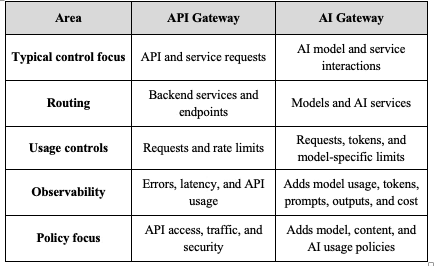
The significance of AI Gateways lies in those added control requirements, not in replacing what already works.
Enterprises may need model-level permissions, richer consumption data, AI-specific routing, and policies that reflect the nature of generated content. Those capabilities build on gateway governance rather than inventing it from scratch.
What an AI gateway adds to the control model
The control problem becomes more complex when applications connect directly to a growing mix of models and providers. Access rules, usage limits, routing decisions, and monitoring practices can become distributed across the application estate. An AI Gateway can create a common place for decisions on model availability, routing, policy, and visibility.
Model choice becomes a policy decision
A model abstraction layer can hold approved endpoints along with metadata, access policies, and identity rules. Applications can therefore consume models from a governed set rather than connecting independently to every provider they need (AWS, 2023).
Consumption carries more context
AI usage cannot always be understood through request volume alone. Model-specific quotas and token consumption can reveal more about how resources are being used and where demand is coming from. Routing can also take into account which models are available or appropriate for a particular workload.
Inputs and outputs create new control points
The request may contain sensitive context, while the response may need additional handling before it reaches the user or application. An AI Gateway can provide a place for privacy, content, and access policies to operate along that path.
Monitoring becomes model-aware
The resulting telemetry can connect an interaction with the model that handled it, the amount consumed, the application involved, and the associated cost. That adds AI-specific context to the operational visibility already provided by conventional API monitoring.
Those capabilities become strategically important when used to enforce governance policy rather than simply to simplify model integration.
AI gateway as a runtime layer for AI governance
AI Governance is often discussed through policies, standards, review processes, and accountability structures. Enterprise architecture has a different challenge. It has to determine how at least part of that governance becomes enforceable when an application, user, or agent actually invokes an AI service.
An AI Gateway can become part of that operating model by placing selected controls between AI-consuming applications and the models or tools they call. Identity, routing, guardrails, rate limits, and budget rules can be evaluated against the live request before downstream execution (NHI Mgmt Group, 2026).
For leadership, the important shift is from asking whether an AI policy exists to asking whether the architecture can apply it consistently. A policy that depends on every application team implementing the same logic independently is difficult to govern at scale. Changes may be applied unevenly, exceptions can become difficult to trace, and responsibility for enforcement becomes fragmented across the application estate.
For architects, that leads to a different set of design questions: Which governance decisions need to be evaluated during execution? Which controls should remain with IAM, cybersecurity, data governance, or model governance systems? Which AI interactions should be required to pass through the gateway? How will approved exceptions and alternative request paths be identified and governed?
Those decisions also define the limits of the gateway. Model evaluation, legal interpretation, organizational accountability, and broader risk ownership still sit elsewhere. An AI Gateway is most useful when its role is clearly bounded within that wider governance architecture.
How an AI gateway integrates with existing enterprise controls
Established enterprise architectures already have controls for identity, security, APIs, and the data foundation that supports applications and AI. The AI Gateway has to fit into that architecture without creating a separate governance stack.
Keep identity anchored in IAM
The gateway can use existing identity and role information when deciding which AI resources are available. IAM can remain responsible for managing those identities, rather than introducing a separate access model simply because the destination is a model or AI service. This keeps AI access connected to established permissions and gives security teams a consistent basis for reviewing who or what is using enterprise AI.
Carry policy into the AI request path
Policies may originate in security, risk, data governance, or model governance processes, but the gateway can provide a point where selected rules affect a live interaction. That separation allows policy ownership to remain with the appropriate function while enforcement reaches the request path.
Extend policy to MCP-connected tools
When agents access enterprise tools through MCP, the governance boundary extends beyond the model itself. MCP requests can pass through a gateway where identity and authorization policies restrict which tools and capabilities an agent is permitted to reach. A2A raises a related governance question for agent-to-agent communication, where authentication and authorization must be maintained across interactions between independent agents.
Feed AI activity back into enterprise observability
Request traces, model usage, latency, and consumption data become more useful when they can be linked to the application or identity responsible for them. Feeding that context into existing observability and security systems helps keep AI activity visible within the same operational environment as the applications and services around it.
Keep AI-generated software within architectural boundaries
Harness Engineering applies machine-enforceable architectural constraints within the development toolchain to govern the structural consistency of code artifacts. These constraints can be enforced through tools such as linters, type checkers, formatters, and CI gates (Kim & Hwang, 2026). This gives architects another control point for maintaining architectural consistency as more software is produced with AI.
Conclusion: From AI policy to governed execution
As enterprise AI moves from model access toward tool use and delegated execution, governance has to follow those interactions into new parts of the architecture. AI Gateways provide a way to extend established gateway principles into that environment without treating conventional API management as obsolete.
For AI architects, CIOs, and security leaders, the priority should be to define the control model early. Decide which AI interactions require gateway enforcement, which responsibilities remain elsewhere, and how exceptions will be governed as agent and tool integrations expand.
References:
1. Gallagher, N., Goodwin, M., & Jackson, G. (2024, August 15). What is an API gateway? IBM. https://www.ibm.com/think/topics/api-gateway
2. Parulkar, S. (2026, May 20). What is an AI Gateway? A Complete Guide. Mulesoft. https://www.mulesoft.com/ai/what-is-ai-gateway
3. Chattha, T., Di Francesco, P., & Hwang, J. (2023, September 28). Create a Generative AI Gateway. Amazon Web Services. https://aws.amazon.com/blogs/machine-learning/…
4. AI gateway controls matter more when strategy meets execution. (2026, July 15). NHI Management Group. https://nhimg.org/articles/…
5. Kim, J., & Hwang, H. (2026, March 19). Harness Engineering: A Governance Framework for AI-Driven Software Engineering. SSRN Electronic Journal. https://doi.org/10.2139/ssrn.6372119
Get the TNW newsletter
Get the most important tech news in your inbox each week.
Provided by Sandesh Gawali


