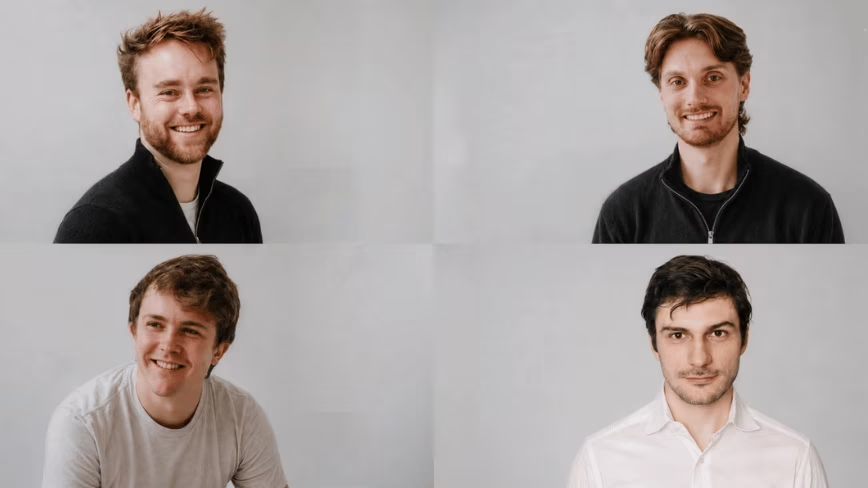
Antioch co-founders Harry Mellsop and Alex Langshur (top, from left), with Collin Schlager and Michael Calvey (bottom, from left)

Antioch, a New York startup that builds simulation software for robots, drones and other autonomous machines, has raised a $32m Series A. Greylock led the round. The money goes on the idea that physical AI teams should test their systems in the cloud before anything touches hardware.
Antioch announced the round in a blog post on 8 September. A*, Category Ventures, BoxGroup and Icehouse Ventures also took part, along with angel investors. Together with an $8.5m seed round in April, Antioch has now raised $40.5m. Greylock partner Saam Motamedi joins its board, the firm said in its own post. Antioch did not disclose a valuation for the new round.
The bottleneck Antioch is selling against
Software teams can change code, run tests and try again thousands of times a day. Robotics teams mostly cannot. They rely on test sites, recorded datasets, hardware rigs and fleets run by hand, which are slow and costly to repeat.
Antioch says its platform closes that gap. It builds a simulation of a customer’s system, including its hardware, sensors, software and models. It then calibrates that simulation against real-world data. Teams can run thousands of test scenarios in parallel, find failures and check fixes before a change reaches a real machine.
The company calls this a verifier for physical AI. It also sells the simulations as a source of synthetic data, for rare failures that would be dangerous or expensive to record in the real world.
Its product pages split the work into four markets: aerial, ground and industrial autonomy, plus what it calls intelligent perception. In April, the company was focused on sensors and perception for autonomous vehicles, farm and construction machinery, and drones, Tim Fernholz of TechCrunch reported at the time of its seed round.
“Software-speed innovation in the physical world will be the foundation of the next industrial revolution,” Motamedi said in Antioch’s announcement.
Half programmed, half learned
Antioch’s pitch sits between two approaches. Classical simulators are built by hand with 3D engines and physics solvers. They are controllable, but they struggle with messy real-world effects such as soft objects and contact. Learned world models, like the open world models Nvidia is promoting, learn behaviour from data instead. Antioch says they need far more real-world data than most teams have.
So Antioch mixes the two. It programs what is known, such as geometry and sensor layouts, and uses real data to learn the rest. The company says it expects learned parts to replace more of the simulator over time.
“The destination is fully learned. The practical path to it is hybrid, and we are driving the frontier,” the company wrote.
Ring, Nvidia and Nebius
Antioch named Amazon’s Ring as a customer.
“Antioch’s simulations have closely matched our physical test results, including in scenarios we deliberately held out of calibration,” said Jason Mitura, VP of software development at Amazon and chief product officer of Ring.
Mitura said that confidence lets Ring move more of its testing and development into simulation. He added that this cuts its reliance on costly physical test programmes.
Launchpad Build AI, which makes AI-powered manufacturing systems, is another. “With Antioch, we have been able to meaningfully accelerate our time to market,” its chief executive, Jon Quick, said in the announcement.
Quick said Launchpad can now test every scenario its systems will meet in production, as well as edge cases that would be impractical to stage. “This is critical for a company like ours, with teams on each side of the Atlantic,” he said.
The platform runs on other companies’ infrastructure. Antioch integrates with Nvidia’s Omniverse libraries, Isaac Sim and Isaac Lab. Nvidia has taken its Isaac tools into other fields too, including an open-source simulator for surgical robots. It also works with Nebius on the computing capacity to run simulations at scale.
“Simulation has the potential to be a massive unlock for physical AI, but it remains one of the hardest parts of the stack to get right,” said Evan Helda, head of physical AI at Nebius.
Who is behind it
Harry Mellsop, Alex Langshur and Michael Calvey previously built Transpose, which Chainalysis acquired. Mellsop also worked on computer vision at Tesla. Collin Schlager, another co-founder, comes from simulation and hardware work at Meta Reality Labs, according to Greylock.
The company was founded in May 2025, TechCrunch reported in April. Fernholz wrote that the seed round, led by A* and Category Ventures, valued Antioch at $60m. Both firms returned for the Series A. Angel backers in the new round include Palantir chief technology officer Shyam Sankar and Foxglove chief executive Adrian Macneil, Antioch said in a press release.
The round has a New Zealand thread. Icehouse Ventures is a New Zealand investor, and the NZ Herald described Mellsop as a New Zealander. It put the round at NZ$54m.
A crowded bet on physical AI
Investors are pouring money into the tools around robots, not only the robots themselves. Andreessen Horowitz raised a $1.1bn fund in August for the physical layer of AI. Others are chasing the data problem Antioch describes from different angles. MicroAGI raised $55m to train factory robots on footage of people doing chores. NEURA Robotics is building real-world gyms where robots can practise.
Antioch says the new money will expand the platform, bring it to more physical AI teams and grow its staff. It is hiring across simulation, machine learning, infrastructure, 3D graphics, sales and operations. Customers are also invited to bring their own systems into the platform. The next test is whether customers beyond Ring and Launchpad move more of their testing from hardware into Antioch’s simulations.
Get the TNW newsletter
Get the most important tech news in your inbox each week.


