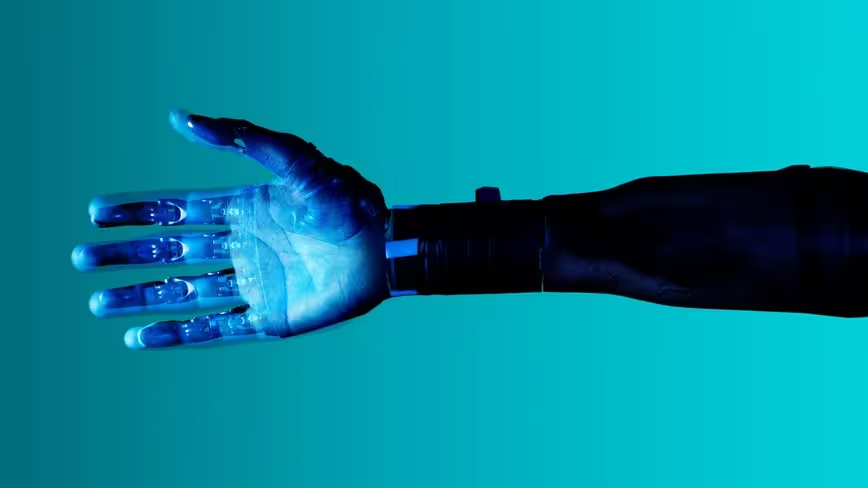
Digital image of a prosthetic arm on a blue background
 Credit: ThisIsEngineering
The hard part of medical robotics is not the robot. It is the practice. A surgical system needs thousands of attempts to learn a delicate task, and you cannot run those on real patients. Nvidia thinks the answer is to let the robot rehearse inside a simulated body, millions of times over.
The company has released an open-source Medical Physics Simulation framework, part of its Isaac for Healthcare platform, HIT Consultant reported. It models how instruments interact with anatomy, so developers can train and stress-test physical-AI policies long before touching hardware.
The speed is the headline. By running 8,192 training environments in parallel on GPUs, Nvidia claims a startling speed-up. It cuts robotic policy training from over five hours to under two minutes. That is the difference between an overnight job and a coffee break.
The more consequential part is what the simulation produces: evidence. Because the framework is open, developers can see the data, models, and weights. They can use them to build the verifiable proof that medical regulators demand.
Two kinds of physics
The framework fuses two approaches. Classical physics, via Nvidia’s Warp and Newton engines, models the hard mechanics: friction, contact, and the resistance of tissue against a catheter or guidewire.
Generative AI physics, from a model called Cosmos-H Dreams, predicts the messier stuff, like how soft tissue deforms. It can even pipe in simulated fluoroscopy, X-ray, and ultrasound.
Who is already using it
The names give it weight. Surgical-robotics firms including Medtronic, Johnson & Johnson MedTech, and CMR Surgical are using the framework for surgical digital twins and endovascular training.
Chris Fryer, chief technology officer of CMR Surgical, said open-source models let firms “build on shared knowledge, accelerating responsible innovation.”
The catch
The generosity has a logic. Open-sourcing the tools makes Nvidia the standard infrastructure beneath the next generation of surgical robots, all of it running on Nvidia GPUs.
A simulation is also not a patient.
A policy that shines in a digital twin still has to prove itself in an operating theatre, and regulators have yet to say how much synthetic evidence they will accept.
Still, the direction is striking. The bottleneck in medical AI has been data, not ideas, and Nvidia has just handed the field a way around it, for free. If regulators agree that a robot trained in a virtual body is safe in a real one, the two-minute rehearsal could become the way surgical machines are built.
Get the TNW newsletter
Get the most important tech news in your inbox each week.


