TL;DR
AWS has launched the Agentic Shopping Assistant, packaging the technology behind Amazon’s Alexa for Shopping into a solution other retailers can deploy in roughly 60 days. Kate Spade is the first customer, with an AI Gift Concierge running on Anthropic’s Haiku 4.5 through Amazon Bedrock.
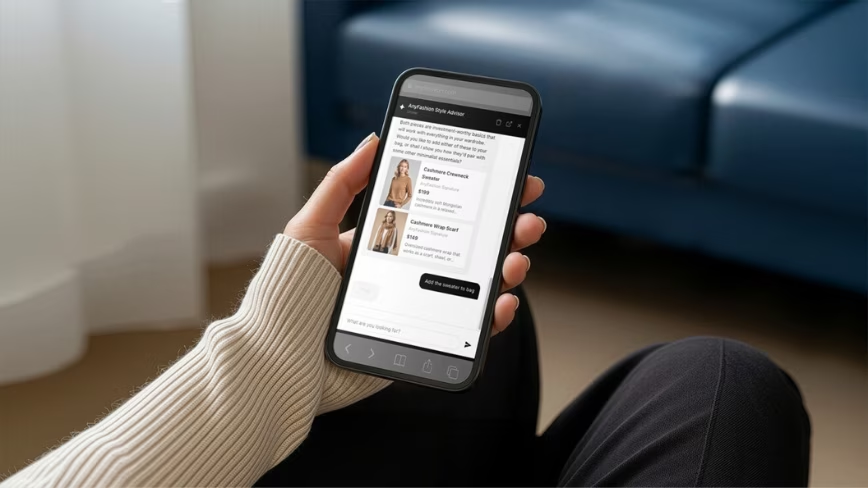
Amazon Web Services has launched a product that lets retailers build their own AI-powered shopping assistants using the same technology that powers Amazon’s Alexa for Shopping. The AWS Agentic Shopping Assistant packages architecture guidance, starter code, and hands-on support from AWS’s Generative AI Innovation Center into a solution that the company says can be deployed in roughly 60 days.
Kate Spade is the first retailer to go live. On 13 April, Tapestry, the parent company of Kate Spade, Coach, and Stuart Weitzman, launched an AI Gift Concierge on KateSpade.com. The tool engages shoppers in conversational dialogue about occasion, recipient, and style, then translates that into curated product recommendations. Tapestry describes it as the first production-ready retail AI assistant built with Amazon Bedrock AgentCore. Additional retailers are currently testing the solution.
The Gift Concierge runs on Anthropic’s Haiku 4.5 model through Amazon Bedrock, with AgentCore providing authentication, observability, and evaluation tooling. The Tapestry team spent roughly two and a half months in rigorous testing before making it customer-facing. Yang Lu, Tapestry’s chief information and digital officer, said at launch that AWS provided the recipe, but the company built the customisation its consumers needed.
The business case Amazon is making to retailers is straightforward. Amazon’s own AI shopping assistant, which merged its Rufus chatbot and Alexa+ into a unified Alexa for Shopping experience earlier this month, was used by more than 300 million customers last year and drove $12 billion in incremental sales. Conversational shopping sessions convert at 3.5 times the rate of traditional keyword search, according to Amazon’s data. AWS is now offering other retailers access to the learnings from that system without requiring them to spend years building one from scratch.
Each deployment is customised to match a retailer’s specific catalogue, customer base, shopping environment, and brand voice. Retailers bring their own product data, business rules, and domain expertise. AWS provides the technical foundation, which is built on Amazon Bedrock, AgentCore, and OpenSearch, and has been validated through billions of shopping interactions on Amazon.com. Amazon describes itself as “Customer Zero” for the solution, meaning every component has been tested in its own retail environment first.
The launch sits within a competitive scramble to control the infrastructure layer of AI-powered commerce. Stripe has positioned its Agentic Commerce Suite as the payment rail for AI agents, with Shared Payment Tokens that let agents initiate purchases without exposing card credentials. OpenAI launched Instant Checkout in ChatGPT with Stripe and released an open-source Agentic Commerce Protocol. Google announced Universal Cart at I/O 2026, combining AI-powered shopping across Search, Gemini, and YouTube with an updated Agent Payments Protocol.
Amazon’s approach differs from its competitors in a critical way. Where Stripe, Google, and OpenAI are building intermediary layers between consumers and merchants, AWS is selling the tools for retailers to build their own AI shopping presence. The pitch is that retailers should own the customer relationship rather than cede it to a general-purpose AI that may not understand their brand, their products, or their customers as well as they do.
That argument resonates with a specific anxiety in retail. As AI agents become the primary interface for purchase decisions, retailers that do not have their own conversational shopping capability risk becoming dependent on platforms they do not control. A specialty retailer knows its products better than any intermediary. A restaurant chain understands its menu and customer preferences in ways no general-purpose assistant can replicate. AWS ASA is designed to let those retailers act on that knowledge.
The 60-day deployment timeline is aggressive but plausible given the managed nature of the solution. AWS’s Generative AI Innovation Center provides hands-on guidance throughout, and system integrator partners are available for more complex deployments. For context, Amazon says it took years to develop the technology internally. Packaging it as a deployable solution compresses that timeline but still requires retailers to invest in integration, testing, and customisation for their specific use cases.
Amazon can afford to be generous with the technology because it benefits either way. AWS reported $37.6 billion in revenue in the first quarter of 2026, growing 28% year over year, its fastest rate in more than three years. Every retailer that deploys ASA runs it on AWS infrastructure, using Bedrock, AgentCore, and OpenSearch. The AI shopping assistant is both a product and a customer acquisition tool for the broader AWS ecosystem.
The Anthropic partnership underpins the strategy. Amazon has invested up to $25 billion in Anthropic, and Bedrock is the primary distribution channel for Claude models to enterprise customers. Kate Spade’s Gift Concierge running on Haiku 4.5 is a concrete example of how that investment translates into real-world deployments. Every retailer that chooses Bedrock for its AI shopping assistant generates inference revenue that flows through the Amazon-Anthropic relationship.
The question is whether retailers will trust their fiercest competitor with this kind of integration. Amazon is simultaneously the largest online retailer in the world and the cloud provider selling AI shopping tools to other retailers. The same company that competes with Kate Spade for handbag sales is now providing the AI engine behind Kate Spade’s shopping experience. AWS has long navigated this tension, hosting competitors like Netflix and Airbnb on its infrastructure, but selling AI that directly shapes the shopping experience is a more intimate relationship than hosting servers.
For now, the early signal from Tapestry suggests at least some retailers are willing to make that trade. The alternative, building a comparable system independently, is prohibitively expensive and slow. And the competitive threat from AI intermediaries like ChatGPT and Google’s Universal Cart is immediate. If a retailer’s products are being recommended by an AI agent it does not control, with no brand voice, no domain expertise, and no direct customer relationship, the case for building its own AI shopping presence becomes urgent regardless of who provides the tools.


 Credit: Amazon