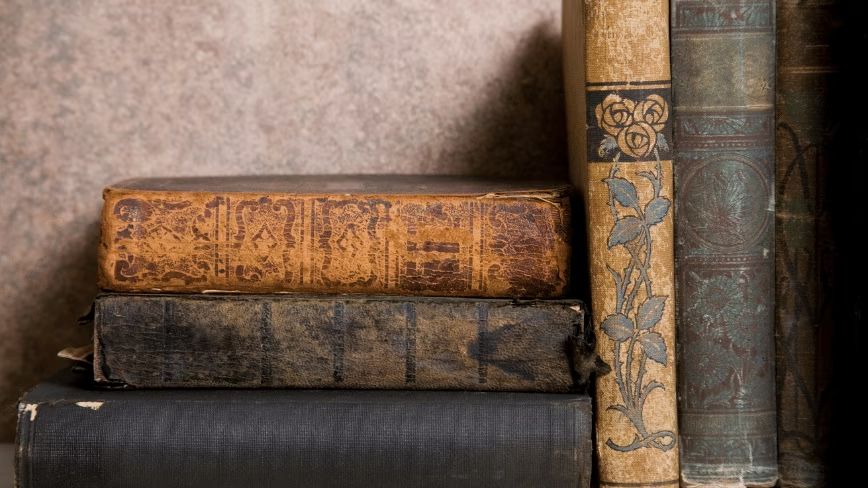
 Credit: alejandrophotography / Canva
A bookseller hid an AirTag inside a rare book and let it go with a bulk order. The tracker travelled across the United States and stopped at a warehouse in Las Vegas owned by Amazon.
Emanuel Maiberg reported the result for 404 Media on Monday. Booksellers have spent a year suspecting that AI companies were buying their stock in bulk and pulping it. Until now nobody could name one. The Amazon book scanning operation had not been reported before.
What Amazon says
Amazon declined to comment on the findings. It gave the same statement to 404 Media and to Ars Technica, and it does not mention artificial intelligence.
“Amazon purchases books through commercial channels to help develop and improve the products and services our customers use,” the company said.
Nothing in that sentence is inconsistent with the reporting. Nothing in it confirms the reporting either.
What 404 Media found at the warehouse
Amazon calls the book scanning team at the site VGT3. Employees told 404 Media what the work involves. Large shipments of printed books arrive, staff slice the bindings off so they can scan the pages faster, and the book does not survive it.
The logo on the door is a dinosaur holding a book and baring its teeth. Ashley Belanger, writing up the investigation for Ars Technica, described it as a Tyrannosaurus rex about to eat one.
404 Media also found forum discussions among workers at the site. Earlier this year, they said, Amazon ran short of books to scan. Some worried the warehouse would close. At one point the supply ran out entirely.
It is still operating.
The barcode detail
One finding does more work than the rest.
Booksellers had already theorised that buyers were chasing ISBNs rather than titles, on the logic that an ISBN marks a distinct edition. Collect enough of them and you have covered every printed book that carries one.
404 Media reviewed the worker discussions and found something specific. Staff scan the barcode or ISBN before they scan the book. The outlet says that gives the theory further credence.
It also explains the buying pattern booksellers found baffling. Buyers skip the celebrated first editions. They chase older books of low monetary value, never translated out of a language few now read, or never printed in enough copies to matter commercially.
The bookseller who planted the tracker put it to 404 Media in terms of what gets lost. A rare book’s worth comes from historical, intellectual and sentimental things that, in their words, the AI companies do not care about. They want the content as a bunch of words strung together.
Why old paper is worth this much
The premium on pre-2022 print has a simple cause. Anything published since may contain machine-written text, and models trained on model output degrade. Mike Pearl made the point for Gizmodo that until roughly 2022, only humans wrote books.
Human writing from before the chatbots is a finite and shrinking supply. We reported this month that China hit the same wall on Chinese-language material.
Yesterday the desk covered another version of the same hunt, with Google paying $10mn for a bankrupt airline’s internal records.
Amazon’s rivals have drawn a line
The comparison with its rivals is the part that stings.
Anthropic told Philippa Wain at the BBC that none of its data acquisition programmes buy and destroy rare or antiquarian books. Ars Technica reports xAI has said the same publicly.
Anthropic does scan destructively. Court documents unsealed last month named the effort Project Panama, with the stated aim of destructively scanning all the books in the world. The company paid $1.5bn to settle a separate claim over pirated copies.
Anthropic draws its line between ordinary second-hand stock and rare or antiquarian works. Amazon has drawn no line at all in public.
Amazon also trains on material closer to home. We reported last week that Twitch will train Amazon’s AI on streams unless users find the setting.
Why this is legal, and where it is not
Destructive scanning exists because of how the law was read.
Judge William Alsup ruled in 2025 that Anthropic’s use of purchased books was exceedingly transformative, and therefore fair use. Buying a book and scanning it is lawful. Destroying the copy afterwards is what keeps one copy in existence before the scan and one after, which is the point.
Emily Hudson, an intellectual property specialist at Oxford, told the BBC the position differs in Britain. The starting point there, she said, is that creating the training library and doing the training both require the copyright owner’s permission.
The booksellers are not united
The trade is genuinely split, and the split is worth reporting rather than flattening.
Stuart Manley of Barter Books in Northumberland told the BBC he had never seen anything like the orders in 30 years. One recent bulk purchase matched a normal week. He is not mourning much of it.
“The world no longer needs five million copies of The Da Vinci Code,” he said. He has books that sat unsold online for 20 years and have now moved.
Derek Walker of McNaughtan’s in Edinburgh drew the line where it matters. An academic text printed in 100 copies with 75 already in libraries is no great loss. He has also sold the only known surviving example of an 18th century edition.
“It would be a much more significant problem if one like that were to be bought for destruction, having survived this long,” he said.
David Tobin of Walden Books in north London put the trade’s discomfort plainly. It is pleasant to sell titles that have not moved in years, and it would be sad if they end up destroyed.
What would settle it
Booksellers feared exactly this three weeks ago and could not prove it. One AirTag changed that.
Three things would settle the rest. Whether Amazon will say what its book scanning is for, since its statement does not mention AI. Whether it will adopt the rare and antiquarian carve-out its rivals claim to observe.
And whether anyone keeps a record of what has gone through Amazon book scanning at VGT3, because a scanned file in a private training set is not the same as a book that still exists.
Get the TNW newsletter
Get the most important tech news in your inbox each week.
Also tagged with


