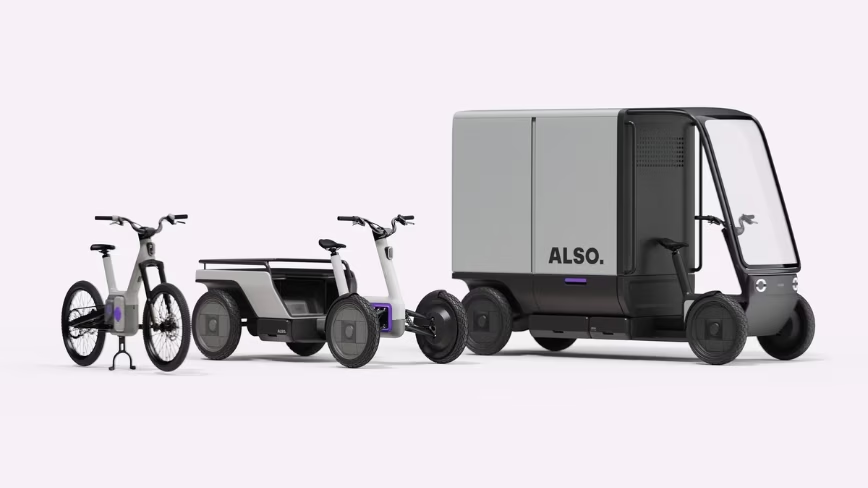
The Palo Alto small-EV company raised $200M in a Series C led by Greenoaks, with DoorDash investing alongside a multi-year commercial agreement to deploy purpose-built autonomous vehicles for last-mile delivery. DoorDash co-founder Stanley Tang joins the board as an observer.
ALSO, the small electric vehicle company spun out of Rivian in 2025, has raised $200 million in a Series C round led by Greenoaks Capital, with participation from Prysm Capital and a strategic investment from DoorDash.
The round values the company at over $1 billion. Alongside the investment, ALSO and DoorDash signed a multi-year commercial agreement to develop and deploy autonomous delivery vehicles at scale, a commitment that gives the capital raise considerably more substance than a financial bet alone.
DoorDash co-founder and Head of DoorDash Labs Stanley Tang will join ALSO as a Board Observer. Rivian retains a significant minority ownership stake in the company.
ALSO was originally incubated within Rivian before being spun out as a dedicated small-EV company.
Its product thesis is that the last mile of delivery, the part that happens in bike lanes, on tight curbs, and in dense urban spaces, requires vehicles built from scratch for those environments, not autonomy retrofitted onto existing full-size platforms.
Its current lineup includes the TM-B, a $3,500 e-bike with a virtual drivetrain, and the TM-Q, a four-wheeled cargo EV designed to haul goods while fitting in a bike lane.
The companies have not specified which vehicle or vehicles will be deployed under the DoorDash partnership, though the TM-Q’s cargo capacity makes it the more obvious candidate for food delivery at scale.
The structure of the partnership is what makes it interesting. Most autonomous delivery investments involve a financial stake with a vague deployment intent attached.
DoorDash has committed to a commercial agreement with a real timeline, giving ALSO a major operator’s network as a proving ground.
DoorDash, which has more than 30% of its US monthly active users ordering across grocery and retail categories beyond restaurants, has clear commercial incentive to reduce per-delivery labour costs as it scales.
Tang described autonomous small EVs as “optimal” for dense, mixed-use environments, framing the partnership as addressing delivery challenges “at the intersection of roadways, bike lanes and road adjacent spaces” that generic autonomous platforms have not solved.
ALSO plans to deliver its initial products in the US in 2026, with international expansion to follow. The Series C, combined with the DoorDash commercial commitment, sets up what would be one of the first serious attempts to deploy purpose-built autonomous small EVs through an operator with real order volume, rather than in controlled pilot conditions.
Get the TNW newsletter
Get the most important tech news in your inbox each week.


