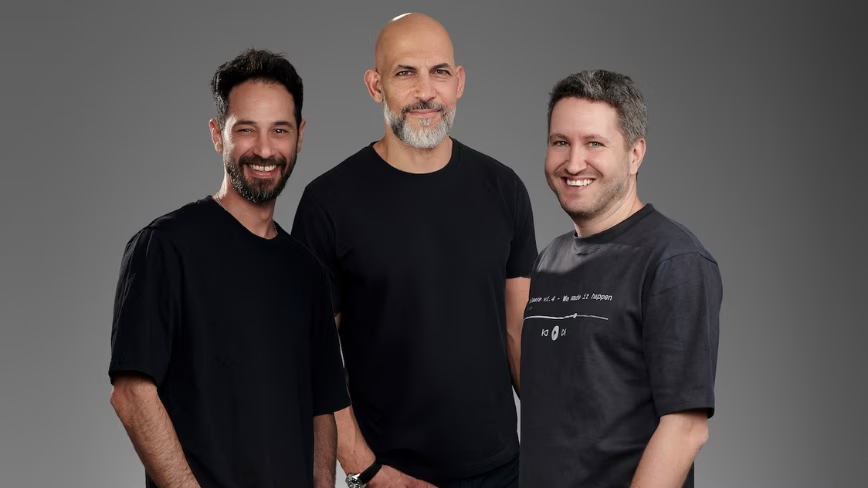
The Tel Aviv-founded defence-AI firm has closed a $31M Series B led by PSG Equity, bringing total funding to $60M as it scales US operations from Washington DC.
Airis Labs, the defence-AI startup that has spent the past two and a half years operating in stealth, emerged publicly on Tuesday with $60m in total funding, including a $31m Series B led by US growth-equity firm PSG Equity.
The round brings in TLV Partners, Stepstone Group, Redseed Ventures, and angel investors including Eyal Waldman, the former Mellanox co-founder and chief executive whose company was sold to Nvidia for roughly $7bn in 2020.
The company’s pitch is narrower than the broad “AI for defence” banner under which a generation of startups has been raising capital.
Airis builds what it calls a video-first intelligence platform: software that ingests fragmented visual data, security camera footage, drone feeds, body-camera recordings, smartphone uploads, social-media imagery, and the long tail of what it labels “user-generated field intelligence”, and produces machine-readable structured output that analysts and AI agents can query, reason over, and act on.
The category, on the company’s framing, is distinct from traditional video analytics, open-source intelligence platforms, and generic data-fusion tools. The customer base, on its own count, is government organisations worldwide, with named selection into the Oracle Defense Ecosystem.
The underlying problem Airis is addressing is real and well-documented in defence-AI circles. Government investigators and military intelligence teams now drown in unstructured visual data.
A typical urban-incident investigation can produce thousands of hours of mixed-source footage; a typical drone-mission archive can fill terabytes of unindexed video. Human analysts cannot review that volume fast enough to catch operationally relevant signals before they age out.
Building software that turns the raw visual flood into searchable, structured intelligence is the category Airis has bet the company on.
The competitive set is meaningful and worth naming. Palantir’s Project Maven remains the headline US defence-AI deployment for video analysis. Helsing sits at the European end of the same arc with a broader battlefield-AI scope.
Anduril, Scale AI’s defence unit, and a clutch of newer Israeli startups including BlueGreen Vision and ION-X compete on overlapping ground. Airis’s differentiated position, on its own framing, is that its platform was built in real operational environments from inception rather than productised out of a research lab, with the implication that the user-experience and workflow integration are tighter than peers’ demonstrations.
The corporate structure is worth pausing on. Airis was founded in 2023 in Tel Aviv by Noam Friedman (chief executive), Rotem Abeles (chief product officer) and Amos Lahav (chief business officer), with a team drawing on alumni from Palantir, Meta, the Israeli Unit 8200 intelligence community and the broader Israeli AI sector.
PSG Equity is itself worth a sentence. The firm, founded in 2014, has backed more than 130 software and tech-enabled companies and operates from Boston, Kansas City, London, Madrid, Paris and Tel Aviv. PSG director Rotem Shacham, who led the Airis investment, was previously a principal at Viola Ventures and served in Unit 8200, the same intelligence-corps lineage shared by much of Airis’s founding team. The cap-table fit is unsurprisingly tight.
What Airis Labs has not yet disclosed is the standard set of substantive questions readers ask of a stealth-exit defence-AI announcement: which specific government agencies are paying customers, what the revenue run-rate looks like, and how the product performs against the named alternatives in operational benchmarks.
The company says it is operational in government organisations worldwide and that the platform has been validated by the analysts who use it rather than by benchmarks.
That is a thoughtful framing on the qualitative side and a slightly worrying one on the procurement-disclosure side. The next 18 months will indicate which.
Get the TNW newsletter
Get the most important tech news in your inbox each week.


