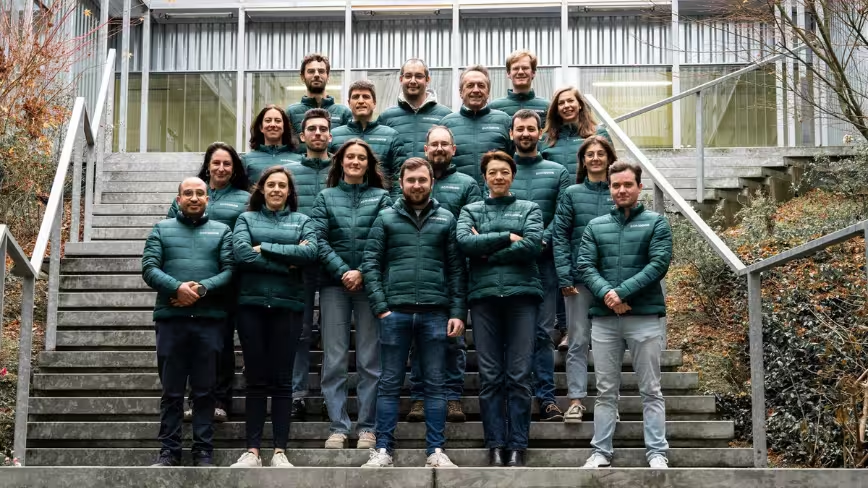
The Rennes-based INRAE spin-off uses blends of volatile organic compounds to repel or attract pest insects without harming pollinators, soil, or human health. Its first product, for sugar beet aphids, received French regulatory authorisation in March 2026 and is distributed by Syngenta.
Agriodor, a French deeptech startup specialising in olfactory biocontrol, has raised €15 million in a round led by Crédit Mutuel Impact.
The Rennes-based company, founded in 2019 as a spin-off from INRAE, France’s National Research Institute for Agriculture, Food and Environment, develops blends of natural volatile organic compounds that exploit insects’ olfactory sensitivity to repel pest species from crops, without harming pollinators, auxiliary insects, or human health.
Agriodor’s approach targets a fundamental behaviour in insect biology: approximately 80% of the world’s invasive insect pests use smell to locate host plants for feeding, mating, and egg-laying.
By analysing the compounds emitted by plants that insects find unattractive, and replicating those molecules synthetically, the company produces fragrances that confuse or deter specific pest species.
These can be deployed as attractants (kairomones, which lure insects into traps) or repellents (allomones, which drive them away), or combined into a push-pull strategy using both modes simultaneously. The products are formulated as granules spread mechanically across fields, making them compatible with existing farm machinery.
The company’s most advanced product targets Myzus persicae, the green aphid responsible for spreading yellowing disease in sugar beet, a crop that lost its main chemical protection when neonicotinoids were banned across France and Europe.
Agriodor’s olfactory repellent, marketed as INSIOR® Gr A in partnership with Syngenta, received French regulatory authorisation for field trials in March 2026. Field trials conducted by Syngenta in 2025 showed a 40% reduction in green aphid populations compared to untreated controls.
The product acts through three modes simultaneously: it repels winged aphids responsible for field colonisation, disrupts their feeding behaviour, and reduces their reproductive rate by limiting energy intake.
Prior to this round, Agriodor had raised approximately €8 million across two tranches: a €5 million round in May 2023 from Capagro, Cap Horn, BNP Paribas Développement, SWEN Capital Partners, and Breizh Up; followed by a €3 million extension from the same investors in February 2024.
In December 2025, Le Journal des Entreprises reported that Agriodor was seeking exactly €15 million for three new products across additional crops, expanded geographical coverage including tropical zones, and new global distribution partnerships.
The company is headquartered in Rennes and targets the US and Brazilian markets, where biocontrol regulations are substantially faster than in Europe, 18 to 24 months for market authorisation versus up to seven years in the EU.
Co-founder and CEO is Alain Thibault; CTO is Dr Ené Leppik, a chemical ecologist whose doctoral research on the bean weevil at INRAE provided the scientific foundation for the company.
Crédit Mutuel Impact is the dedicated impact investment arm of Crédit Mutuel, France’s second-largest banking group, which was founded by farmers and retains a strong agricultural heritage.
An impact-oriented agricultural investor leading a round into a biocontrol startup replacing banned insecticides fits squarely within Crédit Mutuel’s stated priorities around sustainable food systems.
Get the TNW newsletter
Get the most important tech news in your inbox each week.


