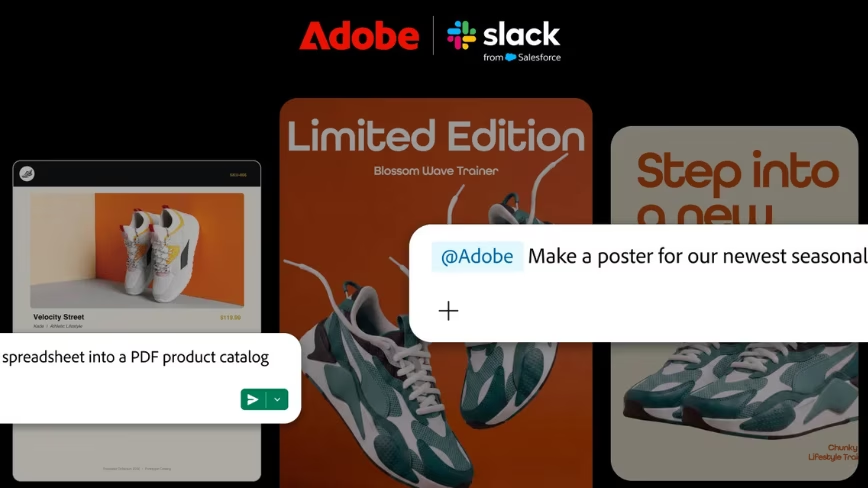
Adobe for Slack brings Adobe’s pro-grade creative and productivity tools where collaboration is happening, helping teams create, refine and share content directly from Slack.
 Credit: Adobe
Adobe for Slack lets Slackbot turn conversations and shared files into images, video and documents using Firefly, Photoshop, Premiere, Acrobat and more than 70 other tools. Article 50 of the EU AI Act now requires synthetic content to be marked in a machine-readable format, and the Commission’s own guidance names Adobe’s C2PA standard as a way to do it.
Adobe has put its creative tools inside Slack. Slackbot routes a prompt to Firefly, Photoshop, Premiere or Acrobat and returns the file, Digital Trends reported.
It reads the channel to work out what you mean. It pulls from conversations, canvases and shared files, and can search a Creative Cloud library by subject, style or mood. More than 70 Adobe tools are connected.
It is not included in either subscription. You need a Business+ or Enterprise+ Slack plan and a separate Adobe one on top. Teams can review and iterate on assets inside channels.
This is the third integration of its kind. Adobe did the same for ChatGPT last month, already has a Claude version, and has promised Gemini.
The European question is about what comes out of it. Since 2 August 2026, Article 50 has required synthetic image, video and audio to be marked in a machine-readable format.
Adobe is better placed for that than almost anyone. It founded the Content Authenticity Initiative and co-authored C2PA, the provenance standard behind Content Credentials.
Brussels has effectively endorsed it. The Commission’s transparency code lists C2PA as an example meeting all four criteria, one analysis notes.
Those criteria include robustness. Marking has to survive format conversion and minor edits and be tamper evident, as far as is technically feasible. It must also be interoperable.
Which is where a chat client gets interesting. Manifests survive conversions handled by C2PA-aware tools, and a naive re-save still strips them.
Nobody has said whether they survive this particular pipeline. Generate in Slack, download, drop into a deck, and the credential may or may not still be attached.
The code anticipates that problem. It encourages pairing C2PA with an invisible watermark, which is what OpenAI adopted alongside Google’s SynthID.
Others are solving it at the other end. YouTube now labels AI-generated video whether or not the creator discloses it, which infers rather than marks at source.
Which is the gap worth naming. Adobe wrote the standard, TNW reported Anthropic marking everything as the same rules took effect, and nobody has tested what a chat client does to either.
Get the TNW newsletter
Get the most important tech news in your inbox each week.
Also tagged with


