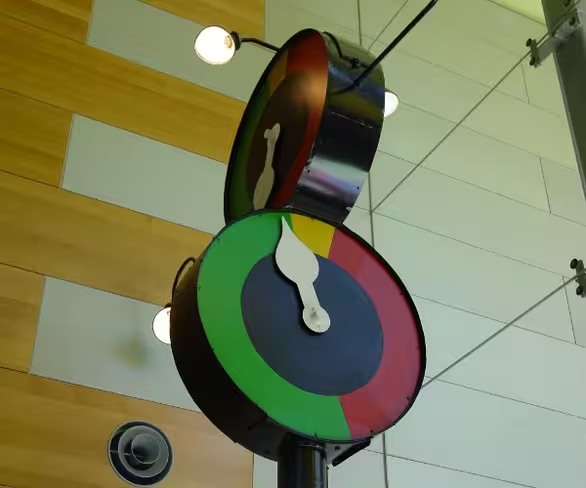
We just stumbled upon the concept designs below of a new kind of traffic light by Thanva Tivawong called “The Sand Glass”. On the post about it by Yanko Design, a number of commenters pointed out a number of ways why this design could be unsafe, but we’d certainly like to hear your thoughts in the comments – what do you think? Genius or unsafe concept that will never be a reality?
New traffic light concept design – genius or unsafe?
18th November 2010 by Chad Catacchio


Personally, I think that simpler is safer, so I’m going with “not an improvement”
@Chad Catacchio Agreed. Plus, smart traffic light systems that dynamically adjust light duration would have compatibility issues with this system.
This might work if there weren’t any color-blind people in the world; but, since there are, it would be a disaster. The fact that the three (or five, depending on where you are) lights are in different positions is a key indicator for people that have trouble distinguishing colors from each other. If you use a single look in a common location for all of the stages of the light, it will be a very bad experience for color-blind drivers.
@Curtiss Grymala Agreed. That’s a huge flaw in the idea, especially with the prevalence of Red-Green colorblindness. Daniel also makes a good point about how yellow lights would confuse drivers.
The best solution might just be the Indian way, which is to pair a stoplight with a big countdown board at the top. While the light is red, the board shows how long it is until it will be green again. When the traffic is moving, it either turns off or shows how long the light will be green for depending on where you are.
Yellow means two things? “Prepare to stop” (or hurry your butt up) and “Get ready to go”. So if a person came up to a yellow light, how would they know what it meant?
Clever idea, but two issues jumped out at me instantly.
1- The chaos this would bring from color-blind drivers (I’ve ridden with a few who had to ask what color a single flashing light was).
2- What about turn lane signals? You know, the lights where just the arrow is lit up. Do you tack a whole additional screen to indicate whether this is a left turn or right turn only signal?
@Benjamin Worrel #2 was exactly what I was thinking. How would that work?
The way I see it, part of what makes current traffic lights safe is that they’re black boxes. The driver can’t necessarily predict them, and that means that the driver has to follow orders. As soon as traffic lights are viewed as data to interpret (and not a command to follow) I think drivers will be less safe. I enter an intersection with the expectation that other drivers will follow the light’s command, not that they’ll decide whether or not to t-bone me.
I think designers like traffic light redesigns because designers are always searching for ways to make interactions clearer, data visualization. What’s unique about traffic lights (and what makes them bad for this kind of designer) is that they’re safer as black boxes, with less-clear information.
I thing the hourglass idea is pretty dumb. After all, existing traffic light systems are more or less the same the world over. It’s a standard, everyone understands it and it works. Don’t mess with it. That said, here in China, many of the traffic lights have countdown timers built into the LED panels. I used to think it was a dangerous idea, but it seems to work.
I think the hourglass idea is pretty dumb. After all, existing traffic light systems are more or less the same the world over. It’s a standard, everyone understands it and it works. Don’t mess with it. That said, here in China, many of the traffic lights have countdown timers built into the LED panels. I used to think it was a dangerous idea, but it seems to work.
The only problem with this is for colorblind people. How would they know which one is red, and which one is green? The “yellow” is easy to spot because it has the number on it.
But green and red, big difference.
see how they do it in denmark already: http://www.flickr.com/photos/jeaneeem/990028667/in/photostream/
Total colourblindness is very rare and is associated with visual acuity below the driving test line. More common is a type were only cetrain hues are not distinguished. This design does work for anyone who makes a clear distinction between red, yellow and green. This design is nowhere near as sensitive as the ishihara test.